NFL · injury
Cooper Jr.'s IR Placement Forces Jets to Lean on Tight End Volume in Green Bay
With a second first-round receiver sidelined, New York's passing game tilts hard toward its oversized tight end room—a shift that reshapes both team and individual receiving distributions.
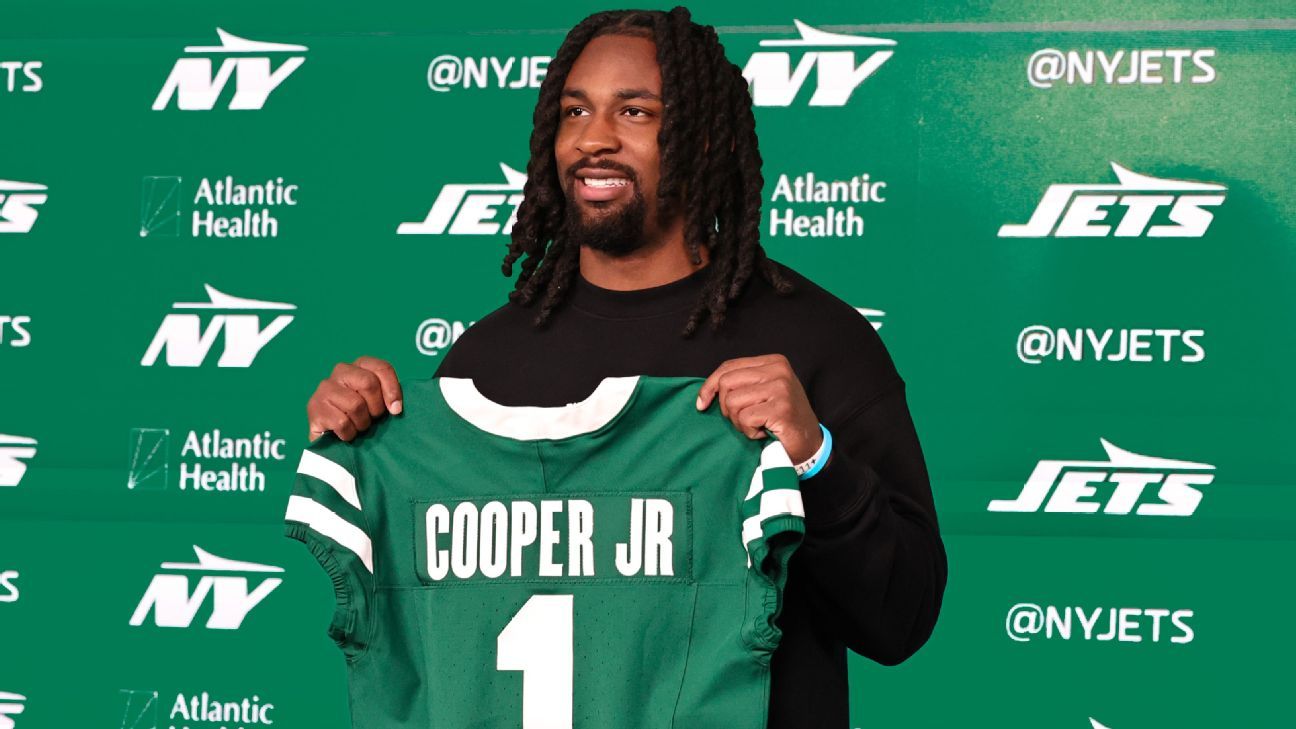
Omar Cooper Jr., selected 30th overall and positioned as a potential game-changer for the Jets' passing attack, is headed to injured reserve Saturday with a sprained ankle. The rookie is eligible to return Oct. 18 against New England, meaning he'll miss a four-game window starting with Sunday's matchup against Green Bay. Despite playing only four snaps in last week's 23-10 win over Tennessee—where he flashed on his single touch, breaking tackles to move the ball 30 yards—Cooper now joins Tim Patrick on the shelf, gutting New York's receiver depth chart.
The Jets enter Week 2 with just four active wide receivers: starters Garrett Wilson and Adonai Mitchell, plus reserve depth in Isaiah Williams and Arian Smith. Smith dropped his only target last Sunday. Williams was targeted once. Neither moves the needle as a focal point. The team has signed Sterling Shepard and Tyler Johnson to the practice squad this week, but neither is expected to be elevated for the Packers game. That leaves New York with a receiver room that lacks both experience and volume—a void the coaching staff will have to fill somewhere.
The Jets signal their response clearly: five tight ends on the active roster, with all five used on a single play in the Tennessee victory. This isn't accidental. With Cooper out and Patrick unavailable, the tight end room becomes the default receiving outlet for a 1-0 offense trying to protect a divisional win and push toward an early 2-0 start—the team's first through two games since 2015. Tight end snap counts and target share will spike as a pure necessity, not scheme evolution. Sunday's game against a Green Bay defense that allowed 58 receiving yards to tight ends in Week 1 offers immediate context for volume allocation.
For prop bettors, this reshuffling has two direct implications. First, Jets tight end receiving yardage props—whether bundled (multiple TEs combined) or individually for the lead pass-catchers—should be treated as overs. The offense has no alternative receiving outlet to mask the volume shift; it will flow disproportionately to the position group. Second, both Wilson and Mitchell receiving-yard lines warrant caution on overs despite their talent. Not because they can't produce, but because the ball distribution has been forcibly compressed. Wilson absorbed 8 targets in Week 1 on 29 offensive plays (27.6% target share). That efficiency may compress if tight ends capture additional volume in Week 2. The Packers' secondary is middling—they allowed 207 passing yards to Tennessee but ceded 4.2 yards per attempt—so the Jets won't be forced to abandon the pass game. But the architecture of that game plan is now dictated by injury, not design. Take that distribution reality into prop pricing before Sunday's kickoff.