Wilson's Outside Move Opens the Deep Game for Jets Offense
By Erik Schwartz ·
Garrett Wilson's shift back to the perimeter removes the schematic friction that's defined his first four seasons and creates a cleaner path to the explosive plays his skill set demands.
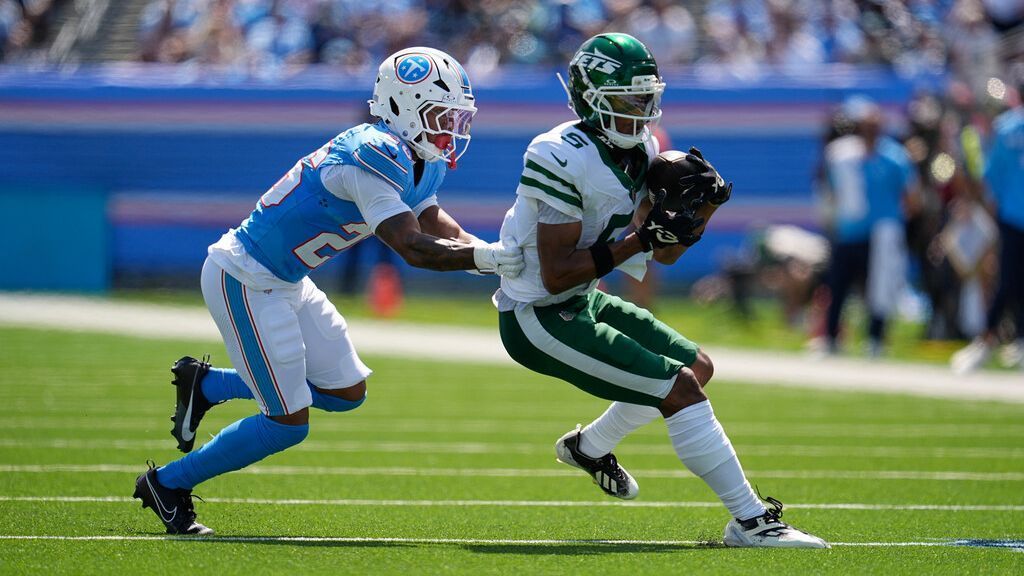
Garrett Wilson lined up in the slot on only four of 46 offensive snaps (9%) in the Jets' season-opening win over Tennessee—a structural reset that marks the end of a four-year experiment. For his first three NFL seasons and parts of a fourth, Wilson operated as a slot-heavy option, accumulating 1,000-yard seasons despite the schematic constraint. Now, under new offensive coordinator Frank Reich and a coaching staff open to philosophical adjustment, Wilson is back on the perimeter, where he spent most of his college career and where he expects his production ceiling to rise.
The mechanics of the shift matter more than the narrative of going "back home." Wilson's slot tenure came with a cost that doesn't show up cleanly in box scores: he was catching short-to-intermediate throws (4-5 yards) with his back to the defense, absorbing contact in traffic immediately after the catch. A receiver of his dimensions—undersized relative to the defensive linemen and linebackers operating in the interior—pays a toll. On the perimeter, Wilson faces press coverage from corners in one-on-one situations, where his route-running precision and ability to separate vertically create clean throwing windows down the field. The Jets' offensive line has improved, and quarterback Aaron Rodgers is comfortable attacking vertical concepts. The alignment matters because it changes the geometry of the throw and the defensive response.
In the opener against Tennessee, Wilson caught five of his six receptions (73 of 79 yards) from outside alignments. That's a single-game sample, but it tracks with his stated comfort level and the team's design intent. Reich's track record with perimeter-heavy receiver ecosystems—his time in Indianapolis with T.Y. Hilton, his work in Washington—suggests this isn't a temporary tweak. The Packers defense this week features a capable secondary but also schemes heavy on two-high looks, which should keep safeties deep and open up intermediate routes underneath. For Wilson's receiving-yards prop, the alignment shift creates a favorable floor: he'll see volume, he'll face fewer stacked-box moments, and his catch-after-contact situations are likely to shift toward cleaner yardage opportunities rather than the traffic-heavy interior work of prior seasons.
The market hasn't fully repriced Wilson's ceiling. His receiving-yards line at most sportsbooks remains rooted in his historical averages (typically 80-90 yards per game in healthy seasons), not in a scenario where he's now running routes from the perimeter in an offense designed to get him the ball vertically. A healthy Rodgers throwing deep is also materially different from the nine different quarterbacks Wilson played with before the trade. If this alignment becomes consistent—and the Week 1 data and coordinator buy-in suggest it will—Wilson's receiving-yards line should drift upward over the next 2-3 weeks as the market catches the schematic shift. The edge exists now because the market is still pricing in historical usage patterns that no longer apply.
Glenn and the Jets are also fighting a historical narrative: they haven't started 2-0 since 2015, the second-longest active drought in the league. A statement win at home against Green Bay this week would accelerate confidence in the new direction. For betting purposes, that narrative pressure is a two-edged condition. It can fuel motivation and tight execution, or it can tighten a team's decision-making. But for Wilson specifically, the edge is cleaner: the outside alignment creates a more predictable receiving environment, regardless of game script.