NFL · roster-move
Kraft's Nine-Month Timeline: Why the Packers' Cautious Return Still Favors Jordan Love's Volume Game
Tucker Kraft's activation off PUP accelerates his availability, but the Packers won't rush him into full 11-on-11 drills until mid-August—a calculus that matters for Love's Week 1 target distribution and Kraft's receiving prop ceiling.
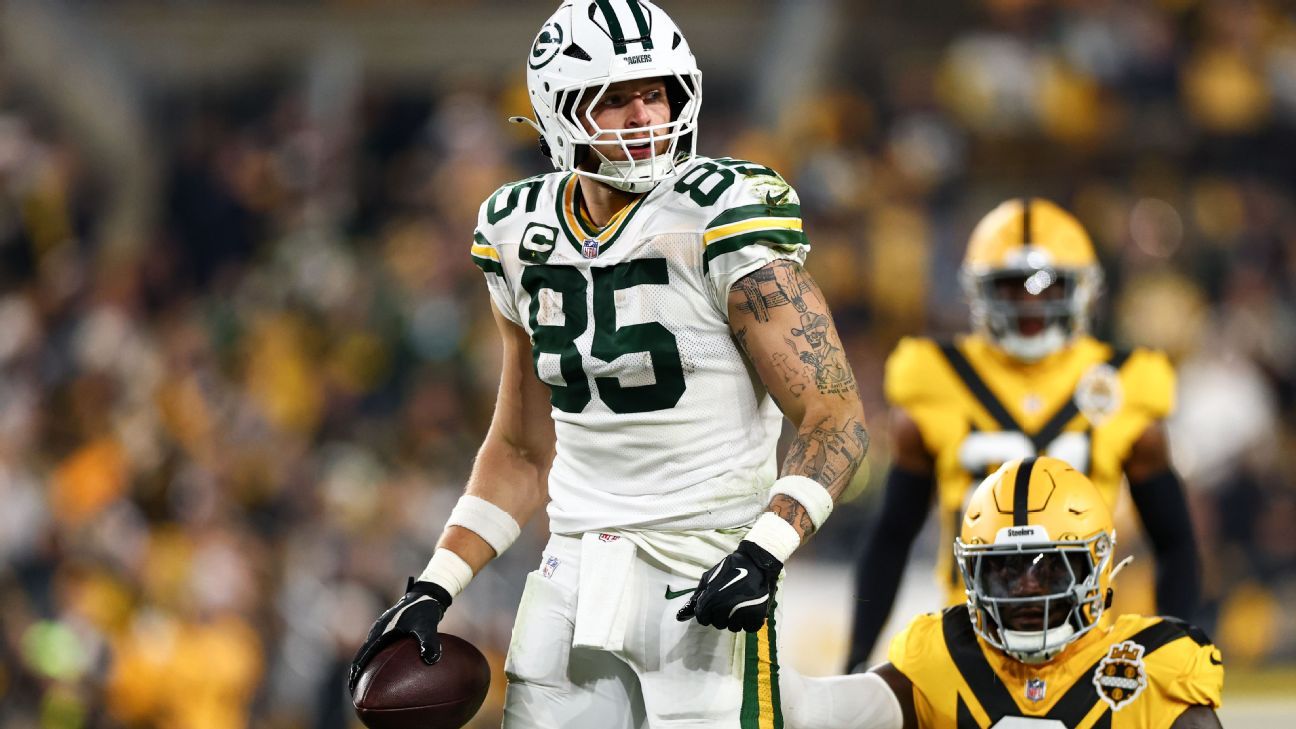
Green Bay activated tight end Tucker Kraft off the physically unable to perform list Friday, less than nine months after reconstructing his torn ACL. The Packers remain uncommonly disciplined about ACL rehab—they don't typically permit contact drills until the nine-month threshold passes—and Kraft's timeline tracks to Nov. 2, 2025 (his injury date) plus approximately 273 days from today. That puts unrestricted 11-on-11 work about 7–14 days away, which aligns with LaFleur's stated plan to ease him through individual and walk-through periods first. Kraft will be available for the Sept. 13 season opener against Minnesota without limitations, but that availability doesn't equal immediate snap-count equity.
The injury cost Kraft momentum at his performance peak. Through Week 9, he'd logged 32 receptions for 489 yards and six touchdowns—the only tight end in football with 30+ catches, 475+ receiving yards, six receiving touchdowns, and a 15+ yards-per-catch average simultaneously. That was a genuine 1,000-yard, 10–12 TD pace. His absence shaped the Packers' passing scheme; Love has now settled into patterns without him. Even with Kraft practicing by mid-August, five weeks of conditioning and route-tree re-integration remain before meaningful game action. Players returning from ACL surgery don't instantly reclaim target share; integration is gradual. GM Brian Gutekunst used the term "very cautious" explicitly, and compared Kraft's current appearance to Christian Watson last season—a player who looked game-ready on the practice field but took multiple games to reach full effectiveness.
The prop market has likely priced Kraft's Week 1 involvement conservatively already, assuming a minutes-restriction or role-split with backup Robert Tonyan. The real angle isn't Week 1 receiving yards (those lines will be suppressed and appropriately so); it's understanding that Love's passing distribution through September stays concentrated on wide receivers and slot targets. Kraft's return doesn't immediately depress Love's attempts—it redistributes them. A tight end returning from ACL surgery typically operates at 60–75% snap count in his first two games, climbs to 80–90% by week four. That's not a binary flip. Love's yards-per-attempt should remain stable across the opening month because Kraft's early-season role is supplementary, not dominant.
For bettors, the takeaway is directional but actionable: fade any overreaction spike in Kraft's receiving-yards props for Week 1 or Week 2 at tight-end premium pricing. If books overcorrect his availability upward (treating "activated" as "full go"), contrarian value exists on game totals and Love's completions in the first two weeks, because the Packers will still lean on proven perimeter targets while Kraft rebuilds. Conversely, if you're building a season-long projection for Kraft's total receiving yards (over/under typically lands 850–950 for a starting TE), his Week 1 minutes restriction actually raises the bar for him to hit a full-season target. The nine-month soft cap is not ornamental—the Packers are honoring it because the science matters, and that discipline will show up in early-September snap data.