NBA · transaction
Brown's Milwaukee Pivot Reshapes Celtics' Star Power Equation
Jaylen Brown's sudden openness to joining Milwaukee in a Giannis swap upends Boston's chemistry and vaporizes the value of one of the East's most productive two-way wings.
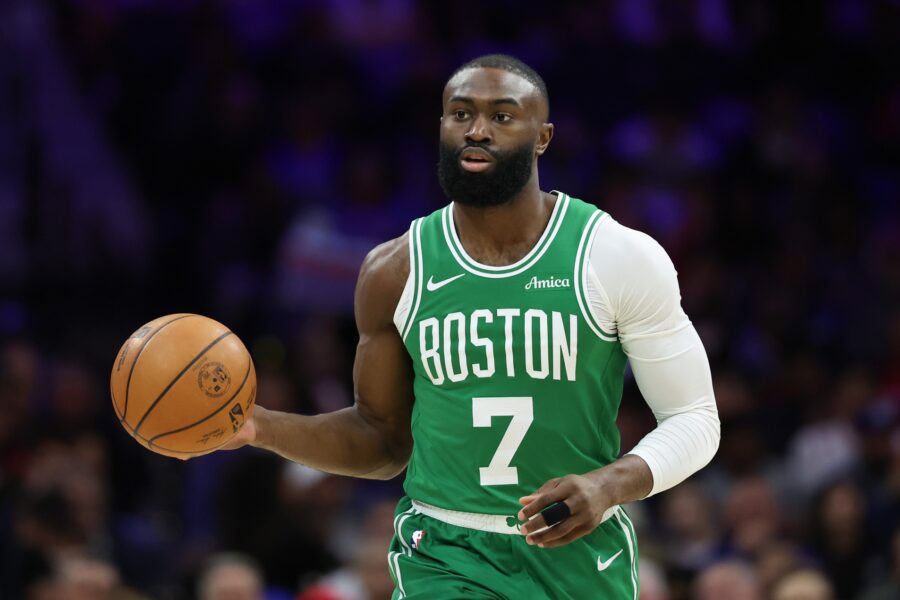
The Celtics are actively shopping Jaylen Brown as the headliner in a bid for Giannis Antetokounmpo, and contrary to earlier reporting suggesting resistance, Brown himself is now pushing for a resolution—potentially within 48 hours. Per Kelly Iko's sources at Yahoo Sports, the 29-year-old isn't just willing to waive his no-trade clause; he's actively hoping Milwaukee completes a deal. Shams Charania reported this morning that the Celtics and Heat are the finalists, though a two-team frame could expand to include other clubs later.
Brown's career arc made him untradeable six months ago. He posted a 28.7-point, 6.9-rebound, 5.1-assist average across 71 games last season—career bests across the board—while clamping opponents on the perimeter and operating as Boston's most versatile offensive weapon. The Celtics rode him to a 56-26 record and a No. 2 seed before collapsing against Philadelphia in the first round, blowing a 3-1 series lead. That implosion, not Brown's individual performance, appears to have triggered the franchise's recalibration. Boston's front office has calculated that Giannis—a younger, more dominant force with elite rim-running and interior finishing—offers a higher ceiling. The financial math works: Brown carries $183MM over the next three seasons and is eligible for a $142MM two-year extension this summer. Moving him creates the cap flexibility to absorb Giannis while retaining complementary pieces.
What's less clear is whether Brown's Milwaukee fit actually improves Boston's title odds. The Celtics won 56 games and owned the second-best offense in the league with Brown as a co-engine; Giannis is a perimeter liability in a three-point era, and plugging him into Boston's spacing-dependent system introduces defensive and offensive trade-offs that don't automatically solve the first-round disaster. That collapse stemmed from execution and momentum, not personnel. The market hasn't caught up to this dynamic yet, and the distraction of a mid-offseason star swap typically creates short-term roster chaos regardless of long-term upside.
From a prop standpoint, the uncertainty alone hammers projections for both teams' first-half output. If the trade completes, Boston's regular-season totals should contract—the offense loses Brown's creation at the wings and his ability to string together 35+ point nights that inflate team scoring lines. Giannis, for his career, operates in the 28-32 PPG band depending on system fit; that's meaningful downside from Brown's recent 28.7 baseline, especially if Boston's offense becomes more ball-handler dependent. Miami, the other finalist, doesn't move the needle much on their own totals regardless of outcome—they remain Adebayo and Jimmy Butler, with modest depth changes. The real volatility sits with Boston, where the ceiling may rise marginally but the floor—and the steady-state regular-season run—likely drops. Team totals for the Celtics in 2026-27 season openers should drift lower once deal momentum solidifies.