NBA · roster-move
Melton's Departure Opens Depth Void in Warriors Backcourt
De'Anthony Melton's rejection of Golden State's minimum-salary option signals the end of a cost-controlled guard partnership and forces the Warriors into an immediate roster recalibration.
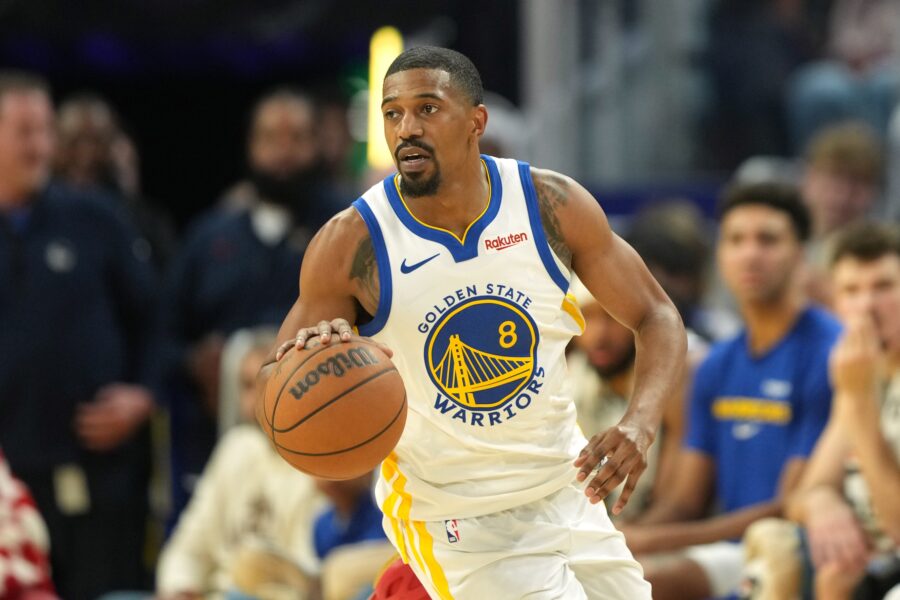
De'Anthony Melton declined his $3.45 million player option with the Golden State Warriors on Monday, hitting unrestricted free agency at 28 years old in pursuit of a larger contract on the open market. The move was telegraphed—reports had circulated for weeks that the veteran guard would test his value rather than accept the veteran's minimum—but its timing and finality still represent a meaningful roster restructuring for a team built on depth and perimeter defense.
Melton's departure exposes a critical gap in Golden State's guard rotation. Over the past two seasons, he'd settled into a complementary role: 8-12 minutes per game defending opposing backcourts and operating within the Warriors' motion offense as a non-ballhandling scorer. His outside shooting held steady around 35% from three, a mark that fit neatly into Steve Kerr's spacing requirements. More importantly, he required no creation—he didn't hunt possessions or demand usage—which made him low-friction alongside Steph Curry and any secondary playmaker. That type of floor-spacer who defends without ego is precisely what contending rosters overpay for in June when the mid-tier free agent class is thin.
The Warriors now face a choice between re-signing Melton at a premium (likely $8-12 million per year, well above his market value six months ago) or pivoting to internal solutions or minimum-salary replacements. Kerr's playbook demands guards who can move the ball, shoot off-motion, and defend without fouling. Losing Melton forces Golden State to accelerate its evaluation of younger guards in the system and potentially chase a veteran who hasn't proven he fits this specific ecosystem. The organizational bandwidth required to onboard a replacement—film study, practice reps, rotation chemistry—arrives at the worst possible moment, with summer league only weeks away and training camp in October.
For bettors tracking Warriors team props, Melton's absence has a direct bearing on bench scoring stability and perimeter-defense variability. The bench unit's point differential will likely tick downward if Golden State can't quickly source comparable shooting and discipline. More tactically, Curry's assist lines and the Warriors' three-point volume in early-season games carry elevated uncertainty until the rotation hardens. A roster built on spacing tolerates very little substitution variance; remove one reliable shooter and the entire offensive calibration shifts. Early season overs on Golden State team totals (particularly in September/October) assume a fully healthy, familiar rotation. That assumption is now clouded. Bettors should wait for clarity on the replacement guard before committing to Warriors totals in preseason props.