NBA · transaction
Clippers Lock in Sanders on Cheap Four-Year Deal—Depth Play With Upside
A 2025 second-rounder gets paid like a rotation wing on a prove-it contract, reshaping LA's guard flexibility heading into the offseason.
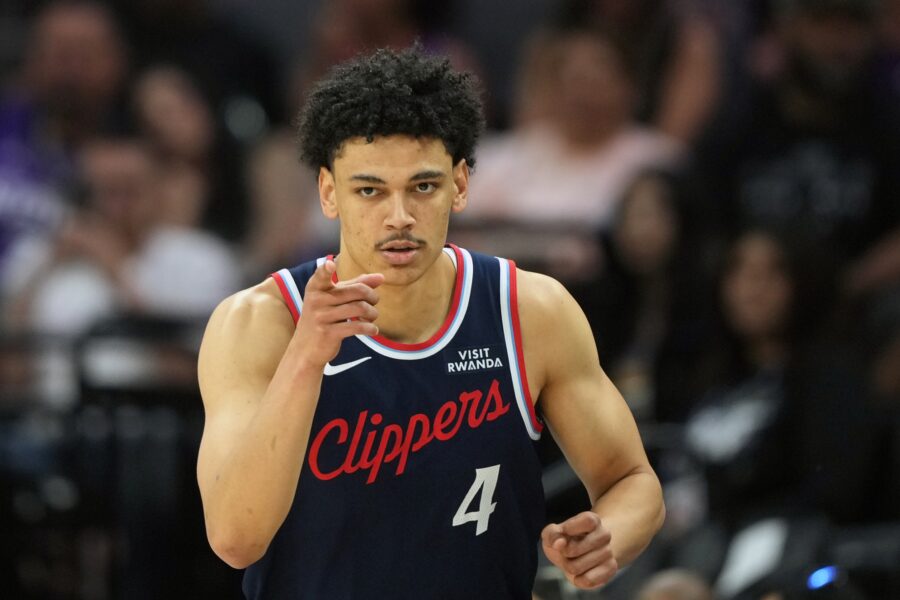
The Clippers have re-signed Kobe Sanders to a four-year deal worth approximately $11.2–$11.3 million, per Shams Charania and Law Murray. Only the first two seasons carry guaranteed money, a structural detail that matters more than the headline AAV suggests. For a second-round pick from 2025 still establishing NBA viability, this is a controlled gamble—the Clippers retain optionality on years three and four while Sanders gets a secure runway to develop.
Sanders entered the league as a perimeter depth piece, the kind of guard-forward hybrid teams stockpile for playoff switching. At the 2025 draft slot where he landed, the organization was signaling modest expectations; the guaranteed-money split suggests they haven't massively upgraded their internal evaluation in twelve months. But the re-sign itself is telling. LA didn't let him hit open market. They're betting on the trajectory rather than the present product. That's the calculus of a well-managed depth organization: lock in your young pieces on structure you can escape if they don't pan out.
From a roster construction angle, the deal buys two seasons of continuity in the guard rotation without clogging future cap flexibility. The non-guaranteed years act as a release valve if Sanders stalls or if the Clippers pivot to a higher-profile acquisition. Comparables at this contract size—$5.6M AAV—are typically backup wings in their second or third year with moderate NBA traction. Sanders fits that frame. He's not a core piece; he's a completion tool.
The prop implication is granular but real. Sanders' playing time footprint depends entirely on injury or depth crises in LA's backcourt. His per-game usage (points, assists, even three-pointers made) will remain volatile and tied to situational availability. On nights where the Clippers go deep into their bench or face attrition, Sanders may see 20+ minutes; on others, he'll be DNP-CD. The long-term deal doesn't change his baseline role—it's a vote of confidence in his developmental arc, not a projection of immediate star usage. Bettors chasing Sanders lines should treat him as a tournament play (late-season games, playoff rotation tests) rather than a regular-season rotation anchor. His contract allows the Clippers to bring him along without pressure to produce now, which paradoxically means his volume props remain unpredictable through the 2026–27 season.