MLB · lineup
Lynch's Rotation Audition Reshapes Kansas City's Depth Picture—And Betting Angles
The Royals are converting their best reliever into a starter out of necessity, creating immediate volatility in how the team will manage innings and bullpen load down the stretch.
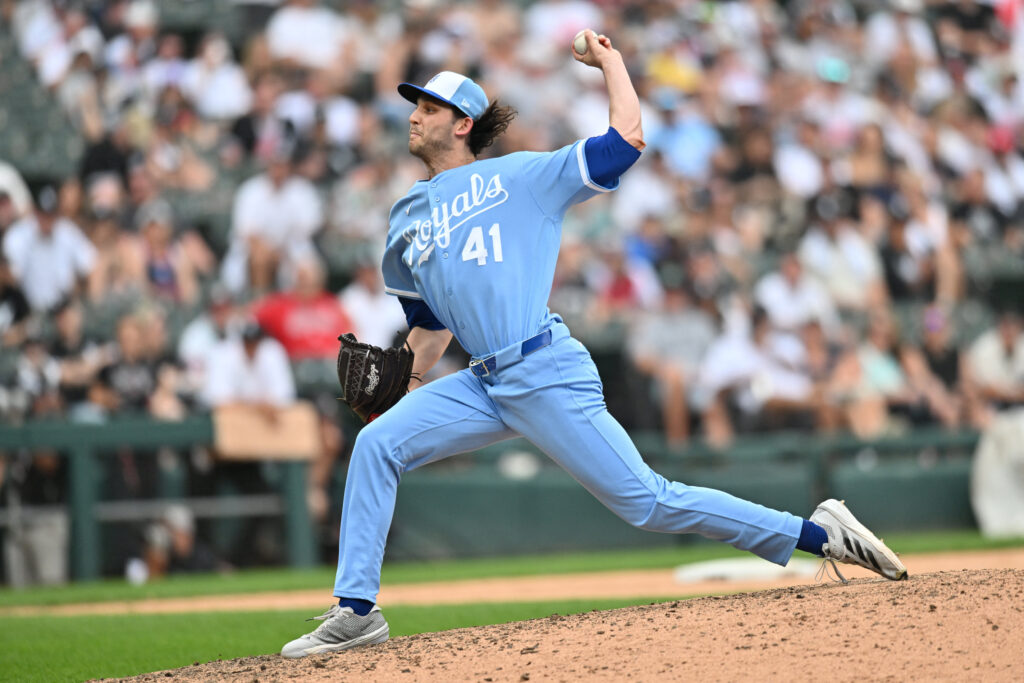
Daniel Lynch IV gets his first start of the season tomorrow against the Cubs, marking the beginning of what Kansas City is framing as a legitimate rotation audition for the 29-year-old lefty. Per MLB.com, the Royals are stretched thin enough in the rotation that they've decided to stretch out their most reliable bullpen piece rather than cycle in organizational depth arms or minor league callups. That decision reflects desperation: Cole Ragans, Stephen Kolek, Ryan Bergert, Ben Kudrna, and Luinder Avila are all out for the season, with Avila having just undergone Tommy John surgery. Mitch Spence is the only 40-man depth starter available, and even he landed on Triple-A's injured list four days ago.
Lynch's profile as a reliever has been sharp. Over 46 innings, he's posted a 1.96 ERA with a 50% ground-ball rate and a 6.9% walk rate. His strikeout rate sits at 19.1%—middling by starting standards but respectable in short relief. The mechanics that worked in the bullpen don't automatically translate to 150+ innings, but Lynch has the foundational tools: a five-pitch mix and elite control. He last worked as a regular starter in 2022, when he threw 131 2/3 innings, and spent time as a starter in Triple-A as recently as 2024. The current iteration of Lynch relies more on a sinker than the weak four-seam fastball that characterized his earlier years, a shift that could improve his durability in longer outings.
The ramp-up timeline matters significantly. Lynch's season-high pitch count is 37 (from an April 1 game against Minnesota played in poor weather), meaning the Royals will need to build his workload methodically. If he stays healthy and locks down the spot, he's got nine or ten starts remaining to prove he can handle the job. By his third or fourth appearance, he should be approaching a functional starter's workload. That timeline positions this as a genuine test with stakes: if Lynch succeeds, he becomes a legitimate candidate for the 2027 rotation alongside Seth Lugo, Michael Wacha, and Noah Cameron. The team's bullpen is being overhauled this winter regardless, so converting one of its best relievers is a calculated risk in a rebuilding context.
For bettors, Lynch's workload trajectory shapes both team total and pitching-efficiency props. The Royals will be managing his innings carefully early on, which tilts first-five-inning lines toward lower run environments in his first two or three starts. His sinker-heavy approach and ground-ball tendencies create natural under momentum in those early-inning buckets. However, the pitch-count ceiling means he's unlikely to accumulate high strikeout volume; fantasy points and K+ props on Lynch should be undervalued by the market, which may price him as if he's the same full-inning reliever from May rather than accounting for his transition. By contrast, team totals for the Royals when Lynch pitches could compress due to the extended rest periods the team will likely build into his schedule—don't expect him on three days' rest early.
The Cubs' Kevin Gausman, making his Chicago debut in that matchup, operates from a position of stability that creates a clean contrast. Expect Lynch props (particularly strikeout-related angles) to carry value throughout this audition period precisely because the market hasn't fully repriced how his usage will change. Once the Royals commit to a rotation slot or demote him back to relief, that edge will evaporate quickly.