MLB · transaction
Cavalli's Four-Year Deal Signals Nationals Confidence in Young Starter—and Lockout Hedge Strategy
The Nationals locked in Cade Cavalli with a $47 million extension that front-loads security against labor uncertainty, raising questions about his role and workload expectations moving forward.
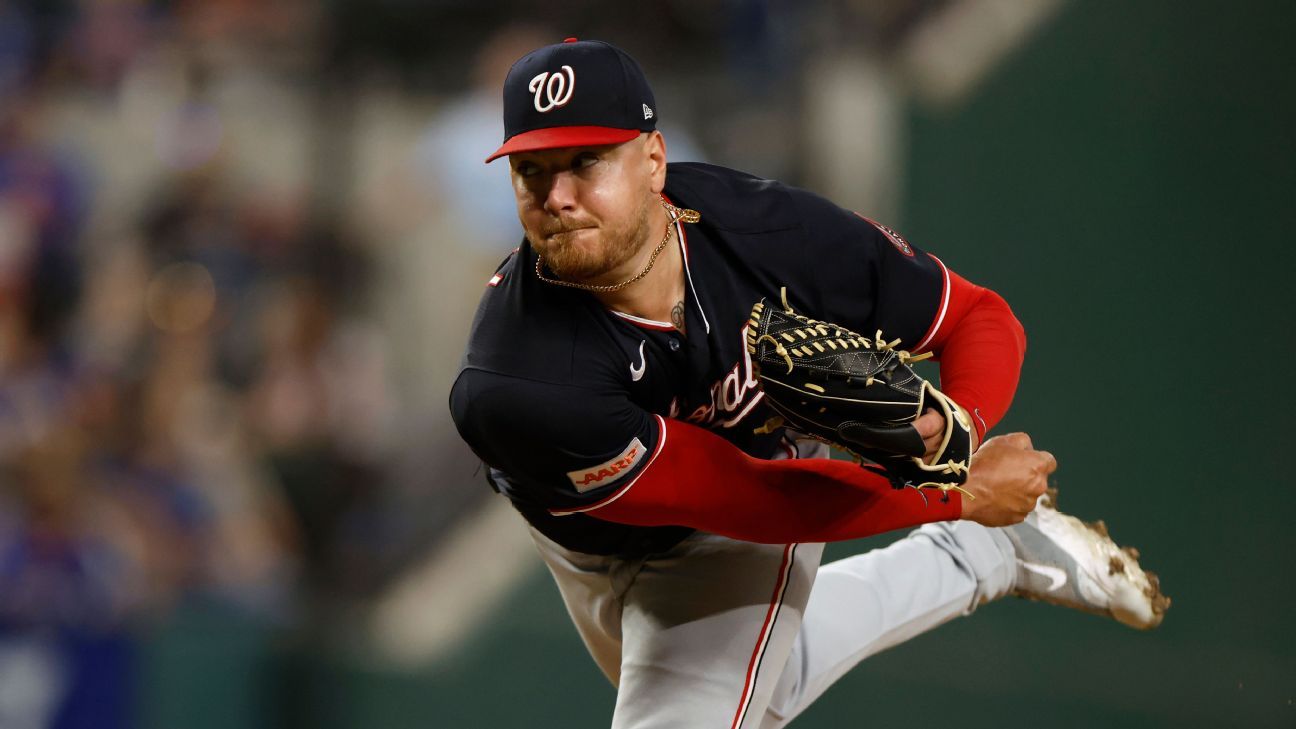
Washington Nationals right-hander Cade Cavalli has agreed to a four-year contract extension worth $47 million covering 2027–2030, with a $4 million signing bonus due Nov. 30 that sidesteps potential lockout losses. The deal replaces his existing one-year pact and includes a $25 million team option for 2031 with a $2 million buyout.
The structure reveals organizational intent beyond mere retention. By guaranteeing $4 million up front and shielding it from labor action, the Nationals telegraph confidence that Cavalli will anchor their rotation for the medium term—a meaningful statement about a pitcher who posted a 3.91 ERA across 155⅔ innings in 2026. The escalators tied to Cy Young voting (up to $5 million for a win, descending to $500,000 for fifth place) embed performance incentives while capping downside: the team absorbs inflation risk on the back end, but Cavalli's 2030 salary floor sits at $20 million regardless of health or performance. This asymmetry matters. Teams don't structure deals this way for mid-rotation depth; they do it for hurlers they expect to log 190+ innings annually and compete for postseason starts.
The signing also reflects uncertainty in labor negotiations. By locking in a guaranteed bonus before any potential December lockout, both sides avoid disputes over escrow or compensation timing. The Nationals are betting Cavalli stays healthy and productive enough to justify the back-loaded commitments ($10M in 2029, $20M in 2030). That's a ceiling bet on his development arc—he's 28 heading into the 2027 season, entering his prime innings-accumulation window. If shoulder or elbow issues emerge, the deal becomes a dead-cap anchor. If he sustains a sub-4.00 ERA and 200-inning seasons, the Nationals secure a homegrown ace on moderate dollars relative to market.
For prop betting purposes, the extension signals elevated workload expectations. Cavalli's strikeout rate has climbed from 8.1 K/9 in 2024 to 9.2 K/9 in 2026—a meaningful trajectory that coincides with refinement in his fastball-curveball combination. Expect higher innings estimates and starting assignment frequency in 2027 and beyond; the Nationals wouldn't guarantee $47M to a piggyback or spot-start option. K props on Cavalli should reflect ~185–195 innings of work annually, not 140–160. His outs-per-game ceiling tightens. Over-strikeout lines priced for 155-inning usage (his 2026 sample) will undervalue his 2027 opportunity set if the Nationals deploy him as a workhorse. Early-season modeling that doesn't account for the extension's implicit durability signaling will miss upside.
The Cy Young escalators also matter for understanding the market's valuation of Cavalli as an individual talent. The incentive structure assumes a realistic top-five finish within the contract window—suggesting internal scouts believe he can reach 2000+ innings at elite efficiency before 2030. That's a high bar, but it's the bar the Nationals just set. Prop bettors who trust the organizational chess move over public narrative (which has often sidelined Cavalli in favor of sexier prospects) may find edge on strikeout volume and innings-pitched totals when markets price him as a replacement-level starter rather than a rotation cornerstone.