MLB · injury
Judge's Calf Strain Casts Shadow Over Yankees' Postseason Availability
Aaron Judge says he'll be ready for the wild-card series despite a moderate-grade calf strain, but the team's medical timeline and his lack of game action tell a different story.
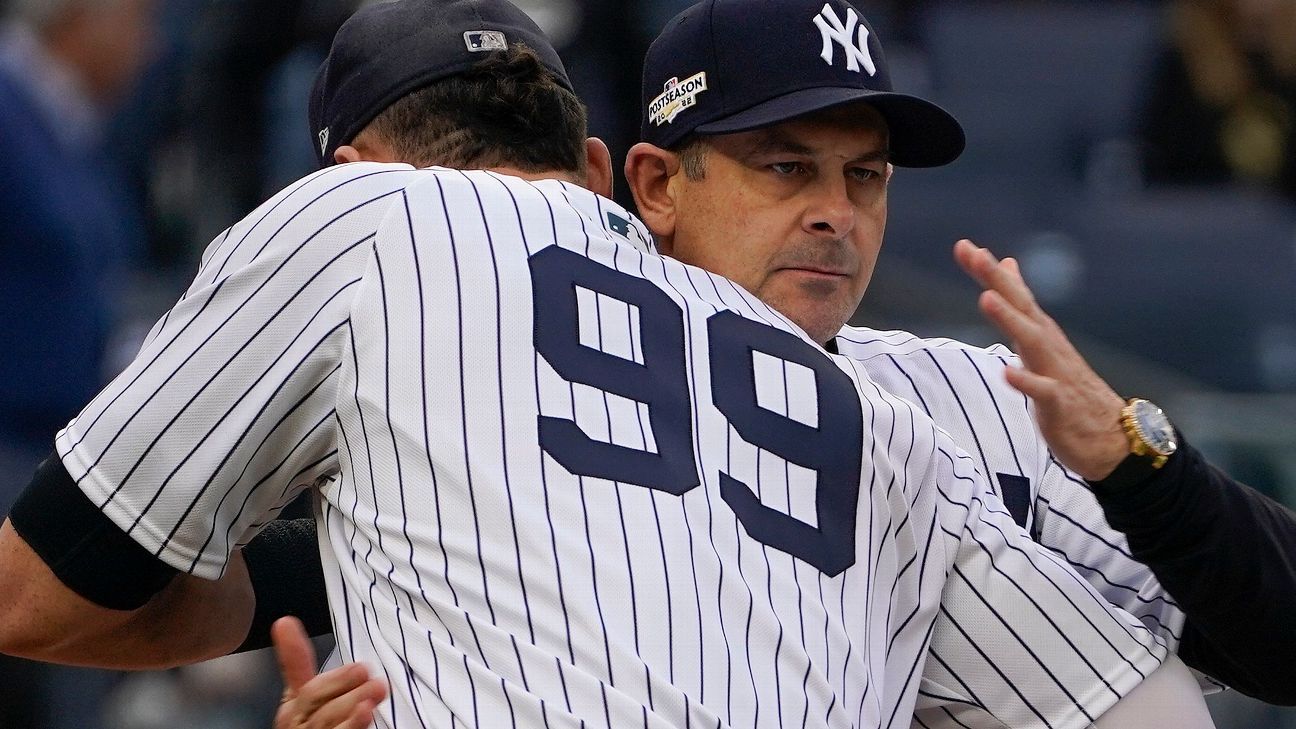
Aaron Boone said Thursday he spoke with Aaron Judge after the star outfielder expressed displeasure over the manager's characterization of his calf injury to reporters, emphasizing the two have maintained an excellent relationship across their nine seasons together. The friction stems from a widening gap between Judge's public optimism about postseason availability and the Yankees' more cautious medical assessment—a dynamic that matters both for the team's October rotation and for bettors sizing up Judge's early-postseason workload.
Judge suffered the soleus calf strain on September 16, eight days ago, in just his seventh game back from a fractured rib that sidelined him for more than three months. An MRI performed Thursday confirmed the moderate-grade nature of the injury. He received a platelet-rich plasma injection on Monday and has since resumed treadmill work and activation exercises in the training room, but has not taken a single swing since the strain occurred. Boone confirmed Judge will not play in the regular season's final game on Sunday, making the wild-card series Tuesday his earliest possible return. Judge has already sat out 24+ days this season; the combination of the rib fracture recovery, the compressed rehab window (no formal rehab assignment before his September return), and now this calf strain creates genuine uncertainty about both his availability and his effectiveness if he does take the field.
The underlying mechanics here expose why the market is likely underpricing the downside risk on Judge props in Game 1 of the wild-card series. Judge went 4-for-23 with 13 strikeouts across just 24 plate appearances in his brief window after the rib injury, posting an unsustainable 0.174 batting average over that stretch. That small sample reflects not just rust but also the biomechanical reality: a player who has missed three months and then strained his calf eight days into his return is hitting against fresh, playoff-caliber pitching without live at-bats since mid-September. His season line of .241 with 18 home runs across 66 games already reflects a down year by his standards—a .871 OPS is respectable but miles from his career norm. A player returning from injury to face a wild-card pitcher rarely produces at his envelope; the market often prices in the name and overlooks the timeline.
For prop bettors, this sets up a fade opportunity on Judge's strikeout and contact props in Game 1, assuming the Yankees do activate him. His strikeout rate in his recent 24-PA window was 54.2%—an extreme outlier even for a cold Judge. That will regress, but not necessarily all the way back to his 28% career rate in a spot where he's on one calf and facing a reliever-dependent October format. Similarly, any prop that requires early-game command (first-inning hit, first-two-AB hits, etc.) faces elevated risk; Judge has not taken a competitive swing in nine days and may see only a few throws in the cage before Game 1 first pitch. The PRP injection suggests the club is optimistic about rapid inflammation reduction, but PRP efficacy is highly variable, and the psychological confidence Judge projects publicly may not align with what his training staff actually expects him to produce.
Boone's language Thursday—"we're all in this together" and "a passionate player that's doing all he can to get back for his teammates"—reads as manager-speak smoothing over a real disagreement. Judge wants to play; the Yankees want to manage his exposure. That tension is the edge. Until Judge takes live swings and demonstrates he can move laterally on the field without compensation, any proposition requiring his full performance envelope should be approached with extreme caution.