Sharks Trade Up for Kesselring: A Defensive Gamble on Bounce-Back Upside
By Justin Erickson ·
San Jose swaps draft capital and roster depth for a right-shot defenseman who flamed out in Buffalo—a bet that fresh scenery unlocks the talent the Sabres couldn't extract.
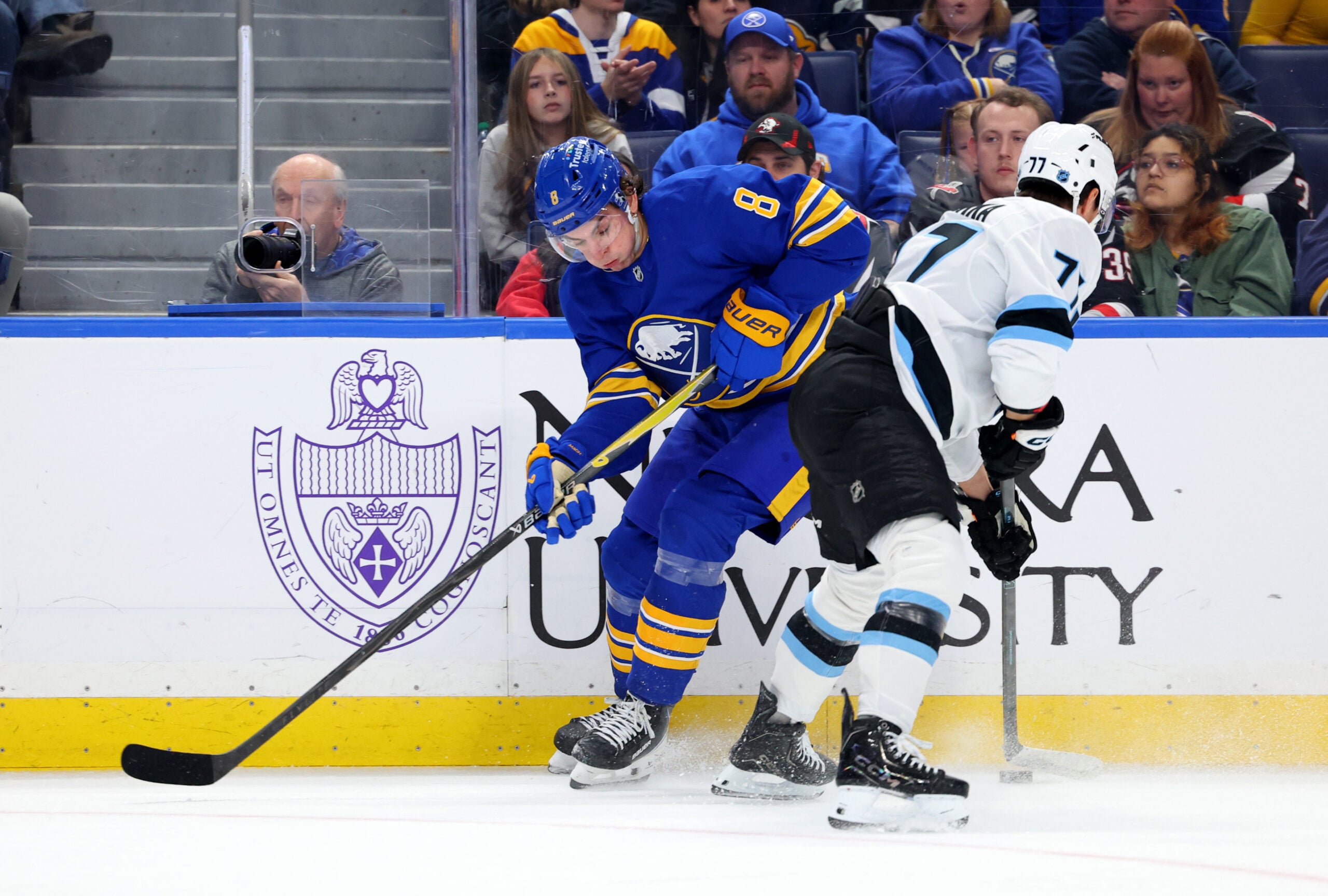
The San Jose Sharks acquired defenseman Michael Kesselring and Buffalo's 27th overall pick in exchange for their own 20th pick, a move that signals the organization's willingness to trade near-term draft capital for defensive depth. The deal arrives with significant risk: Kesselring played only 34 games last season for the Sabres, recorded two assists, and appeared in exactly one playoff game before effectively losing the trust of head coach Lindy Ruff. When Buffalo signed him to provide right-handed shot stability on the back line, the investment never materialized. But the Sharks are betting that organizational friction—not a fundamental skill decline—explains his collapse.
Kesselring's downfall in Buffalo followed a predictable arc. Early chemistry with Owen Power suggested the pairing might anchor the Sabres' top four. That window slammed shut when injury removed him from the lineup and Zach Metsa played well enough to lock the job. Ruff's confidence never returned, and Kesselring's icetime withered to single-digit shifts on nights he dressed at all. For a young defenseman trying to establish himself in the league, that kind of organizational cold shoulder is often a death sentence—not because he lost his ability to play, but because repetition, consistency, and coaching trust compound far faster than raw talent alone.
The Sharks' blue line is old (Dmitry Orlov is 34), thin beyond Orlov and Sam Dickinson, and badly needs internal youth. At 26, Kesselring still has time to develop into a legitimate top-four contributor if he stops playing scared. San Jose's rebuilding posture—Macklin Celebrini and William Eklund driving the forward narrative—can actually work in his favor: he'll get opportunity without the win-now pressure that crushed his confidence in Buffalo. The Sharks are not expecting Kesselring to carry them to a playoff berth this season; they're expecting him to show enough over 50-60 games to justify keeping him long-term on a restricted free agent deal.
From a betting standpoint, this trade creates a near-term volatility spike in San Jose's defensive metrics. Kesselring's shot suppression numbers in Buffalo (per 60 metrics, blocked shots, defensive positioning) were depressed by injury and icetime scarcity—not a true reflection of his capability. Early-season prop markets may still price him as a depth liability rather than a development asset stepping into real minutes. If the Sharks deploy him on the second pairing with regular power-play time, his shots-on-goal and blocked-shot totals should trend upward from whatever Buffalo's restricted usage suggested. The booking angle is patience: wait for two to three weeks of his actual deployment in San Jose before locking into any prop lean tied to his individual defense numbers.
The 27th-pick add-on sweetens the deal for San Jose and reflects Buffalo's willingness to absorb a cost for shedding a failed experiment. For San Jose's forward depth, that extra pick in the 20-30 range is meaningful in a draft where position scarcity at wing and center remains acute. The Sharks cashed a mid-round pick and a potential reset-season defenseman for moving down seven spots—a trade that favors the team willing to take the flyer on second acts.