NHL · transaction
Giroux's Faceoff Anchor Is Worth the Age Trade-Off for Ottawa
Claude Giroux's 63.1% faceoff win rate gives the Senators a rare edge in possession control that younger alternatives can't replicate, even as his skating declines.
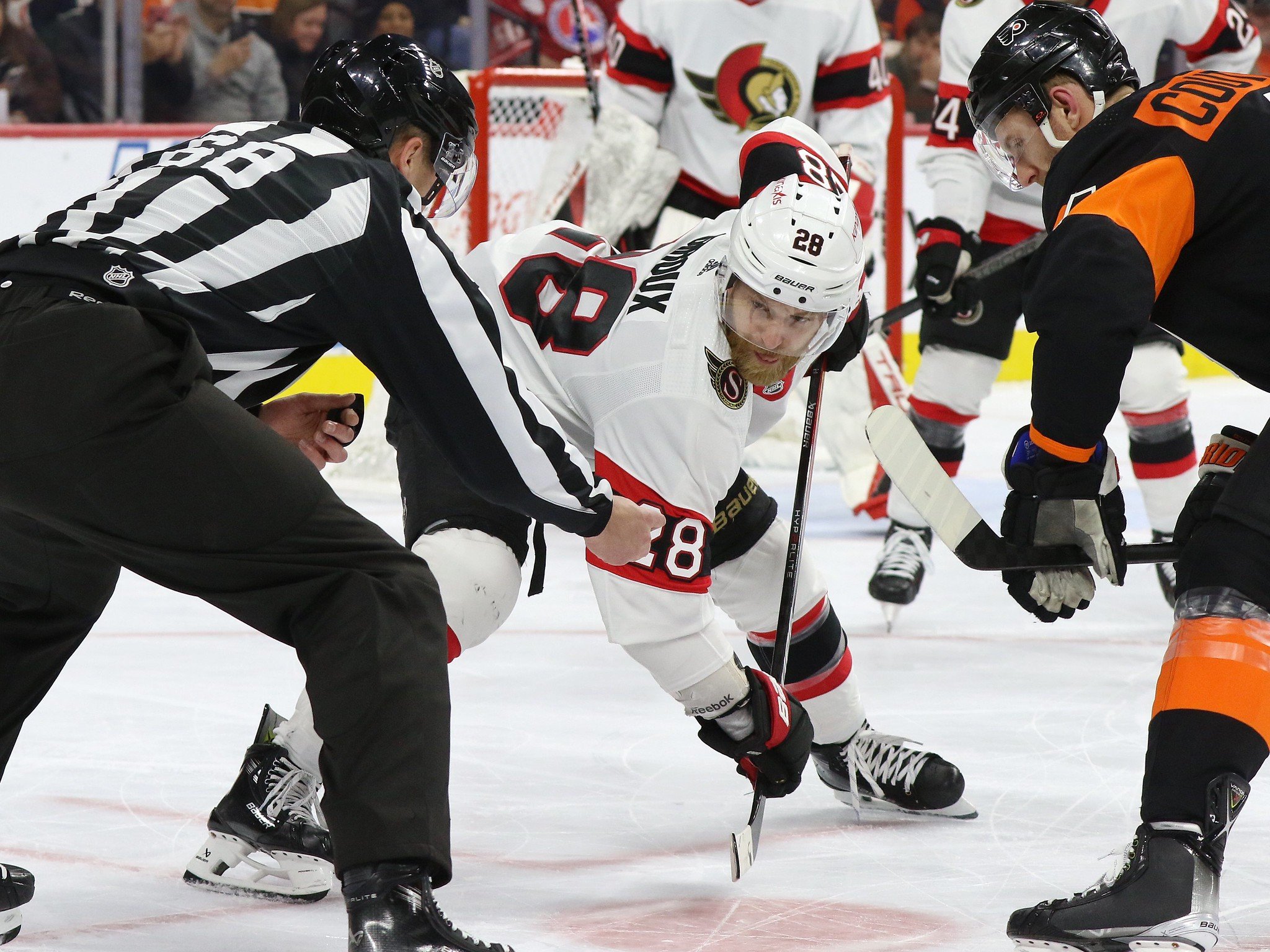
The Ottawa Senators face a straightforward roster decision: re-sign 38-year-old Claude Giroux or gamble that internal options can fill his specific role. Per reporting, Giroux wants to play his 20th NHL season and hasn't indicated plans to retire. On the surface, age is a legitimate concern—his foot speed has noticeably slowed over the past two seasons, and a first-round sweep by the faster, more dynamic Carolina Hurricanes exposed that vulnerability. But Ottawa's management would be making a critical mistake if they weigh Giroux's skating decline too heavily against the core value he actually provides.
Giroux led the NHL in faceoff percentage this season at 63.1%, with particular dominance in high-leverage situations: 69.6% on shorthanded draws and 68.3% in the defensive zone. Those aren't marginal improvements. The Senators' internal alternatives—Shane Pinto and Ridly Greig—combined for 51.5% in the dot, creating an 11.6-point gap in a metric that directly influences puck possession in critical moments. Winning a defensive-zone faceoff with a one-goal lead and a man down isn't just valuable; it's foundational to playoff survival. Giroux has 1,400-plus games of experience executing exactly that scenario. Pinto and Greig are still learning the leverage.
The offensive production question is secondary here. Giroux was ineffective with the puck in the playoffs, and his pace of play will only slow further—no hiding from that. But if Ottawa slots him on the third line with Pinto and Michael Amadio, his role becomes hyper-specialized: win draws in defensive situations, manage the puck efficiently, and provide veteran steadiness. Natural Stat Trick data shows that line combination generated positive shot and scoring-chance share. That's the floor, not the ceiling.
From a lineup construction angle, Giroux's re-signing directly impacts Ottawa's ability to compress shot volume in tight playoff games. Better faceoff execution in the defensive zone correlates to fewer high-danger chances surrendered early in sequences—which translates to lower goalie workload in the third period, when teams play tighter. Marcus Högberg and Linus Ullmark will see fewer scramble situations if the Senators consistently win draws after icing or in transition. Over a 16-game playoff run, that compounds. The Hurricanes punished Ottawa partly because Ottawa couldn't maintain puck control in its defensive end; Giroux's presence in the dot is direct damage control against that weakness.
The salary-cap space exists—the league cap is rising to $104 million—and Giroux will accept a modest one-year deal to stay. Letting him walk to save $2-3 million in cap space is penny-wise and playoff-foolish. The Senators are a young core one veteran faceoff anchor away from being genuinely dangerous in the Atlantic Division. Giroux is that anchor.
NHL Intelligence — Hockey intelligence beyond the scoreboard. Open NHL Intelligence →