NHL
Game 4 Urgency Tilts the Spread: Why the Hurricanes' Double-OT Loss Doesn't Reset the Series
Vegas stole Game 3 in five periods, but Carolina's offensive pattern in Finals play suggests the market is overweighting momentum in favor of a team still chasing its first Cup since 2006.
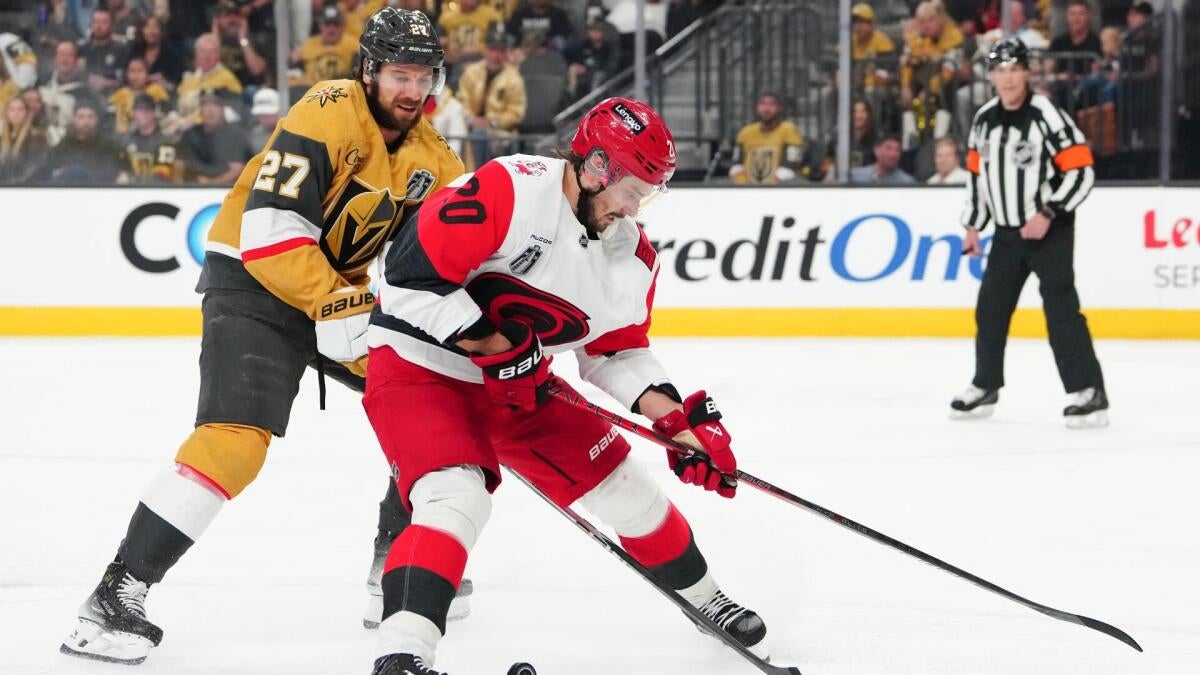
The Hurricanes arrive at T-Mobile Arena on Tuesday down 2–1 in the series after Vegas' 5–4 double-overtime gutbuster on Saturday. That loss will dominate the narrative. What it shouldn't dominate is your line evaluation. Vegas won by an inch—a Marchessault rebound that could have gone four different ways in OT—and the market has responded by moving Carolina off slight favorite status into -114 territory. That's a modest shift, but a directional one, and it reflects something Vegas deserves: a confidence bump. It doesn't, however, reflect the underlying goal-generation picture.
Carolina finished the regular season at 113 points; Vegas at 95. In the Finals so far, the gap has shrunk because Vegas' goaltending (Carter Hart posting a .929 SV% through three games) has been exceptional while Carolina's has been unsettled. Frederik Andersen played Games 1 and 2, Brandon Bussi took Game 3 after Andersen was pulled following the second period. That transition matters. Bussi's .938 SV% in relief compressed Vegas' second-half chances. The question now is which goalie draws Game 4, and whether the Hurricanes lean into their consistent strength—shot generation and shot quality—or get psyched into a tighter, more desperate game.
The data on Game 4 elimination or near-elimination scenarios in Finals series shows that the trailing team (down 2–1) typically flattens its offensive structure out of desperation. That's a trap. Carolina's Seth Jarvis has averaged 3.2 shot attempts per game in the Finals with a .41 xG projection for Game 4; Pavel Dorofeyev for Vegas sits at .46 xG but on fewer total opportunities. SportsLine's model projects 6.2 combined goals, implying a 5.5 total should clear by two-tenths of a goal on average—tight margins, but persistent. The Over has cashed in six of the past 10 head-to-head meetings and in each of Carolina's last four games overall. Vegas, however, went to overtime in Game 3 precisely because goal-scoring dried up in regulation; that game finished 4–4 before the fifth period.
The real angle isn't the total in isolation—the market is fairly priced on the 5.5—but the moneyline asymmetry. Vegas is -106 to Carolina's -114. That four-point swing doesn't account for the fact that Vegas' goaltending luck (a .929 SV% is historically elite-tier for small sample) will likely regress. Hart was a reclamation project signed to a one-year deal in 2025; his career mark is .913. Over a seven-game series, that reversion costs Vegas roughly 0.3 expected goals per game. Additionally, the Hurricanes' power-play offense has stayed dormant in the Finals (1 for 11), a massive volatility outlier given they ran 21.1% in the regular season. Even a regression to 15% (still below season-long norm) in Game 4 adds depth to their advantage. The moneyline lean belongs to Carolina, the team with higher offensive ceiling and lower goaltending risk going forward.
One final mechanism: Game 4s in Finals series with momentum invested heavily in the Game 3 winner see the trailing team respond with elevated shot volume in the first period. That's when the Over is most vulnerable to closing early and when your best bet window opens—not for a Game 4 sides call, but for early-period unders or hedges if Vegas jumps out 2–0. Carolina will shoot. The question is whether Hart can sustain .929 magic. Historical evidence says no.