Carolina's Suffocation Defense Rewires the Goaltender Workload Equation
By Justin Erickson ·
The Hurricanes are holding Montreal to 15 shots per game in the Eastern Conference Final—a defensive stranglehold that fundamentally alters how to evaluate their goalie's performance and durability.
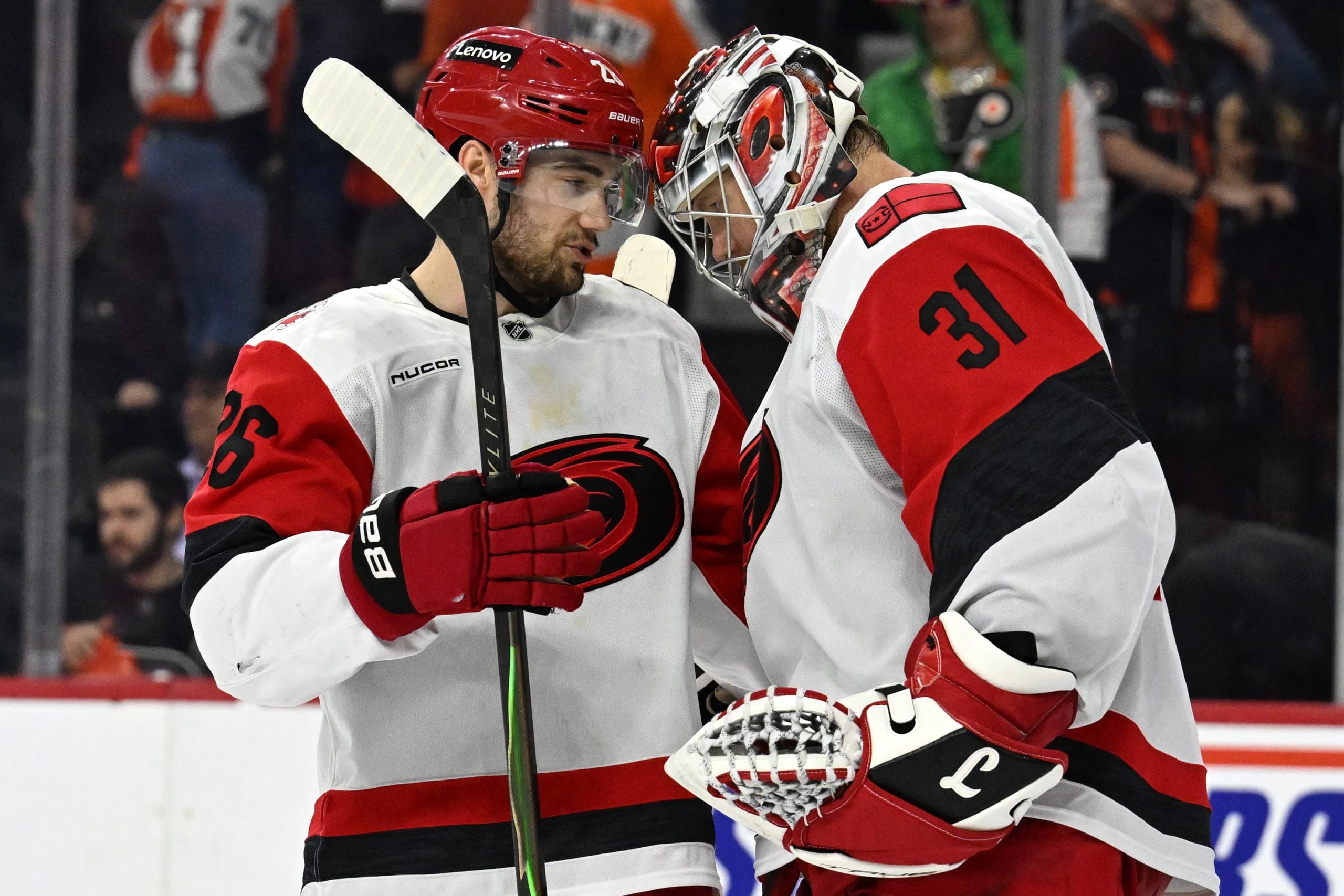
Through three games of the Eastern Conference Final, Carolina has allowed Montreal just 47 shots total. That's 15.7 per game—a figure so extreme it warrants structural analysis rather than dismissal as variance. The Hurricanes aren't just winning possession battles; they've engineered a system where the Canadiens rarely generate scoring chances at all. When a team faces that volume scarcity, traditional goaltender evaluation metrics—save percentage, goals against average—become noise. Andersen's ability to stay sharp matters less when he's seeing Grade A chances once every other period instead of five times per night.
The mechanism is threefold: aggressive puck-carrier harassment in the neutral zone, a six-man defensive corps rotating through elite positioning, and systematic shot-blocking that prevents perimeter attempts from ever reaching Andersen's crease. Jaccob Slavin has blocked eight shots; Sean Walker eight more; Jackson Blake and Jalen Chatfield six each. These aren't incidental deflections—they're architectural. Carolina's defensemen are eating low-danger chances before they develop into shot attempts. The Canadiens have entered the offensive zone repeatedly and left without registering offensive opportunities. That's suffocation by design, not luck.
The implication for goaltender durability flips the script on historical precedent. Andersen famously tired in previous playoff runs when the Hurricanes reached this stage, but this year's defensive load-management is preemptive. By suppressing shot volume, Carolina is preserving his focus and mental acuity—the invisible tax of facing 35+ shots nightly in a seven-game series. Fewer shots means fewer rebound situations to manage, fewer scrambles in tight spaces, and crucially, fewer instances where a hot opponent hand-passes through the crease. Andersen hasn't been tested on rebound control because the system prevents rebounds from happening.
For prop bettors, this creates a two-tier decision tree. First: Hurricanes goaltender save percentage looks artificially weak (driven by high-danger conversion, not poor play). Fading Andersen's SV% over for the remainder of the series is a trap; the defensive system guarantees he'll see the worst chance quality of any playoff goaltender relative to volume. Second: opponent total shots against becomes the reliable lever. Montreal's implied offensive output in Game 4+ should be priced assuming normal playoff-series spacing (roughly 30-32 SOG per 60 minutes of play). Instead, Carolina's scheme suppresses that to 25-27 per 60. If the line opens Montreal shots at 28-30, that's overpriced. The Hurricanes' shot-blocking discipline and harassment patterns have held across two overtime periods and a blowout; this isn't a single-game anomaly. It's a tactical framework now stress-tested across three distinct game states.