NHL · transaction
Markström to Florida: A Defensive Bet on Goalie Salvage
The Panthers acquire a 36-year-old goalie with declining metrics and a historically brutal season, banking on scheme and teammates to reverse a sharp two-year downward slide.
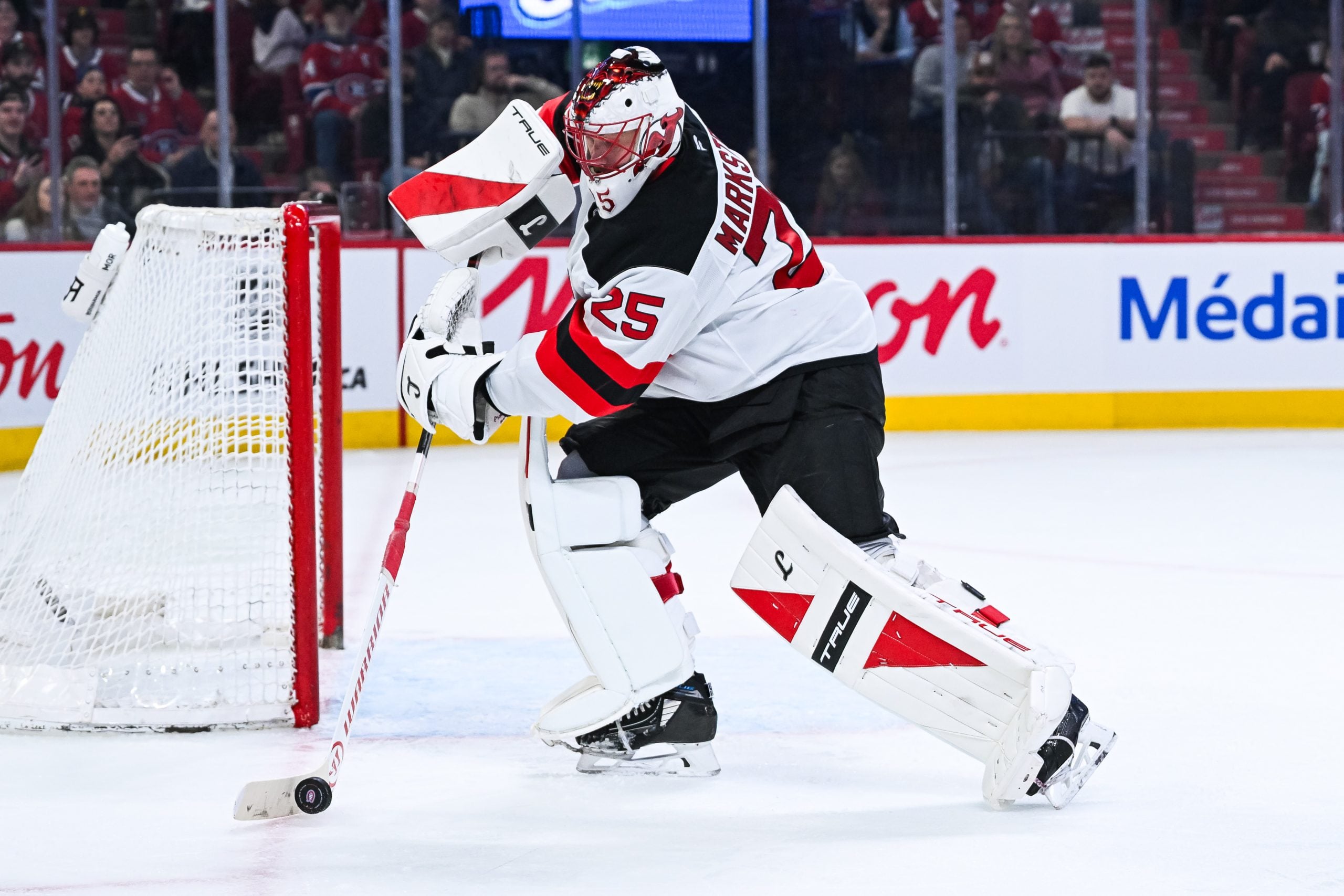
The Florida Panthers acquired Jacob Markström from the New Jersey Devils on June 30, 2026, sending forward Evan Rodrigues, Jesper Boqvist, and Ben Steeves in return. Markström, who signed a two-year extension with New Jersey in November that activates July 1, becomes Florida's successor to Sergei Bobrovsky—a move driven by the goalie market's thinness and Bobrovsky's reported demand for $6-7 million long-term. On paper, the swap looks sideways at best: Markström finished 2025-26 with an .883 save percentage and allowed 11.9 goals above expected, numbers that track almost identically to Bobrovsky's .877 SV% and 12.2 xGA allowed. The difference is philosophical. Rather than meet Bobrovsky's salary demands, the Panthers are betting they can resurrect Markström in a better defensive system.
Markström's season-long decline masks a specific vulnerability: the Devils' 9-0 loss to the Islanders that saw him surrender nearly 7.5 xGA in a single game. Strip that outlier, and his underlying performance improves to marginally below league average across the remaining 60-game sample. But the broader trend is harder to ignore. Over the past two seasons, Markström's save percentage has eroded steadily, and at 36 years old entering next season, age-curve attrition is a legitimate lens. The Panthers' gamble rests entirely on the premise that New Jersey's defensive infrastructure failed him more than his own capability has declined. Whether that's true will determine if this move is a calculated salvage job or an overpay on a sinking asset.
For betting purposes, the timing and market context matter. The goaltender market in June is always thin—there are no gold-standard free agents available, and teams needing depth must either overpay or dig into trades. The Panthers' willingness to assume Markström's full contract signals internal confidence in his bounce-back potential; organizations that didn't believe in the recovery wouldn't shoulder the cap burden. That said, Florida's prop lines on goaltender performance—save percentage, goals against, and shutout likelihood—should tighten considerably in early-season markets. Books will price Markström's 2026-27 season based on his recent Devils output initially, but if the Panthers' defensive structure truly does elevate him, early overunders on his SV% prop (likely set around .900 or slightly lower) could represent value. The catch: any single-game outlier in his first month will recalibrate the market sharply. Markström's edge exists only if Florida's system delivers on the premise that a change in environment matters more than age and recent decline.
The Devils, conversely, upgrade their bottom six with a lower-ceiling angle. Rodrigues (11 goals, 31 points in 69 games, 54%+ xG share at five-on-five) and Boqvist (a familiar name from the 2022-23 52-win squad) give New Jersey functional complementary forwards after a season in which their bottom six was materially weak. Rodrigues' contract runs one year at $3.018 million, Boqvist's at $1.5 million—both immaterial against the salary cap and both one year removed from potential rebound opportunities. For New Jersey, the Devils' underlying metrics don't shift dramatically; they're adding depth players, not superstars. From a betting angle, the Devils' win total might tick up marginally (if the books hadn't already priced in bottom-six overhaul), but it's a secondary lever compared to the goaltending calculation in Florida.