Desharnais Fills Washington's Blue-Line Gap, but Defensive Depth Alone Won't Move Capitals Totals
By Justin Erickson ·
Washington's four-year, $16.8 million commitment to a 30-year-old shutdown defenseman reflects organizational need, not offensive catalyst—a signal worth reading in team-total props.
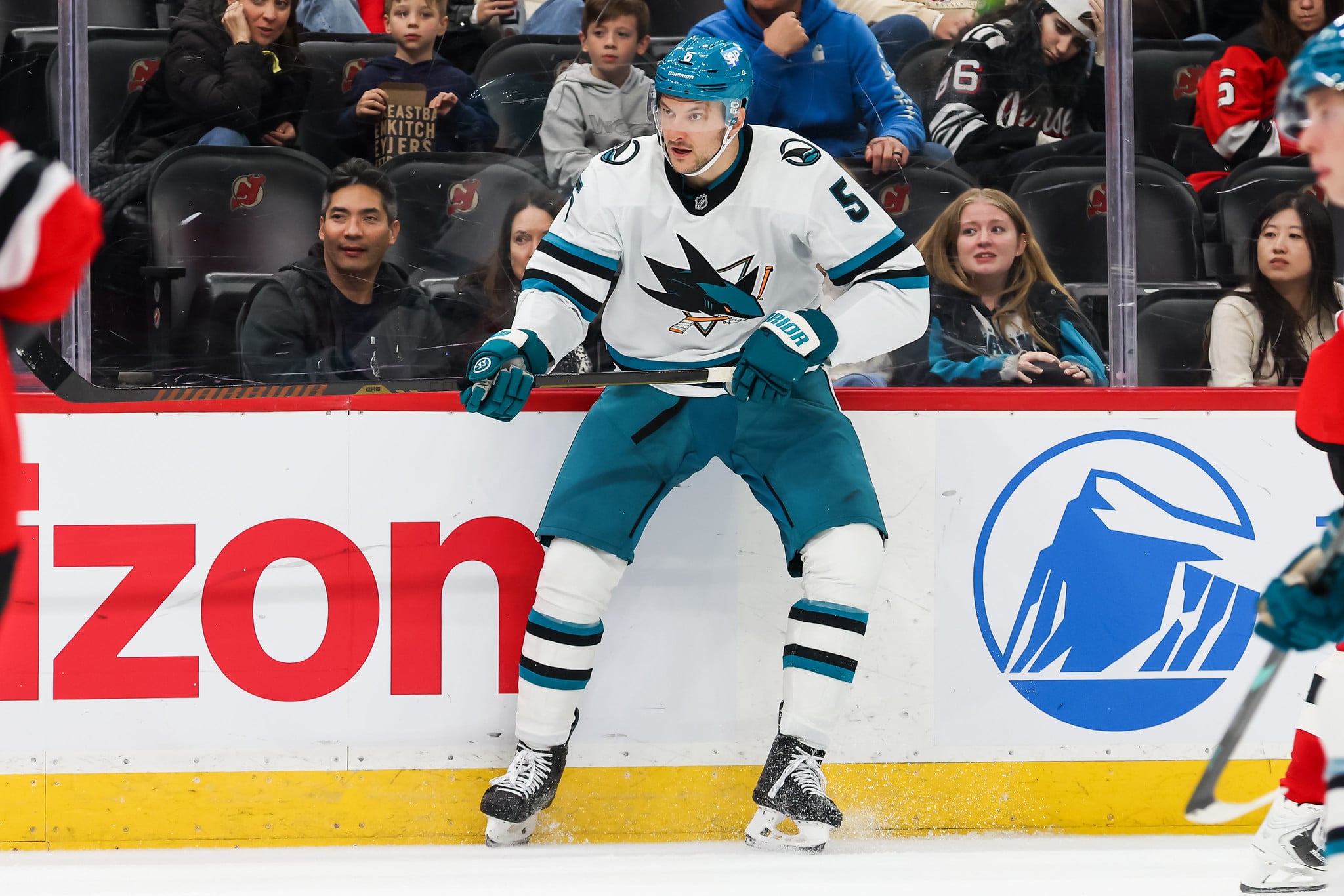
The Washington Capitals signed Vincent Desharnais to a four-year, $16.8 million contract as free agency opened, plugging a hole on the back end vacated by the departures of Nic Dowd and Trevor van Riemsdyk. At 6-foot-7 and 225 pounds, Desharnais is a quintessential defensive defenseman: high-volume shot-blocker, net-front anchor, and physicality distributor. His 2025-26 season with San Jose—18:11 of ice time per game, 83 blocked shots, 103 hits across 53 games—shows exactly what the Capitals are buying: defensive grunt, not offensive production.
The timing matters. Rasmus Sandin is set to miss the start of the 2026-27 season with a knee injury, forcing Washington's defense to absorb additional minutes without one of its more mobile, puck-moving options. Desharnais will likely pair with Jakob Chychrun on the right side—Chychrun providing the skill and transition ability, Desharnais providing the brute-force stability. This is necessary architecture, but it's not an offensive upgrade. Over his four seasons in Edmonton and two stints since (Vancouver, Pittsburgh, San Jose), Desharnais has posted a combined 23 points in 137 games. His career-high assist mark came last season: five. He is not a secondary option in the Capitals' scoring attack; he is insurance against chaos.
What this signing signals for team totals is subtler than a simple "defense improves, goals down" claim. Washington's offensive identity is anchored to Alex Ovechkin, Tom Wilson, and the core forwards. A defensive defenseman doesn't meaningfully increase Ovechkin's shot volume or Wilson's scoring rate. What Desharnais does provide is stability in the bottom six and penalty-kill minutes, reducing the likelihood of defensive collapses that force the team to chase games with empty-net offense or overtime drama. The effect on team goals is flat to slightly conservative—fewer blowout losses, fewer desperation-scoring scenarios, fewer games that spike the total through sheer intensity.
Bettors should observe that this move did not come with corresponding forward acquisitions beyond the depth add of Boone Jenner. The Capitals have not signaled an aggressive offensive remodel; they have signaled defensive consolidation. If the market prices the 2026-27 Capitals team total at the same level as 2025-26 (when they scored 3.4 goals per game on average), there is a modest lean toward the under. Desharnais's insertion into the lineup—even in a stabilizing role—reduces variance on the upside without creating new offensive vectors. The over becomes a bet on sustained Ovechkin/Wilson performance and forward depth performing above expectation. The under becomes a bet on defensive depth reducing catastrophic losses and keeping games tighter.
One caveat: Sandin's return timing is unknown. If he clears before October, Washington's blue line gains a puck-moving option alongside Desharnais, which would slightly elevate offensive transition opportunities and total-game scoring potential. Until that clarity emerges, treat team totals at 2025-26 pricing as a fade-over proposition—the market has not yet discounted Sandin's absence, and a shutdown defenseman in his place is unlikely to compensate for lost offensive generation at the back end.