NHL
Canucks' Overtime Escape Sets Edmonton Rematch as Character Test—Boeser's Quiet Role May Define Vancouver's Rebuild
Vancouver stole opening night on a shorthanded goal in overtime after blowing a three-goal lead; tonight's rematch against Edmonton reveals whether the Canucks have genuine resilience or just got lucky.
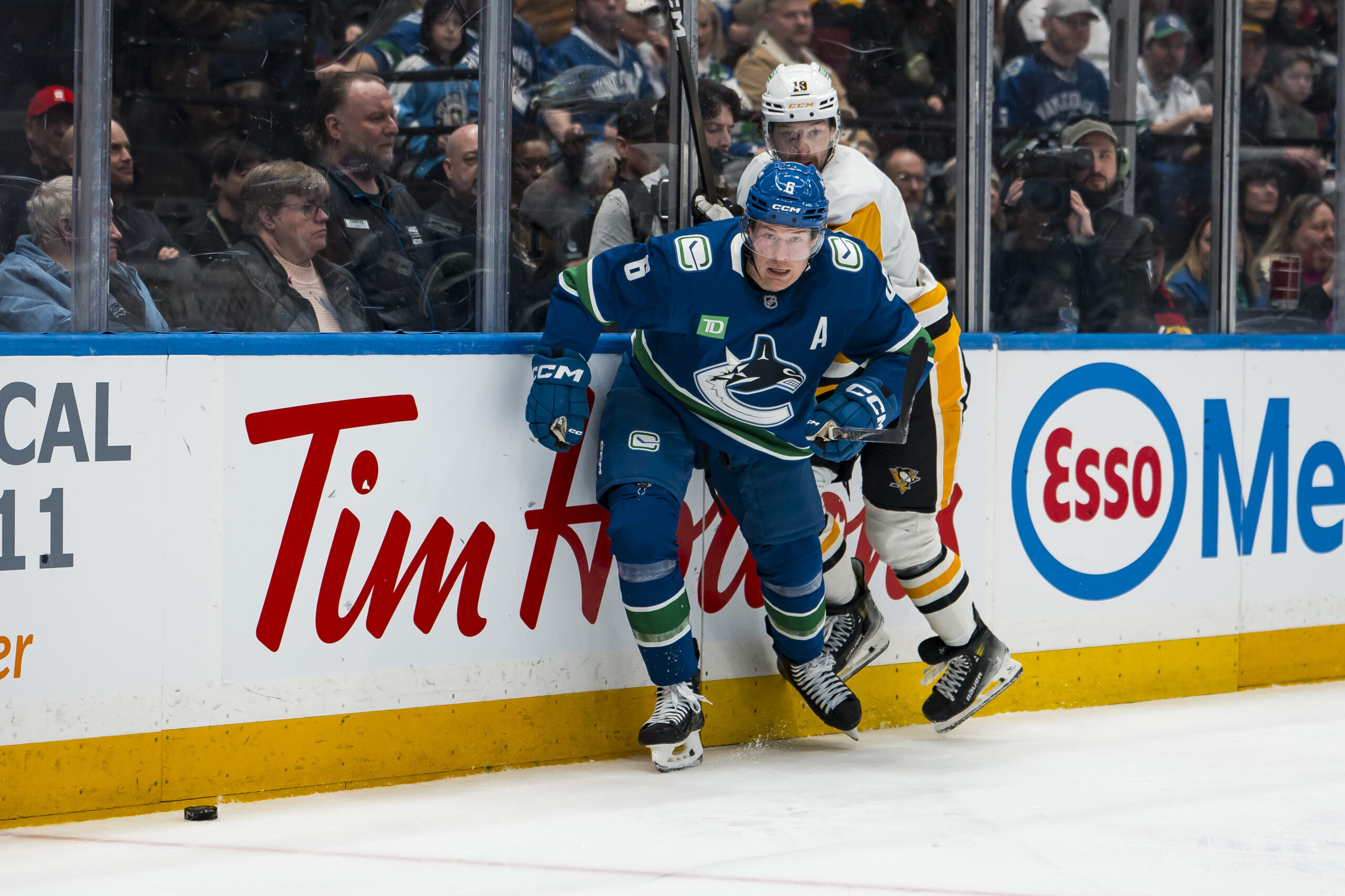
The Vancouver Canucks did something on opening night that a team with last season's worst record had no business doing: they won a game they had already lost. Up 5-2 with 11 minutes remaining against Edmonton, the Canucks surrendered three consecutive goals, watched Evan Bouchard notch a five-point performance including a hat trick, and saw the Oilers force overtime with 43 seconds remaining. Paul Cotter then won a puck battle against Ryan Shea in the extra period, somehow threaded a pass to Max Sasson while horizontal on the ice, scrambled back to his feet, and finished the chance himself. It was the kind of chaotic, improbable sequence that normally signals opening-night noise—the sort of result that carries no predictive weight and disappears by October's second week.
But Manny Malhotra, in his first game as head coach, chose a different framing. He pointed not to the six goals or the wild swings in momentum, but to what his players did after surrendering three straight: they did not fold. That is not a trivial distinction for a roster that finished in the basement and is being asked to believe a new era has begun. Edmonton's perspective offers the counterbalance. Mike Babcock called his team's loss ridiculous and cited turnovers, extended shifts, and poor decision-making—the kinds of execution failures that star-laden rosters can usually overcome but shouldn't have to. Bouchard himself, despite the historic night, acknowledged that Edmonton needed to play with more detail. Tonight's rematch will measure whether Vancouver's resilience is structural or circumstantial, and whether Edmonton's depth of talent can simply overwhelm sloppy process.
The prop lens here tilts toward caution on the Canucks as favorites, if the market has moved them that direction based on opening night alone. Vancouver's underlying profile hasn't changed: they were 32nd in the league last season and built largely around youth (Elias Pettersson) and injury recovery (Thatcher Demko). One overtime win doesn't erase that gap against a McDavid-Draisaitl duo that should feast on the chances a rebuilding defense will concede. Shots on goal likely favor Edmonton in this range unless Vancouver's new coaching culture has genuinely tightened their structure in 48 hours—a claim that one game cannot establish. The Canucks' goaltending also enters as a variable: if Demko has re-established himself, the equation shifts toward underdog value on a second consecutive Vancouver result.
One detail that may matter more to Vancouver's long-term prop environment is the emerging role of Brock Boeser. At 29 and a Canuck since 2015, Boeser has absorbed more organizational cycles than any current roster member. He is not the rebuild's centerpiece—that responsibility falls to Pettersson and Demko—but he may be something more functionally valuable: a veteran connector who can anchor secondary scoring while younger pieces develop. For bettors tracking Canucks season-long totals and player props, Boeser's stability and willingness to stay through a rebuild signal that Vancouver's offense has at least one reliable, high-volume contributor. His assist rate and shot volume are the kind of consistent markers that survive season-long variance better than youth-driven fluctuation. If Boeser is embedded into Malhotra's system as a third-line pivot or secondary power-play contributor, his points projections have clearer floors than Pettersson's upside carries uncertainty.
NHL Intelligence — Hockey intelligence beyond the scoreboard. Open NHL Intelligence →