Carter Hart's Playoff Volatility Is a Real Problem for Vegas—and a Market Signal
By Justin Erickson ·
The Golden Knights' Cup run hinges on their goaltender stabilizing, but the pattern of .850s and .926s suggests even strong defensive play can't rescue poor goaltending in a high-pace second round.
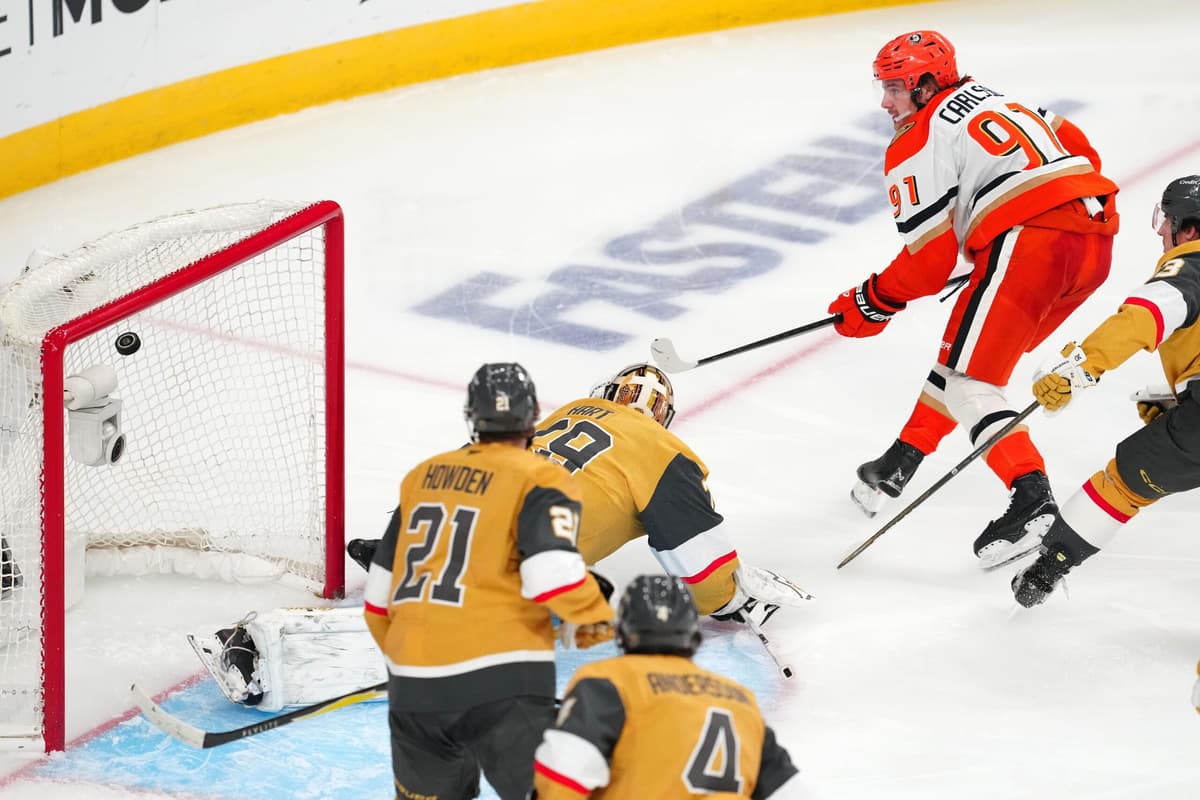
Vegas and Anaheim are deadlocked 2-2 in the second round after the Ducks' 4-3 road win on Sunday, and the conversation around the Golden Knights has shifted sharply toward one name: Carter Hart. The 27-year-old sits in an unusual position—returning to play after missing two seasons, armed with a .891 regular-season save percentage and the tactical familiarity of working under coach John Tortorella from their Flyers days. That résumé was enough to lock down the playoff starting role. But through the first two rounds, Hart's performance has traced a jagged line: dominant stretches (.926+ across four straight games early in the Anaheim series) punctuated by sharp dips (sub-.870 games that leave Vegas exposed).
The volatility isn't noise. In the first round against Utah, Hart finished with three consecutive games below .900 before stabilizing. Against Anaheim, he opened with four straight games north of .926—then cratered Sunday night. That pattern matters in a playoff series that rewards consistency. Anaheim's offensive pace and willingness to shoot from everywhere exploit the soft spots in Hart's game; the Ducks' ability to generate high-volume chances means they don't need a goaltender to be sharp every night—they need Vegas's goaltender to be sharp every night. When Hart dips into the .850-.870 range, Vegas's defense, which hasn't matched the structure of the 2023 Cup-winning squad, can't compensate through system alone.
The real test surfaces now in the series. Vegas retains home ice, but if Hart enters another dip phase, the Golden Knights will face a choice: lean harder on backup Adin Hill (the unlikely star of the 2023 Cup run) or trust that Hart's next upswing is imminent. That calculus is brutal because you can't time it in a playoff series. One weak game compounds into two, and suddenly you're down 3-2 with momentum running the other way. Hart's inability to avoid soft goals—the kind that swing momentum in a one-goal playoff game—becomes the limiting factor, even if Vegas's skaters out-chance Anaheim.
For bettors, this volatility translates directly to saves and goals-against exposure. Hart's save-percentage range (.850-.926 is massive) creates a two-way market edge: on nights when Hart is trending into a down phase, Vegas's team total tightens and Anaheim's over becomes more attractive. On nights when Hart is climbing out of a dip, Vegas's implied scoring ceiling sits lower than it should. The Golden Knights' depth and offensive talent remain real, but they've become a timing game masked as a series. Watch the first-period save percentage in Games 5 and 6; if Hart surrenders a goal in the opening 10 minutes, the market will price Anaheim's moneyline aggressively, and it will likely be justified. The Ducks are good enough to punish early shakiness.
Vegas has the skill to overcome one or two Hart stumbles in a best-of-seven, but a third dip phase tips the series toward Anaheim. The betting market hasn't fully priced in the risk that Hart's swings are structural, not random variance. That's an edge to exploit when Hart enters a downward phase.