NHL
Hart's Postseason Mastery and the Makar Void: Vegas Rewrites Game 1 Against Favored Colorado
The Golden Knights stole Game 1 in Denver behind Carter Hart's 36-save performance and exploited the Avalanche's missing best defenseman—a blueprint that reshapes the series value.
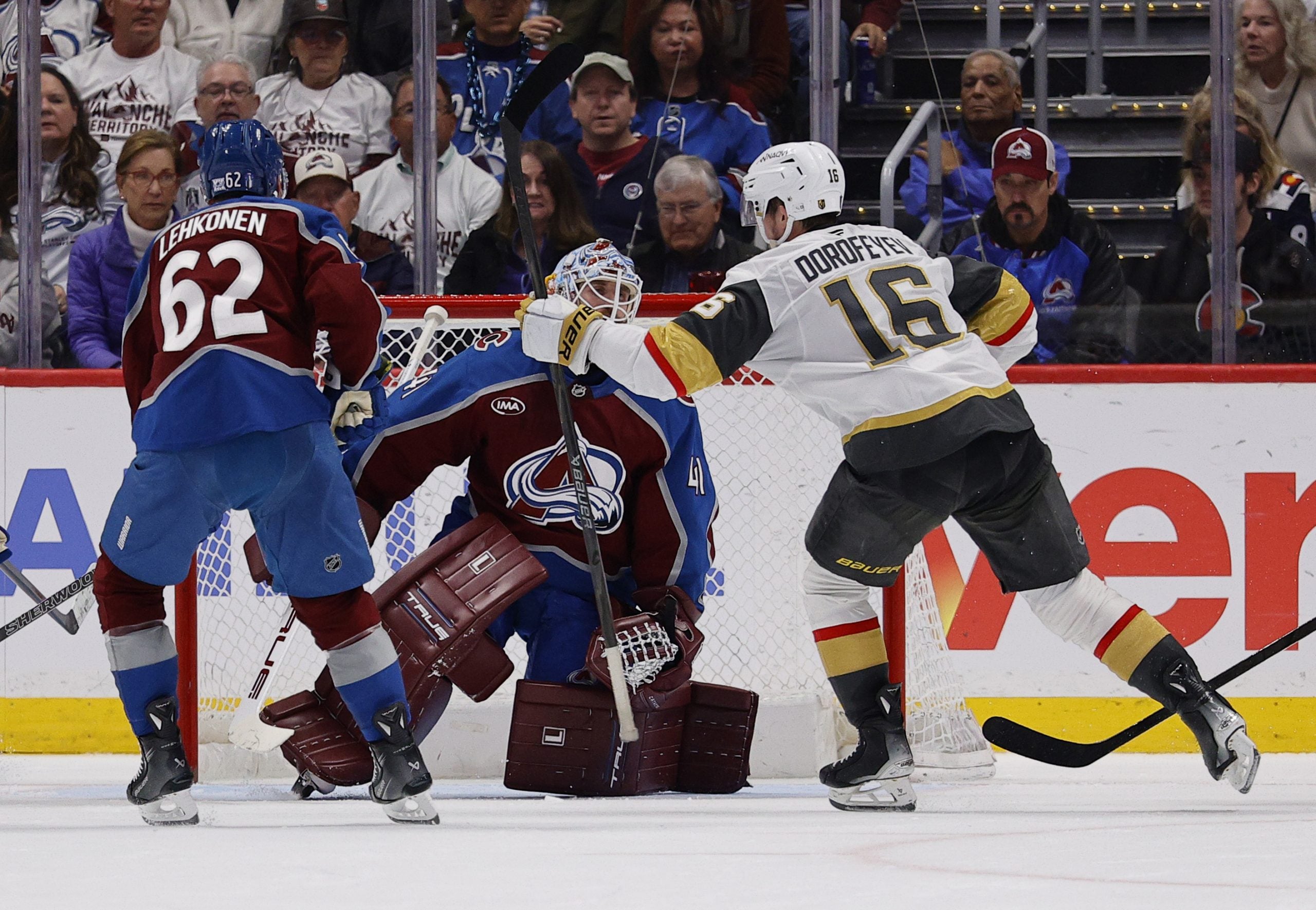
Vegas walked into Denver as a double-digit underdog and left with a 4-2 Game 1 victory, the kind of result that forces series recalibration across every major betting platform. The Golden Knights didn't just steal one; they executed a controlled team game against a wounded favorite that couldn't access its standard offensive rhythm. Colorado came in as heavy favorites to win the series—and for good reason, having dispatched Minnesota in five—but Game 1 exposed a structural vulnerability the books may not have fully priced.
The obvious culprit: Cale Makar's upper-body injury, suffered in the Minnesota clincher, rendered Colorado's most dominant defenseman unavailable. Makar isn't just Colorado's best player; he's the offensive engine on their power play and the defensive stabilizer who reduces leakage in transition. Without him, the Avalanche generated volume—38 shots—but couldn't convert quality into execution. Vegas, meanwhile, got exactly the game it needed: one where it could lean on Hart's postseason brilliance and trust its depth scoring to hold up under pressure. Hart made 36 saves on 38 shots (the 37th should have counted as a goal due to Andersson's stick), turning aside high-danger chances with the kind of composure that separates series winners from series losers.
The Las Vegas performance wasn't predicated on luck or hot goaltending luck—it was deliberate. The Golden Knights played with the confidence of a team that knew its opponent was operating at reduced capacity. Brett Howden's go-ahead goal came from poor rebound management by Scott Wedgewood, and Dylan Coghlan's opener was soft, but those margins compress when one team has its best player available and the other doesn't. The psychological edge matters here: Vegas walked into a hostile environment, knew what was missing from Colorado's lineup, and executed. That type of mental clarity translates into repeatable patterns.
For bettors, the implications are multifaceted. If Makar returns for Game 2, the Avalanche's power-play and transition efficiency should snap back toward their 2026 regular-season baseline—which means shot volume, assist rates, and scoring pace all shift higher. Colorado's team total for Game 2 (currently unsettled, but likely in the 3.0–3.5 range given the 4-2 final) becomes vulnerable to the upside if Makar takes the ice. Conversely, if Makar sits again, Game 1's blueprint holds: Vegas' defensive suffocation and Hart's save percentage become repeatable, and unders on Colorado's team total gain durability. Hart's 36-save, 0.947 save percentage in a playoff game is elite-tier execution—the kind that doesn't fade across a series unless Colorado's shot quality spikes dramatically or the injury narrative shifts. Watch the Makar status closely; his presence or absence is the primary lever moving all downstream props on Colorado's scoring and Vegas' defensive load.
NHL Intelligence — Hockey intelligence beyond the scoreboard. Open NHL Intelligence →