Texans Lock In Collins With Raises, Signaling Offensive Commitment for 2026-27
By Justin Erickson ·
Houston's contract restructure removes distraction from its most consistent receiver and reshapes offensive capital allocation for the next two seasons.
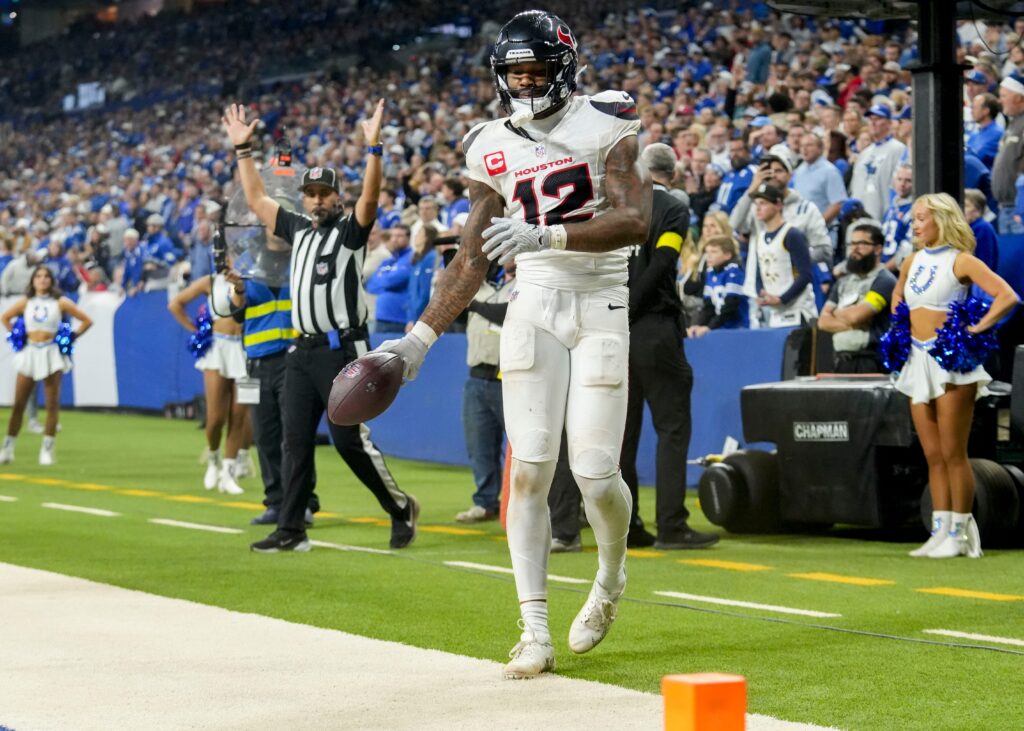
The Texans reworked Nico Collins' deal Tuesday, injecting $9 million in cash into 2026 and $8 million into 2027 while guaranteeing both years—a move that ends any lingering trade chatter and reaffirms the receiver as a cornerstone of the offense. Per ESPN, the restructure preserves the original three-year, $72.75 million framework while concentrating liquidity into the near term.
The timing and structure reveal organizational priorities. Collins had no 2027 guarantees on a $21.25 million salary; now that year is fully secured. The raises—totaling $17 million over two seasons—come without adding years to the deal, which means Houston is paying premium compensation to a proven target rather than extending his runway. This is a capital-allocation decision, not a complacency move. The Texans explicitly rejected trade overtures post-draft, and this restructure locks in a receiver who has delivered consistent production across multiple seasons. At the time of his May 2024 extension, Collins inked a deal below market rate—A.J. Brown reset the WR market at $32 million AAV weeks before, and Jaxon Smith-Njigba has since commanded $42.15 million annually. Collins remains $20 million-plus below that tier on paper, making the restructure a net-gain maneuver for cap flexibility while rewarding reliability.
The mechanical effect: Houston is signaling faith in its passing game architecture. C.J. Stroud will enter his third season with continuity at the receiver position, and the guaranteed dollars remove volatility from the roster ledger. The team front-loaded 2026-27 spending, which matters for game planning. Offensive coordinators operate differently when they know their top three options are locked in; play-calling becomes more aggressive, red-zone usage more confident. Collins' target share and yards-per-catch metrics should reflect that stability.
For prop bettors, the edge lies in understanding how guaranteed money translates to field volume. Collins' receiving yards and receptions will track with air yards into his routes—and Stroud's willingness to target him in contested situations climbs when the receiver is financially cemented. Over the 2026-17 window, Collins' 6+ receptions line and 65+ receiving-yards line gain durability because the offense has structurally committed to using him. The market won't price this organizational signal immediately; it will treat Collins as a statistical commodity (mid-tier receiving talent) rather than a capital-deployment statement. That gap—between utilization and valuation—is where the angle lives. Teams that restructure mid-contract to guarantee future money are signaling confidence and intention, not hedging bets. Watch his target share climb relative to preseason projections.