Saints Face Kamara Reckoning: How Dead Money Complicates New Orleans' RB Math
By Justin Erickson ·
New Orleans' commitment to Travis Etienne has forced a decision on Alvin Kamara—but the cap ledger may dictate the outcome regardless of performance.
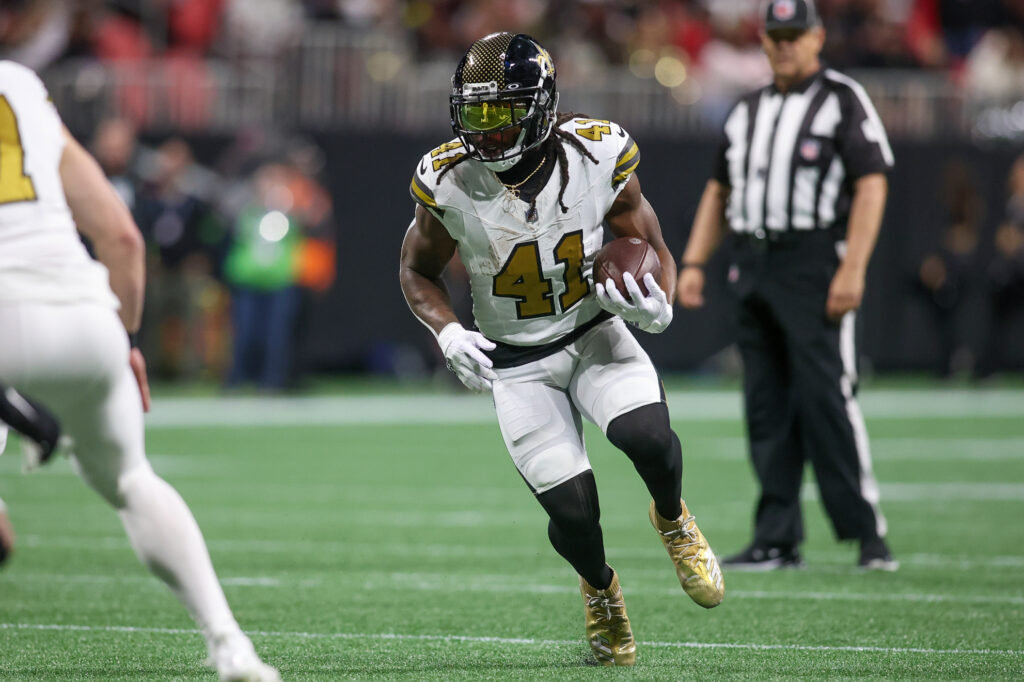
The Saints are approaching a fork in the road with Alvin Kamara, and the path forward hinges less on what he can still do on the field than what it will cost the franchise to move on. Per Pro Football Rumors, the team's front office is weighing options on the veteran running back after signing Travis Etienne to a lucrative deal with significant guaranteed money in March. Kamara drew trade interest during the initial market movement, but remains on New Orleans' roster as May unfolds—a limbo that reflects the organizational math growing more complicated by the week.
The core issue is structural, not talent-based. Kamara, now in his ninth season, still profiles as a dual-threat weapon in the passing game—a skillset that hasn't depreciated despite the wear. But the Saints' salary cap picture is constrained, and the Etienne addition signals a strategic pivot toward younger, similarly versatile talent at a lower cost-per-year. The decision facing Mickey Loomis isn't whether Kamara belongs in an NFL offense; it's whether the dead cap penalty—a sum that would accompany either a trade or release—justifies keeping him at his current book value when that capital could be reallocated elsewhere.
The dead money math is the cage here. Any move generates a cap charge that lingers into 2027, meaning the Saints cannot simply cut their way to relief. A trade softens but doesn't eliminate the hit, while keeping Kamara means absorbing the full cost while a younger, cheaper option sits in the same backfield. That tension is precisely what keeps marginal veterans in organizational purgatory. Loomis will move when the cap casualty becomes tolerable—either through trade demand materializing at a price the Saints view as fair, or through the calendar moving the dead money structure into a less poisonous window.
For prop bettors, this uncertainty ripples outward in two directions. First: Saints running back touch distribution becomes unstable. If Kamara exits, all volume routes to Etienne, who becomes a season-long receiving and rushing anchor—a cleaner target for total yards and TD props. If Kamara stays, he becomes a volume-capped secondary option in a committee, depressing his ceiling on a week-to-week basis. Second, and more subtle, is the Saints' offensive predictability. A team forced to manage an unresolved roster decision often lags in offensive continuity early in the season; coaching staffs field-test multiple backfield packages while the front office negotiates, which typically manifests as lower-than-expected efficiency in the first four to six weeks. Watch Saints RB receiving yards unders in early-season props—the uncertainty phase almost always underperforms preseason projections because the offense itself is still finding its rhythm.
Monitor trade chatter and minicamp reports closely. A Kamara departure before June would signal a cleaner 2026 projection for Saints backs; a July or August move suggests the team couldn't find a taker at acceptable value and settles for a sunk cost. Either way, the prop consequences are binary and durable: committee uncertainty fades once the transaction is complete, making single-week speculation riskier than season-long exposure. The real edge is timing the market's overcorrection to whichever outcome materializes.