Panthers Put Young Extension on Ice: What a Contract Holdout Means for His 2026 Efficiency
By Justin Erickson ·
With no deal expected until spring 2027, Bryce Young enters a prove-it season where every incompletion carries contract leverage—and touches the betting market's read on his ceiling.
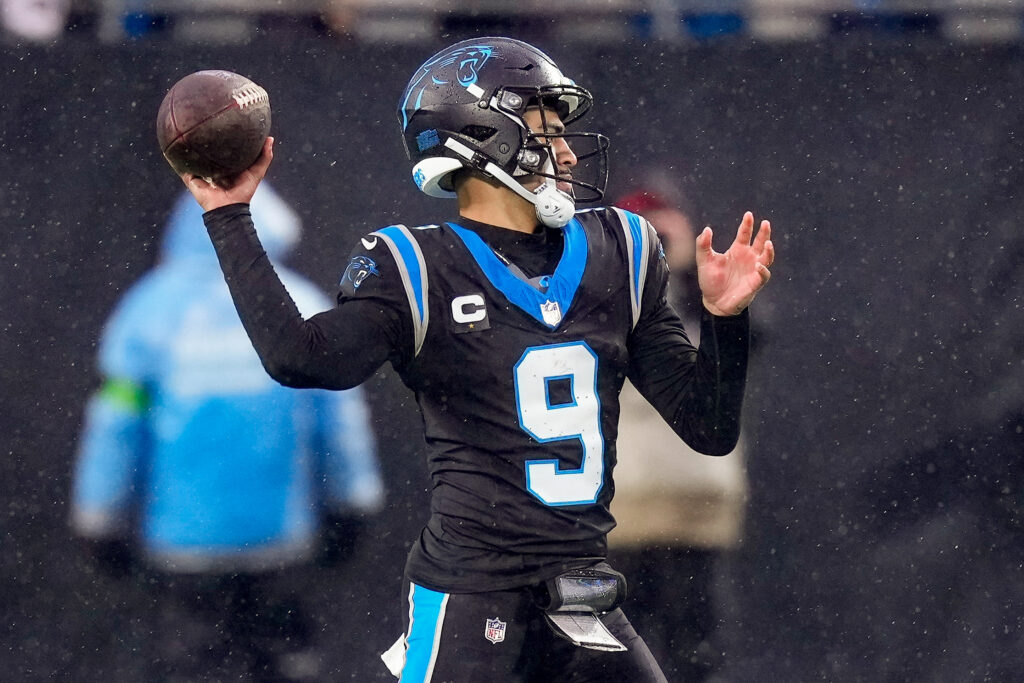
Carolina's front office made it official Monday: no Bryce Young extension will happen in 2026. Panthers EVP Brandt Tilis told reporters the team will "see how the year plays out" before committing to the former No. 1 overall pick to a long-term deal, a transparent way of saying the quarterback must earn his eight-figure raise on the field first. Young's fifth-year option, already exercised in April, locks him in at $25.9 million for 2027—well below the $51 million-plus annual average attached to the league's 12 highest-paid starters. The gap between that security blanket and true star money is where Carolina's entire calculus lives.
Young's trajectory remains uneven. Benched midway through his second season in 2024, he's notched incremental gains under Dave Canales this year: Carolina won the NFC South and improved from an 8-9 record, but the quarterback's individual performance ceiling remains contested territory. Young hasn't thrown for 4,000 yards in a season yet. His TD-to-INT ratio last year sat at 15:11—better than 2024 but still pedestrian. The Panthers' hesitation isn't personal; it's mathematical. They're not alone in this holding pattern: C.J. Stroud, Young's 2023 draft-mate and a far more dominant early performer, is also navigating contract talks with Houston as Week 1 approaches. The difference is opportunity cost—Stroud's leverage stems from elite output; Young's stems from unfinished business.
For bettors, the extension delay creates a secondary dynamic worth tracking: incentive alignment. Young enters 2026 with something to prove that transcends typical week-to-week performance variance. Every interception reinforces Carolina's caution; every extended drive strengthens his case. This isn't subtle psychological leverage—it's material. A quarterback auditioning for eight figures across the next three years doesn't take the same risks a guaranteed star does. You'll likely see a Young who manages games, avoids hero-ball moments, and leans heavier on ball security. That behavioral shift will show up in passing attempts, completion percentage, and interception rate in ways that standardized seasonal volume projections might miss.
The market's current read on Young's passing totals and TD props is anchored to his 2025 baseline. But a contraction season—fewer shots downfield, higher clutch-situation selectivity, fewer fourth-quarter gunslinger moments—could push under bets on his seasonal yardage and touchdown totals to value. Carolina's offensive line and receiver group remain middle-of-the-pack; Young won't benefit from system inflation. If he scales back usage to protect a contract year, defenses will adjust accordingly, creating a feedback loop where yards and scores both compress. The inverse bet—that Young forces the issue to prove his worth—carries higher variance but could pay if his confidence and Canales' trust hold. Either way, the extension standoff writes itself into the tape. Bettors should expect Young's volume to tighten relative to a traditional "third-year leap" projection.