NFL
Loveland's Silent Season Meets a Harder Test
Chicago's third-overall tight end pick has caught one pass through two games; Monday's Eagles defense ranks among the NFL's stingiest against his position.
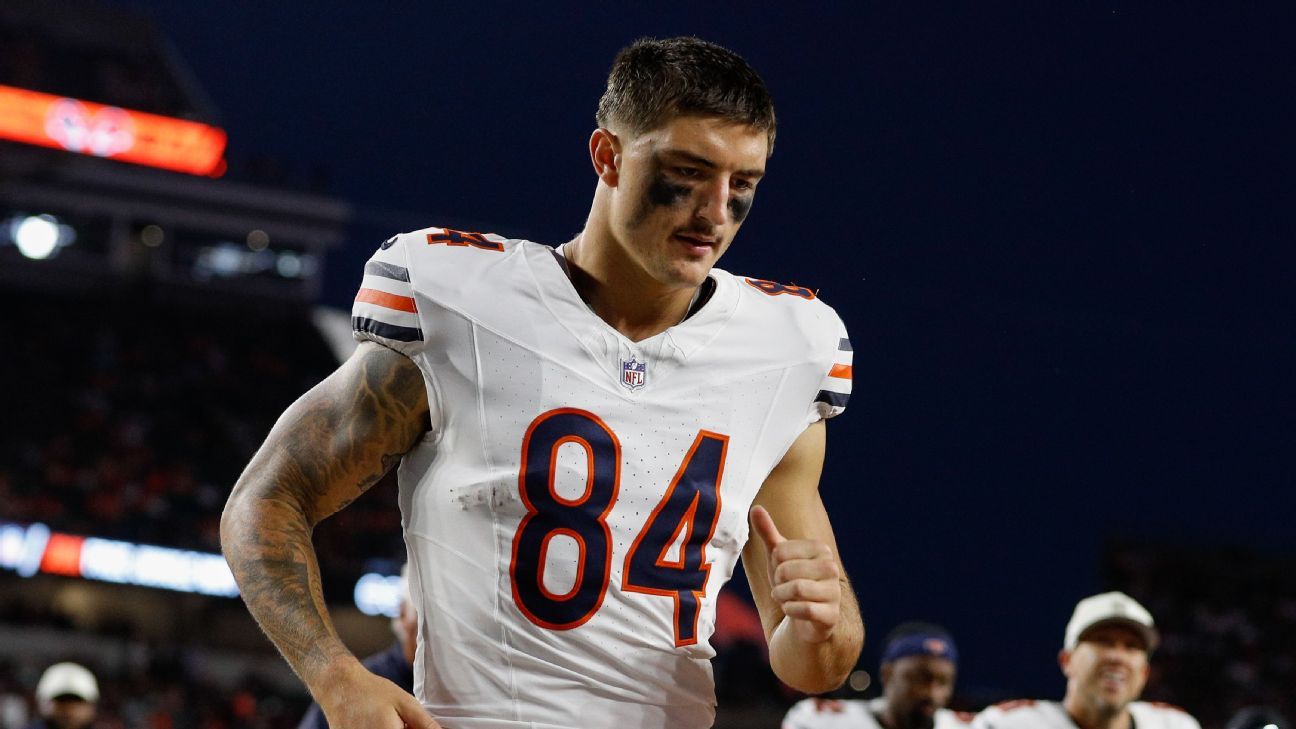
Colston Loveland arrived in Chicago as the No. 10 overall pick in 2025 and closed his rookie year with 713 receiving yards and 58 receptions, establishing himself as Caleb Williams' primary target down the stretch. Eight games into his second season, he has one catch for 3 yards on five targets across two contests—a production cliff that inverts every expectation around a then-emerging tight end asset. The Bears' home opener against Minnesota on September 20 yielded only that single reception, and the Eagles matchup Monday night (8:15 p.m. ET) arrives with Loveland active in just 48% of ESPN fantasy leagues.
Williams' absence shapes the immediate frame. The quarterback exited Week 3 with a Grade 2 hamstring strain and is inactive for Monday's contest; Case Keenum, his replacement, brings a vastly different throwing profile and target hierarchy. Loveland flourished last season partly because Williams recognized him as a high-leverage option in space—the familiarity built over a full offseason and regular season. Keenum operated Sunday drives without that continuity and without the arm talent to extend plays or attack intermediate windows that favor tight end production. The mechanical shift alone depresses Loveland's opportunity ceiling, regardless of how open he runs.
Philadelphia's pass defense compounds the problem. The Eagles have surrendered the third-fewest receptions (six) and second-fewest receiving yards (42) to tight ends through two weeks, with only nine total targets thrown into their coverage against the position. That's elite efficiency, not a small-sample anomaly—Philadelphia's linebacker Chance Campbell specifically highlighted Loveland's movement ability as a design concern, suggesting the Eagles have game-planned explicitly to limit touches. Against a scheme built to strangle intermediate traffic and a quarterback without Williams' processing speed, Loveland's route tree becomes reactive rather than generative.
The prop angle here trades on market lag. Loveland entered Week 4 with his receiving-yards line likely uncorrected for Williams' injury; sportsbooks may still price him as a secondary option to a capable starter rather than an afterthought in Keenum's system. His average of 597 receiving yards over his final 10 games last season creates a baseline that looks inflated when the passer changes—and the defense ranks third-toughest on his position. Fade receiving-yards overs. If his line sits at 25 or more receiving yards, the under carries low variance; 15-20 is the realistic ceiling in a Keenum + Eagles defense matrix. Anytime touchdown is similarly vulnerable, as Loveland's scoring opportunities depend on red-zone involvement that rarely materializes without a elite passer creating space.
This is not a permanent fade. When Williams returns, Loveland's role should reset. For tonight's contest alone—with a backup signal-caller and a top-tier run defense waiting—treat Loveland's receiving props as overpriced remnants of his second-half rookie form.
NFL Intelligence — Football intelligence beyond the final score. Open NFL Intelligence →