NFL · transaction
Case Keenum and the Bears' Monday Night Survival Test
With Caleb Williams sidelined by hamstring injury and Tyson Bagent in concussion protocol, Chicago turns to a 38-year-old journeyman against Philadelphia's defense—a scenario that reshapes both quarterback and ground-game prop architecture.
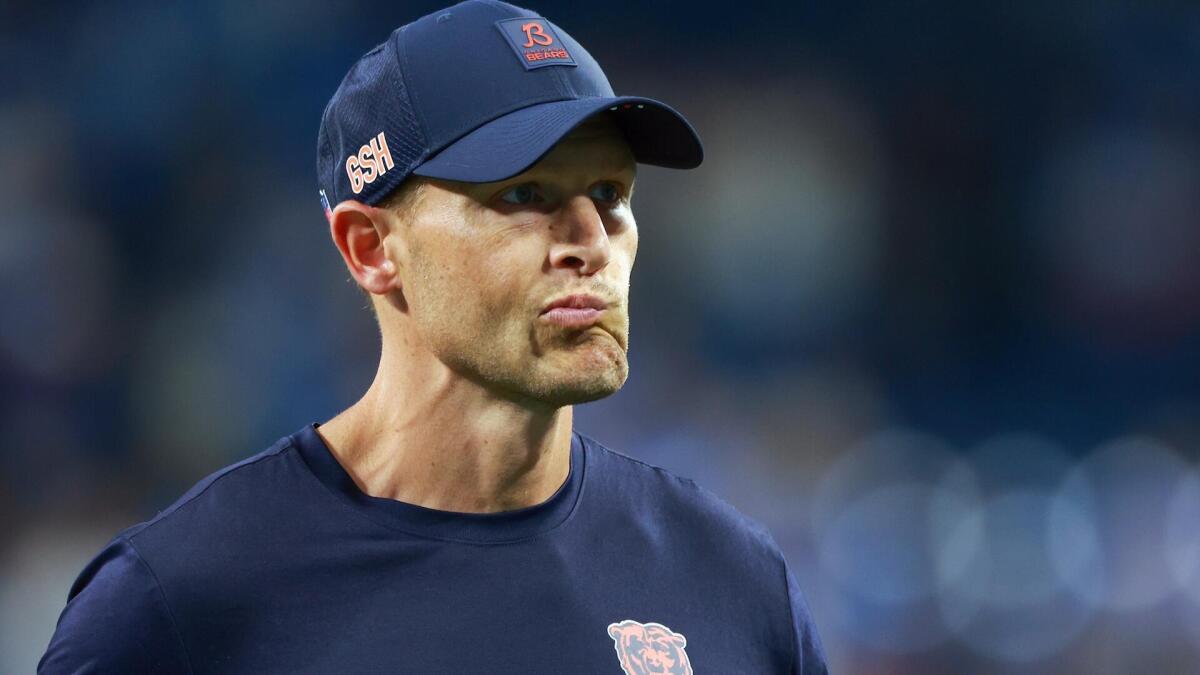
Caleb Williams limped off the field in the fourth quarter of Chicago's Week 2 loss to Minnesota with a lower-body hamstring injury that will sideline him through at least Monday's primetime matchup against Philadelphia. The good news: it's not season-ending. The bad news: the Bears' quarterback room is now threadbare enough to make Case Keenum the operational starter, a 38-year-old undrafted veteran who has thrown exactly two starts since 2023. Backup Tyson Bagent remains in concussion protocol, leaving Ben Johnson without a conventional plan-B signal-caller for the first time in his coaching tenure.
This is genuinely unprecedented ground for Johnson. In three seasons as Detroit's offensive coordinator, Jared Goff never missed a start—injury-free and with no need to rest during a blowout. Last year as Chicago's head coach, Williams played all 17 games. Johnson has never called plays for a quarterback who wasn't drafted first overall, let alone a third-stringer operating on fumes. That's not a stylistic challenge; it's a scheme architecture problem. Johnson's offense is built around precision timing in the passing game and early-down control. Keenum's arm—still functional but operating with limited zip and accuracy variance—doesn't slot cleanly into that framework. The Eagles' secondary isn't elite, but they don't need to be. They'll rush four, sit in coverage, and dare Keenum to execute timing-sensitive intermediate routes he hasn't run in meaningful reps all season.
The path to survival for Chicago runs through the ground. The Bears are averaging a league-leading 212.5 rushing yards per game, with D'Andre Swift (169 yards through two weeks) and Kyle Monangai (147 yards) both top-ten in carries and yardage. Philadelphia has allowed 127 rushing yards per game—ninth-worst in the league—and generated minimal interior pass rush disruption in their first two contests. The Eagles don't have the defensive line injury profile of other teams, but they're beatable in the run game if a team commits to it early and often. Johnson will have no choice. With a replacement-level arm under center, play-action boot-legs and max-protect max-patience schemes become liabilities; the Bears flip the call sheet toward inside zone, gap-scheme concepts, and downhill attacking runs designed to establish line dominance before Philadelphia's rush can materialize.
Prop angles sharpen considerably here. Swift's receiving workload may dip—Keenum won't have the confidence to hit him on wheel routes and wheel-to-checkdown progressions that typically inflate those targets. Focus instead on his and Monangai's rushing volume and efficiency. Swift sits at 4.8 YPC through two games; that number should stay healthy if Chicago front-loads run calls and the Eagles' interior gets fatigued. A total of 18-22 combined carries for Swift and Monangai is reasonable; their combined rushing yards should clear 150 in an environment where Johnson is actively game-planning to minimize Keenum's dropbacks. The Eagles' run defense tightens considerably in the second half of the season once film accumulates, but Monday night represents a window before scheme adjustments cascade through the league.
Keenum's passing lines are artificially depressed by lack of usage, not lack of completion percentage or efficiency. Expect 35-40 attempts maximum—Johnson will protect him by staying under center and chewing clock through the ground. At that volume, Keenum's passing yards prop is a fade; even at elevated per-attempt averages, total output hits a ceiling when the game plan is structured to minimize his exposure. Any passing TD line at +140 or better is a reasonable leverage bet on the alternate possibility—a long-range shot if Chicago falls behind and Johnson is forced to open the offense. The real money is in run-game props and team total unders, where conservative playcalling and a replacement-level arm create natural ceiling effects.