Ravens' Week 2 Collapse Against Saints Exposes Offensive Volatility—and a Prop Market Overcorrection
By Justin Erickson ·
Baltimore's 24-17 loss to New Orleans wasn't just a missed comeback; it was a masterclass in self-inflicted damage that rewrites the team's offensive ceiling for the rest of the season.
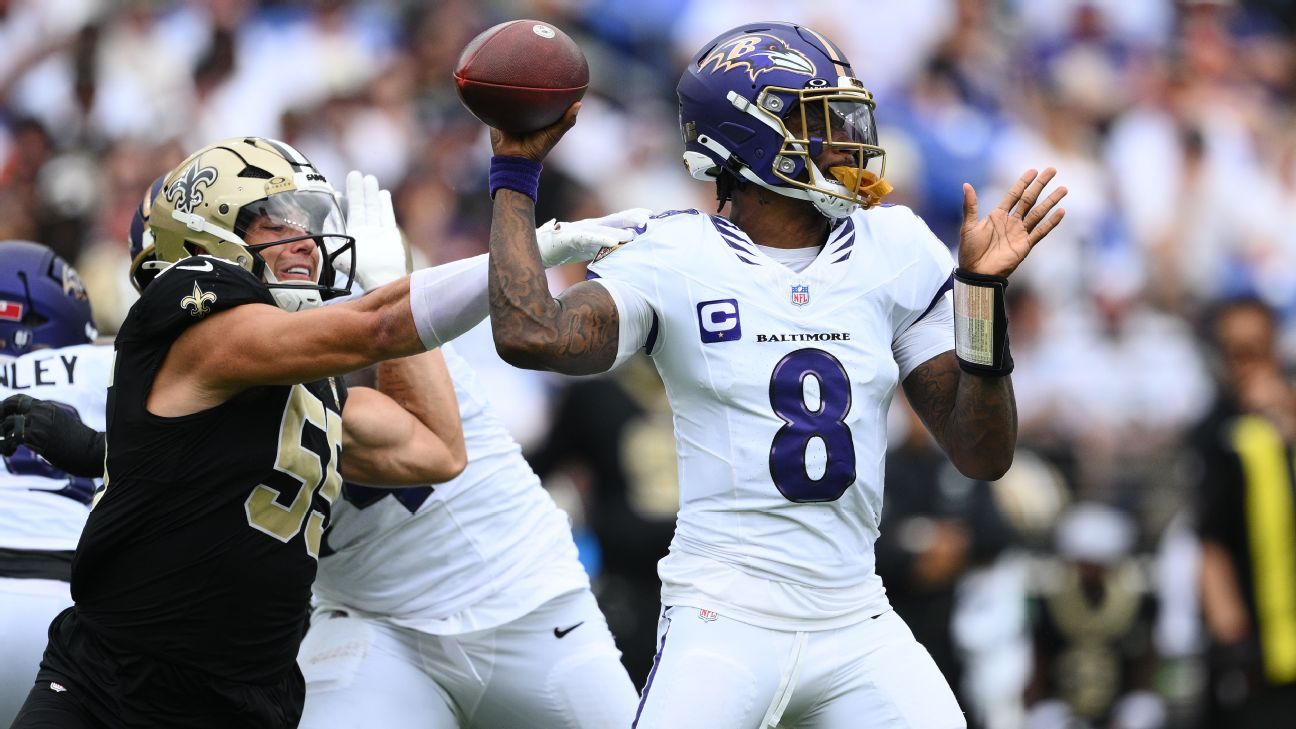
The Ravens looked like a Super Bowl contender in Week 1. By the final minute of Week 2, Lamar Jackson's deep ball sailed five yards past Rashod Bateman into the arms of Saints safety Julian Blackmon, and Baltimore's offensive momentum evaporated in one turnover. The 24-17 loss to New Orleans wasn't a close battle decided by field position or execution—it was a series of compounding errors that began with play-calling and spiraled into the kind of game film that coaches use as a cautionary tale.
Trailing by a touchdown in the fourth quarter with third-and-1 at their own 37-yard line, the Ravens dialed up a 50-yard deep shot to Chris Moore instead of handing the ball to Derrick Henry. The pass got batted away. That decision, more than any single stat line, defined the afternoon: a willingness to force the issue downfield even when the math and personnel dictated otherwise. Jackson finished the game with a pick, the offense committed multiple drive-killing penalties, and two key injuries—Zay Flowers (hamstring) and Ronnie Stanley (toe)—left questions about roster availability heading into a Week 3 matchup in Dallas. This wasn't the Ravens' offense misfiring against a superior scheme. This was Baltimore beating itself.
The prop market has already begun repricing Jackson and Henry for the stretch run. Jackson's passing yardage line will likely tick up slightly from where it opened, driven by recency panic—one bad game against a middle-tier Saints defense shouldn't alter the baseline. But there's a real mechanism at work that prop bettors should isolate: Stanley's injury could be serious. If the left tackle misses time, Jackson's time-to-throw decreases, his completion percentage typically falls 3–5 percentage points, and his rushing volume goes up out of necessity. That's not volatility; that's a structural change to the offense. Henry, by contrast, looked explosive in space and didn't deserve to be frozen out of a third-and-1 situation—his Week 2 performance argues for HIGHER rushing volume going forward, not lower. The market may paint Baltimore's entire offense as unreliable after one loss. The smarter read is that specific positional changes (left tackle health, receiver depth) drive the actual variance.
Dallas ranks middle of the pack in rushing defense but allows above-average pressure rates. If Stanley is out or limited, expect Jackson's rushing attempts to rise and his passing attempts to remain steady or decline. Henry should see elevated opportunities; the Saints game proved the Ravens know where their edge is, even if they didn't use it. Conversely, if Stanley returns healthy and Flowers clears the concussion protocol, Baltimore's Week 1 efficiency is the better baseline—not the panicked one-game snap.
The angle here isn't contrarian betting against the Ravens. It's drilling into the why behind the loss and separating correctable mental mistakes (bad play-call, forced throw) from structural roster changes (injury to a star left tackle). One fades; the other persists.