Kirk Cousins Wins Raiders QB Competition; Fernando Mendoza Benched Despite No. 1 Pedigree
By Justin Erickson ·
Las Vegas breaks a six-year streak of rookie first-overall picks starting Week 1, handing the job to a 38-year-old journeyman and signaling the front office's confidence in Cousins over their franchise-reset pick.
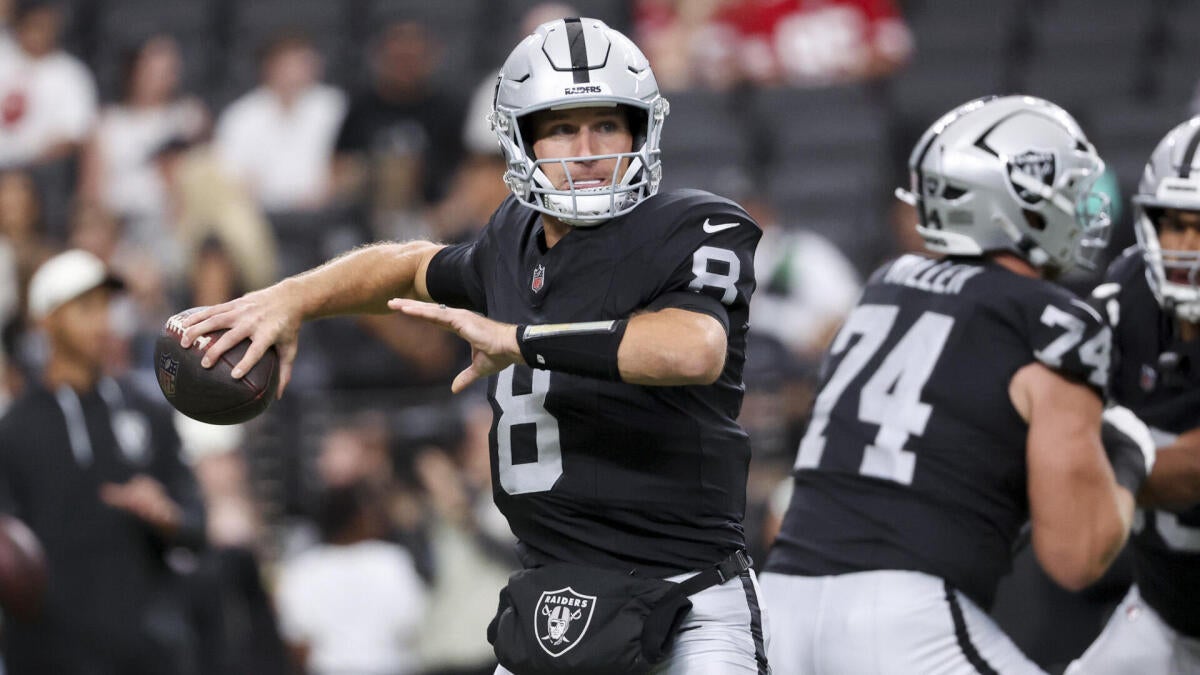
Klint Kubiak officially named Kirk Cousins the Las Vegas Raiders' starting quarterback on Wednesday, a week and a half before the Sept. 13 season opener against Miami. The decision closes what appeared to be an open competition but was rarely that—Cousins, signed to a one-year, $20 million free-agent deal, was always positioned as the bridge starter, yet his preseason performance and practice reps were so clean that Mendoza, the No. 1 overall pick, couldn't displace him.
Mendoza's camp was uneven. After an impressive preseason debut, he threw interceptions in both Week 2 and Week 3, completed just over 50% of his passes, and repeatedly struggled when working with second- and third-string blocking. Cousins, by contrast, completed 13 of 17 attempts (76.5%) across two preseason games for 101 yards and a touchdown—quiet, efficient work that didn't require a second conversation. Kubiak's stated reasoning—that Mendoza needs more repetitions and that practice snaps shrink once the season begins—is defensible on a developmental timeline, but it also acknowledges a reality: the rookie wasn't ready, and the veteran was.
The narrative weight here is significant. Since Baker Mayfield (2018) sat as a rookie, six consecutive first-overall QB picks have opened their season as Week 1 starters: Kyler Murray, Joe Burrow, Trevor Lawrence, Bryce Young, Caleb Williams, and Cam Ward. Mendoza breaks that streak, marking a departure from the modern draft strategy of "plug the generational prospect in immediately." Las Vegas's willingness to bench its capital prize suggests either that Mendoza's tape demanded it (plausible, given the interception samples) or that the franchise recalibrated its timeline (also plausible, given the low-cost bridge contract). Either way, it's a signal that Cousins—a 38-year-old who ranked 27th in EPA per play last season with Atlanta—is the safer play for Week 1 and possibly beyond.
For bettors, Cousins' Week 1 workload carries predictable downside. He hasn't been the high-volume passer needed to stack passing yards or touchdown props in a single game; last year, he appeared in 10 games for the Falcons and started just eight, averaging 215 yards per start and 1.25 TDs per game across a full season. Miami's defense, while not elite, is competent, and the Raiders' offensive line will be leaning on second-stringers early. Cousins' passing yards prop at likely 235–245 yards territory leans unders; his completion percentage (he finished 61% last season) will be a weak anchor for over-backs, though his TD floor is durable given a conservative play-calling approach under Kubiak. The real edge is in fading volume-dependent receivers like tight ends or slot receivers—Cousins distributes but does not elevate.
Mendoza's benching is equally relevant to the books. Backup rookie QB props are notoriously mispriced because the market assumes a seat-warmer role; if Mendoza enters the game (unlikely in Week 1, but possible in blowouts), the odds will swing wildly. More practically, any Raiders passing props priced on the assumption of a young, dynamic arm should shift lower. Cousins is a game-manager, not a playmaker. Week 1 totals at 45–47 points should lean unders, particularly if the Dolphins' defense commands even league-average respect.