NFL · milestone
McDaniel's Offense Could Slash Herbert's Hit Rate—and Reshape Chargers Passing Props
Justin Herbert took 225 sacks in six seasons under conservative scheme; Mike McDaniel's fast-release, motion-heavy system cut Miami's pressure rate to league-best levels and offers a structural fix.
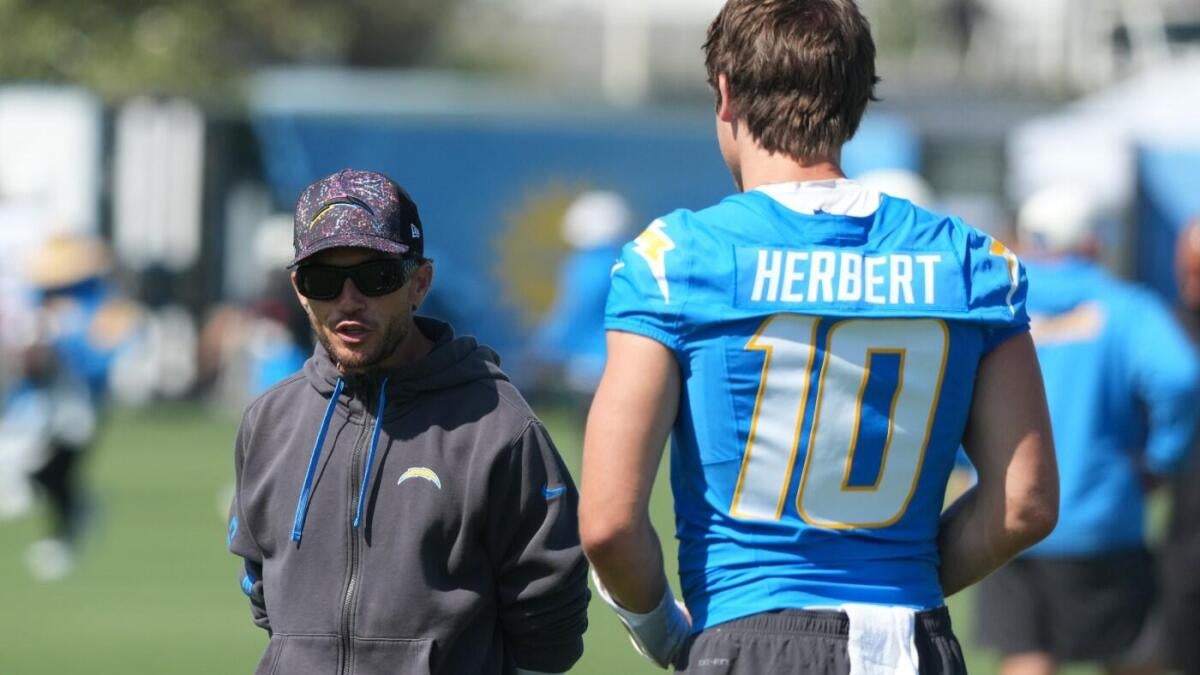
Justin Herbert got engaged to singer Madison Beer within the past week, and while the quarterback's personal stability is genuine cause for optimism, the more material shift for 2026 betting angles arrives on the sideline: new offensive coordinator Mike McDaniel, hired after four seasons as Miami's head coach, brings a systematically different approach to protecting one of the NFL's most-punished signal-callers. Herbert has absorbed 225 sacks and 615 hits since entering the league in 2020—the most of any quarterback in that span—including a Chargers single-season record of 54 sacks in 2025 when he also led the league in pressure instances (263) and hits (129). That damage profile doesn't reflect poor mechanics or decision-making alone; it reflects scheme architecture.
Under predecessor Greg Roman, the Chargers ranked 27th in quarterback pressure rate allowed (38.1%) and fifth-longest in average time to throw (3.06 seconds). McDaniel's Miami offenses, by contrast, surrendered the second-lowest pressure rate in football (29.5%) while operating at the league's fastest tempo, averaging 2.67 seconds per throw. Those aren't marginal deltas. A nine-yard difference in average time to throw compounds across 600+ pass attempts per season. McDaniel leans heavily on motion (his offenses ran 73.6% personnel motion from 2022-25, highest in the league), under-center looks, and zone-blocking schemes borrowed from his mentors Mike Shanahan and Kyle Shanahan—all designed to create quick reads, reduce the quarterback's time in the pocket, and neutralize edge pressure before it develops.
The Miami data carries real weight because it wasn't dependent on a single star player. In 2022-23, when Tua Tagovailoa and Tyreek Hill were healthy, McDaniel's offense averaged an NFL-best 6.3 yards per play. Over the last two years with injuries to both, Miami still posted 5.8 yards per play across four seasons, fifth-most in the league. That consistency suggests McDaniel's system is portable and robust, not a product of one personnel set. With Rashawn Slater expected to return after missing all of 2025 to a ruptured patellar tendon, and Joe Alt healthy (he missed 11 games in 2025), Herbert enters 2026 with both starting tackles available for the first time under Roman—and a coordinator whose entire philosophy revolves around keeping them from having to hold longer than 2.7 seconds.
For prop bettors, the implication is structural. Herbert's passing-yards prop should see modest downward adjustment if the market hasn't already baked in fewer drop-back opportunities and faster releases. His sacks-allowed season total is the clearer arbitrage: 2025's 54-sack pace was partially a function of bottom-five offensive line health and an ponderous scheme. McDaniel's system, operating at league-best pressure rates and with key defenders returning, should reduce that figure materially. Look for sacks-allowed totals to open conservatively, anchored to last year's extreme. They should compress as the season approaches and reporting confirms Slater's return and the offensive tempo's actual uptick.
Passers under McDaniel have also historically benefited from play-action efficiency—a direct output of his run-game credibility and motion volume. Herbert's yards-per-attempt should tick upward (he averaged 7.28 last season, solid but not elite). If books price him to duplicate 2025's usage patterns—roughly 670 pass attempts at the current pace—his total passing yards may look inflated relative to a faster, motion-heavy scheme. The edge exists in the gap between last year's desperation volume and this year's structural efficiency.