Strange Deal Signals Jaguars' Offensive Commitment—But Market Reality Says Otherwise
By Justin Erickson ·
Jacksonville locks in its tight end at eleventh-best money at the position, a valuation that reveals as much about the team's confidence as it does about the modern TE market's stubborn salary compression.
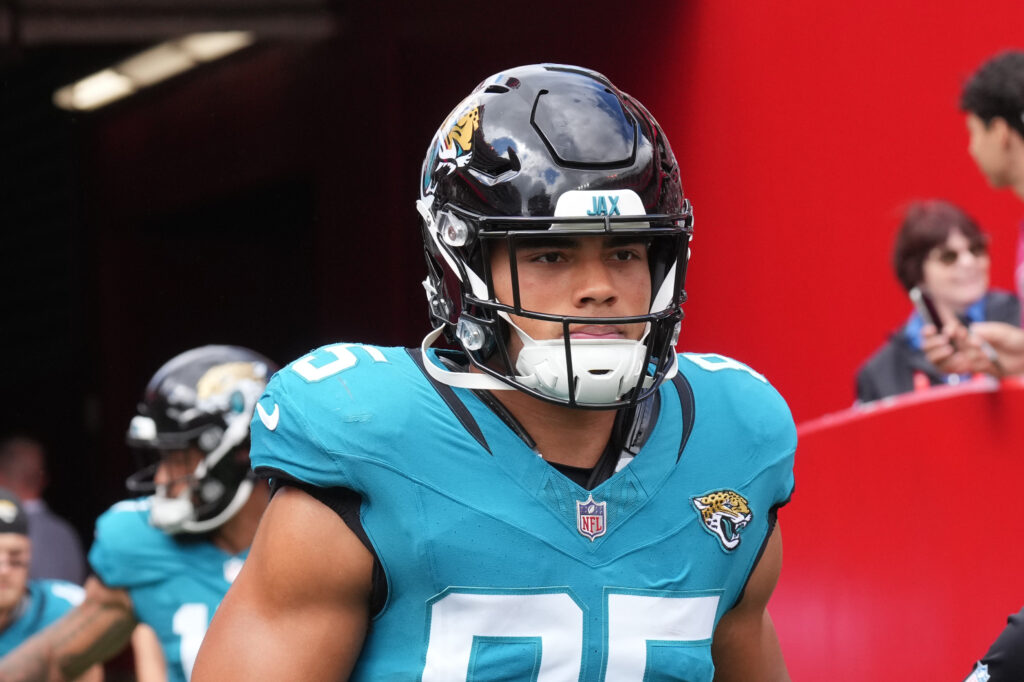
The Jaguars and Brenton Strange have agreed to a three-year extension worth $36 million in total value, with $17 million guaranteed at signing. The headline number masks a tighter picture: Strange's $12 million average annual value ties for 11th among NFL tight ends, a positioning that says more about organizational constraint than position-group scarcity. The TE market has crawled upward at a glacial pace in recent years, even as elite receiving talent at the position commands premium touches and red-zone opportunity. Strange, who entered the league as a third-round pick in 2022, has shown flashes of connectivity with Jacksonville's passing offense but hasn't yet produced the volume—or the consistency—that forces the market's hand.
The extension timing itself carries operational weight. This isn't a star-tier deal; it's a retention move on a player entering his fifth season with continuity value. Jacksonville's offense has leaned on Strange more in Year 4 than in previous seasons, and the team apparently believes he's part of a competitive window rather than an expendable asset. But the AAV tells you Jacksonville isn't bidding against itself. The guaranteed money is front-loaded ($17MM at signing), a structure that reflects prudent cap management and a lack of bidding-war desperation. Compare this to top-tier tight ends—the Kelces, the Andrews, the Pitts of the position if he'd developed as draft capital suggested—and the gap widens immediately. Strange gets paid as a solid professional, not a game-changer.
For bettors, this extension does little to shift Strange's receiving volume forecast for the 2026 season. The Jaguars' passing attack runs through its wide receivers and quarterback decision-making; tight end usage is situational and red-zone dependent. Strange has averaged 35 to 45 targets per season in his tenure, a floor that reflects his role rather than trajectory. The extension confirms he'll remain in the offense, but it doesn't guarantee increased snap counts or target share in a way that would move receiving prop lines. His receiving yards and reception totals have hovered in the 35-50 yard and 25-35 reception range depending on seasonal variance—a range consistent with a secondary receiving option rather than a focal point.
The real prop angle here is one of absence, not presence. If Strange had walked in free agency or been traded, his target vacancies would have redistributed across the Jaguars' pass catchers, potentially lifting receiving props for Jacksonville's wideouts. That redistribution won't happen now. His extension is a cap-efficient hold, meaning the money allocated to him was already baked into competitive-window planning. The market priced this deal fairly at 11th-tier TE wages because that's what the Jaguars' offense actually uses him for—not the potential upside his draft pedigree once suggested. Bettors should treat this as confirmatory, not catalytic: Strange will do what he's always done, within the volume bounds he's always worked.