NFL · injury
Kolar Stays Active but Unavailable; Chargers Scramble to Patch Tight End Rotation
A Monday reversal on Charlie Kolar's status leaves Los Angeles without its depth at tight end heading into Buffalo, forcing a practice-squad raid that reshapes Week 3 passing-game architecture.
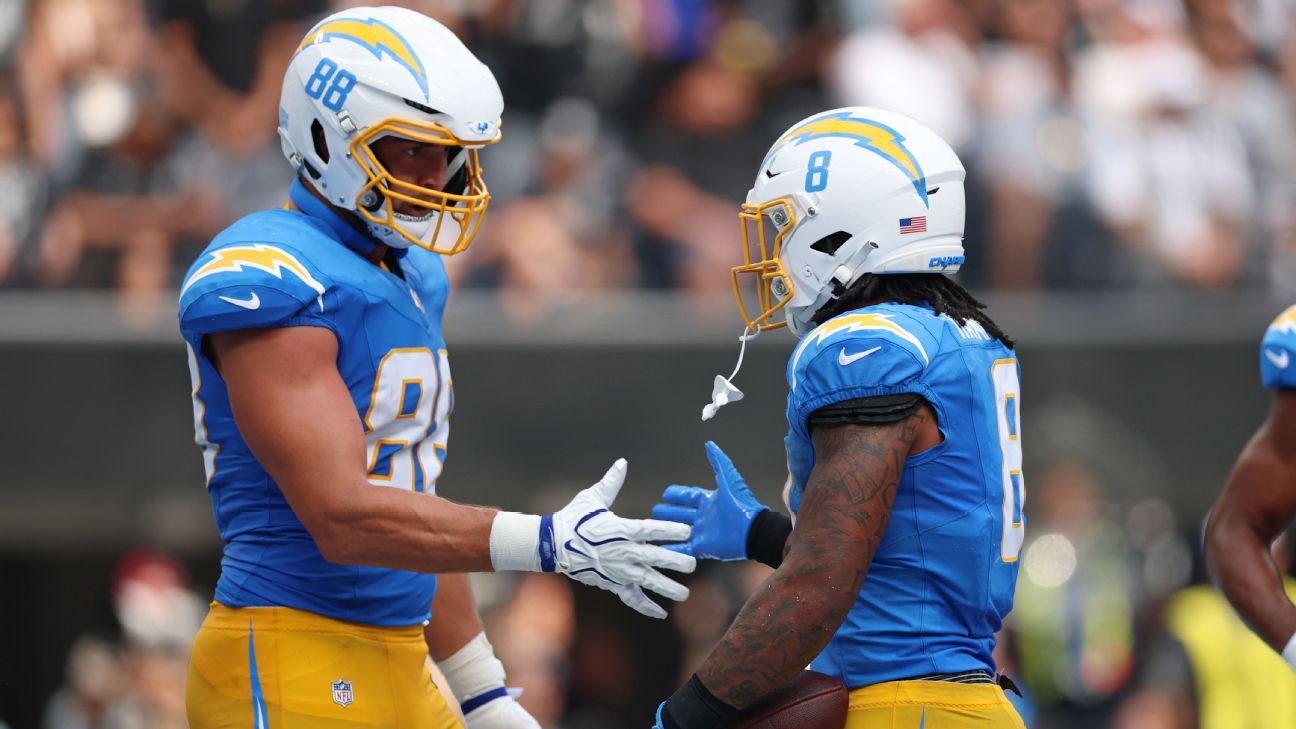
The Chargers initially committed to placing tight end Charlie Kolar on injured reserve Monday after he fractured his left forearm in Sunday's 26-14 loss to Las Vegas. Coach Jim Harbaugh announced the move alongside David Njoku's IR designation—a double blow to a receiving corps already struggling to function. But surgery altered the timeline. Kolar will remain active on the roster, sidestepping the 21-game window that injured reserve imposes. The cost: he is unavailable for Sunday's game against Buffalo and cannot practice Wednesday. That leaves Los Angeles running operative tight end Oronde Gadsden—a player Harbaugh's offense has already identified as a run-blocking liability—as the only healthy option at the position.
The roster move that followed tells the real story. Tuesday, the Chargers signed tight end Hayden Rucci off Jacksonville's practice squad. Rucci is not a backup. He is institutional knowledge on loan. He played four games in Miami last season under Mike McDaniel, who is now Los Angeles' offensive coordinator. This is the Chargers' system. Rucci knows the route tree, the blocking calls, and the tempo. McDaniel's scheme runs through play-action and tight-end deployment as leverage points. A competent run blocker at tight end is not supplementary—it is foundational to orchestrating the offense. Gadsden's deficiency in that area, Harbaull acknowledged indirectly by racing to the practice squad, has already constrained Los Angeles' run game and play-action fakes.
Rucci is expected to be ready to contribute Sunday. That means the Chargers are signaling he will carry meaningful snaps against a Buffalo defense ranked in the top half for pass-rush efficiency. For Los Angeles' Week 3 passing game, this is a material upgrade from the Gadsden-only scenario, but it is not restoration. Kolar and Njoku were supposed to be the receiving depth that allowed the offense to operate at full bandwidth. Now the Chargers are substituting institutional familiarity and scheming alignment in their place. On paper, that supports fewer passing attempts and lower completion percentages as the offense compresses to safer checkdowns—fewer explosive routes, more short stuff.
Bet-wise, the prop implication runs against pass volume. Justin Herbert's Week 3 passing-yards total and the Chargers' team passing total should reflect the absence of two credentialed route runners and the team's reliance on a practice-squad signing in a brand-new-to-the-system tight end two. Buffalo's defense ranks 6th in pass DVOA. McDaniel's offense is unlikely to open up the playbook when rotation pieces are missing. Herbert's completion percentage may also decline—fewer high-percentage targets available, higher reliance on scramble-and-pray moments. The line will price in the Njoku absence. It may not fully account for how Kolar's unavailability, even active status, throttles the intermediate receiving game that Chargers' offense needs to function.
Watch for early reporting on whether Rucci participates in any walk-throughs or positional drills Thursday or Friday. That timing, combined with the extent of Gadsden's snap count in Week 2, will tell you whether the Chargers are truly comfortable stretching him into heavy run-blocking duty or if they view Rucci as an immediate catalyst. If Gadsden is projected for 60%+ snap share in pass-heavy looks, fade overs on Herbert's completion and yardage props—the target distribution will be compressed. If Rucci is working into the game plan, the ceiling remains capped until at least Week 4.