NFL
Diggs' Young-QB Pedigree Resets Commanders' Receiving Math—And Daniels' Ceiling
Stefon Diggs signed with Washington to support Jayden Daniels in his sophomore push, but his track record with developing quarterbacks suggests the real edge lies in volume and scheme fit, not veteran mentorship alone.
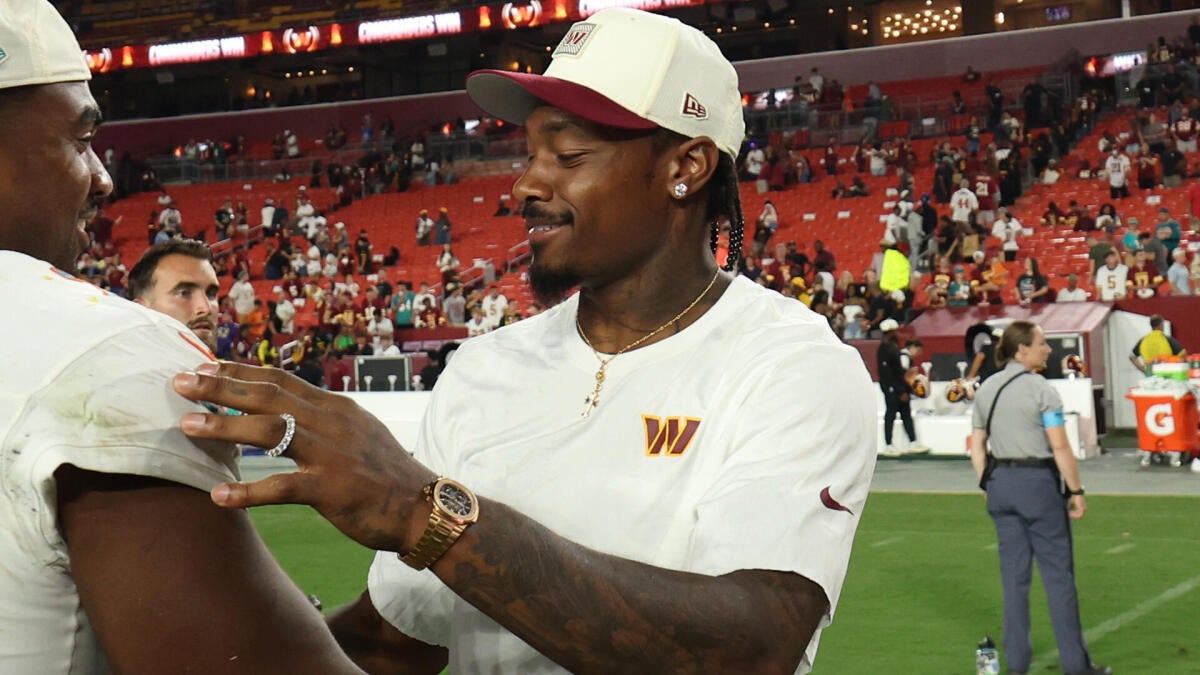
Stefon Diggs inked a one-year deal with the Washington Commanders worth up to $12 million, entering his fifth NFL stop—and his fourth consecutive team led by a quarterback in year one or two of their tenure. The signing pairs him with Jayden Daniels, a third-year starter preparing for his second full season after injury limited him to seven games in 2025. Dan Quinn, also in his third year as Commanders head coach, framed Diggs as an "incredible teammate" with elite football intelligence, a stabilizing presence in an offense learning a new system. The optics are clean: veteran receiver, young quarterback, playoff-caliber supporting cast anchored by Terry McLaurin. The reality of Diggs' career trajectory is sharper.
Diggs has never been a quarterback whisperer in the traditional sense. His presence doesn't elevate young signal-callers through tutelage—it elevates them through schematic opportunity. In Minnesota (2015-19), he benefited from a run-first offense that leaned on play-action and scripted spacing. In Buffalo (2020-23), Josh Allen's arm talent and mobility created vertical windows Diggs exploited relentlessly. With the Texans (2024) and Patriots (2025), he arrived into offenses built around them, not the reverse. What Diggs did provide those teams was immediate production and playoff credibility. The Vikings made the playoffs in his first year after missing in 2014. The Bills went from a first-round exit to an AFC Championship game appearance in his debut. The Texans and Patriots both made the postseason in his first season with each team—not because of Diggs' mentoring, but because the additions of star weapons (and in Houston's case, an elite young QB) completed talent rosters that were ready.
Daniels' 2025 season is the blueprint: 3,568 passing yards, 69% completion percentage, and 891 rushing yards as a rookie—the third-best passing volume for any first-year QB since 2010 by efficiency-adjusted metrics. He played most of the season without an elite WR2 after Deebo Samuel was traded to San Francisco. Now Diggs arrives as a proven 1,000-yard receiver with five consecutive seasons of 900+ yards. The Commanders' passing game ceiling just widened. But the betting implications require precision. Diggs' presence doesn't guarantee Daniels hits 4,200+ passing yards (the bar for a top-12 season)—it changes the distribution of how those yards get allocated. Last season, McLaurin absorbed 31% of team targets despite Samuel's volume. Diggs, per his career pattern, will draw 22-26% of targets in year one with a new QB, freeing McLaurin into more efficient leverage spots. That reshuffling favors higher efficiency (yards per attempt) over raw volume. When Diggs joined Buffalo, Allen's Y/A climbed to 8.1 from 7.4 the prior season, despite fewer total pass attempts. Daniels' Y/A was 7.8 last year—solid, not elite. Against a schedule ranked 16th in difficulty (vs. 8th last year), expect incremental volume growth paired with cleaner spacing. The prop-relevant trade: Daniels' over on passing yards at 4,000-4,200 becomes an efficiency play, not a volume spike. Target that line early in the season before market adjusts for Diggs' specific role.
NFL Intelligence — Football intelligence beyond the final score. Open NFL Intelligence →