Daniels Faces Another System Reboot Mid-Career as Commanders Gamble on Complexity
By Justin Erickson ·
Washington's second offensive overhaul in three years leaves its franchise quarterback learning on the job again, just as he builds momentum from a career-derailing injury season.
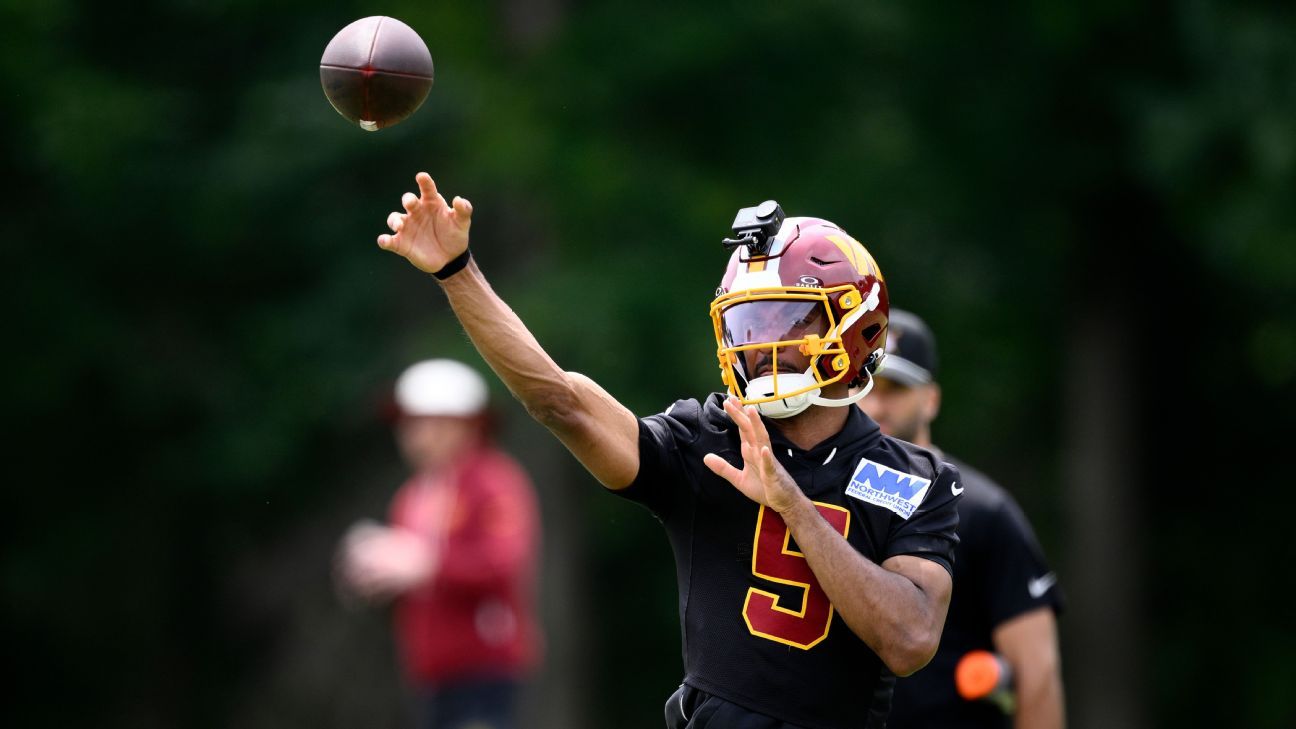
Jayden Daniels acknowledged Wednesday that he remains months away from commanding David Blough's new Commanders offense with fluency, a candid admission that underscores the organizational instability plaguing Washington's quarterback development. The system swap—from Kliff Kingsbury's no-huddle attack to Blough's under-center, call-and-response approach—marks the second major offensive overhaul in Daniels' three-year NFL tenure, forcing him to re-learn nomenclature, play-call logic, and pre-snap reads just as he emerges from a 2025 season that saw him play only seven games total due to sprained knee, hamstring, and dislocated elbow injuries.
The timing compounds the risk. Daniels' rookie year (2024) was exceptional—12-5 record, 3,568 passing yards, 25 TDs, 891 rushing yards—good enough to earn Offensive Rookie of the Year honors and push Washington to its first NFC Championship Game appearance since 1991. That production stamped him as foundational, capable of sustaining a playoff contender even without star receiver AJ Brown or secondary offensive weapons. Last year's injury gauntlet erased that momentum entirely: he threw for 1,262 yards (eight TDs, three INTs) across seven games and sat out the final four weeks after re-injuring his elbow in a 31-0 loss to Minnesota in Week 14. Kingsbury's dismissal and Blough's hire signal that Washington's brass believes execution and system familiarity, not talent, were the throttle.
The problem is real. A quarterback learning a third distinct system by his fourth NFL season is a red flag for decision-making consistency and precision. Under-center operations demand different footwork, different cadence processing, and different spatial awareness than spread-heavy schemes. Daniels said he's comfortable with the footwork mechanics but remains focused on "why we're attacking this play, what we want to do on this play." That's not foundation—that's construction. The coaching staff sees growth, but growth in June does not guarantee Week 1 readiness or mid-season command, especially when he's returning from multiple lower-body injuries that tend to linger into the regular season.
For prop markets, this cascades into three concrete implications. First, Daniels' passing-yards total should trade lower in Week 1 and open-month pricing than his 2024 pace would suggest—not because his arm talent has declined, but because system uncertainty typically tanks completion percentage and average depth of target in early-season windows. If sportsbooks price him at 250+ passing yards, the market is ignoring the friction cost of new terminology and decision-making speed. Second, his interception rate bears monitoring; quarterbacks in the first 4-6 weeks of a new system often spike their INT rate as they're still building automatic reads and feel for coverage rotations. Third, his rushing opportunities may decrease initially if the new system emphasizes pocket structure and under-center handoffs over scramble-friendly layouts—expect his rushing-yards props to come in well below his 2024 per-game clip (124.6 yards).
Daniels will become more dangerous as minicamp progresses into training camp and the preseason. The talent hasn't gone anywhere. But Week 1 and the first four games represent a tactical disadvantage that the market will likely underprice, especially if Vegas assumes his 2024 baseline rather than accounting for system drag and injury recovery overlap. Smart money will fade overs on his early-season yardage props and lean toward under-the-total team scoring until the Commanders' offense finds rhythm.