Commanders lose Okonkwo and Luvu for Dallas trip; defensive playcalling and pass-game efficiency take hits
By Justin Erickson ·
Washington's second-week absence of its starting tight end and primary linebacker upends both sides of the ball against a Dallas defense that has already shown vulnerability in coverage.
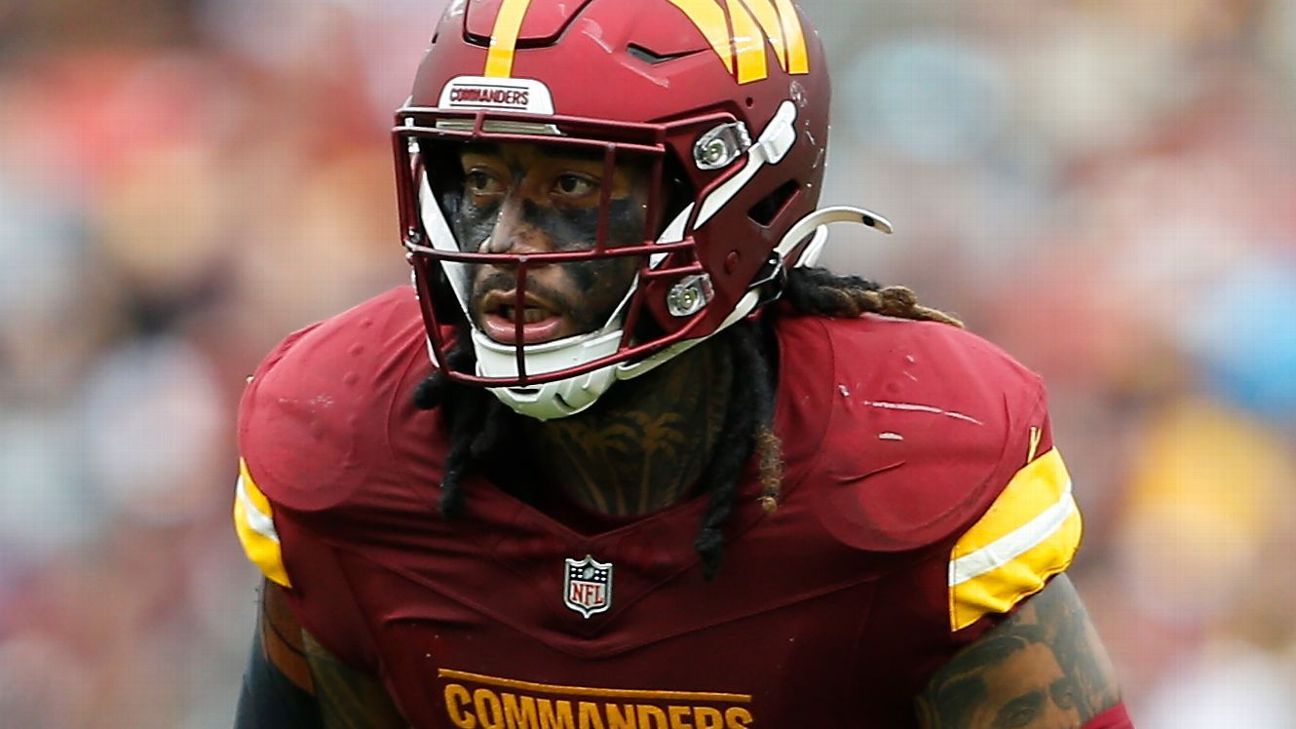
The Washington Commanders ruled out tight end Chig Okonkwo and linebacker Frankie Luvu for Sunday's road matchup against the Dallas Cowboys, marking the second consecutive week of forced defensive and offensive adjustments. Okonkwo suffered a hamstring injury in the closing stage of last Sunday's loss to Philadelphia; Luvu sustained a groin injury in the same game. Neither player has practiced since the injury, though both logged limited work with athletic trainers on Friday.
Okonkwo's absence creates an immediate void in Washington's pass-game architecture. The Commanders signed him in the offseason specifically to function as a secondary explosive option within play-action packages—the offense deployed three-receiver sets on 71.6% of snaps against the Eagles, signaling heavy reliance on vertical spacing and intermediate route concepts. With Okonkwo out, the tight-end rotation falls to John Bates (strong run-blocker, 74 career receptions across 83 games), Ben Sinnott, and Colson Yankoff, a pair of 2024 draft picks combining for just 18 career catches. The depth chart reflects a tight-end class that is not match-capable against man coverage or capable of separating on intermediate break routes. Dallas enters the game having seen early-season pass-catchers exploit soft zones; substituting a high-upside tight end for group-average receivers moves the needle on Washington's ability to execute timing-dependent concepts.
Luvu's absence reshapes the defensive makeup in a scheme that leans heavily on linebacker blitz packages. Coordinator Daronte Jones' system relies on linebackers as edge rushers and primary gap-fill blitzers—Luvu served as the defensive playcaller against Philadelphia and logged a sack in just two quarters of action before the injury pulled him from the game. The team will lean on Leo Chenal (signed as a free agent) and seventh-overall pick Sonny Styles (who sacked Jalen Hurts last week) as the primary inside linebackers, with second-year Kain Medrano filling the third spot. Jordan Magee, another linebacker, has already landed on injured reserve due to a hamstring injury earlier this week. The loss of playcalling responsibility and hands-on execution from Luvu—a 35-game starter since the 2024 offseason—transfers both communication and gap integrity to less-experienced voices in a critical defensive coordinatorship transition year.
From a betting lens, these absences press directly on team-total and passing-volume markets. Washington's offense already showed fragility against Philadelphia's interior pressure; without Okonkwo as a secondary read option and forced into heavier reliance on three-receiver distributions, the passing game faces compression. Dallas' front four has shown early-season burst—the Cowboys' pressure-rate ranked in the league's top tier through Week 1—meaning Washington's offensive line must handle a capable rush without the clock-consuming safety outlet that a receiving-threat tight end provides. Quarterback-to-receiver timing breaks or extended three-step progressions increase incompletion risk and sack exposure. Washington's team total and passing-yard projections should price in reduced offensive efficiency, not a marginal downward revision. The defensive side mirrors the vulnerability: Styles has tape against one opponent; Chenal carries free-agent understudy status into a Dallas attack built on screen passes and underneath route concepts that exploit coverage gaps. A second consecutive week of heavy substitution and in-game communication delays (Luvu's playcalling absence is material) suggests the Commanders' defense is not operating at full schematic execution.
Bettors tracking early-season team-total and passing-volume optics should view Washington's Sunday closing number with skepticism if it does not substantially adjust downward from opening. A 35-game starter at a critical coverage position and an offensive target signed specifically for play-action supplementarity represent two-fold structural damage that extends beyond single-player replacement value. The market often prices personnel loss at 2-3% efficiency dips; the timing (second-game execution phase for a new coordinator) and scheme-specific roles (playcaller, play-action release valve) warrant deeper adjustment. Dallas, despite early-week injury conversation around its own secondary, enters with a defensive scheme and personnel group already equipped to exploit tight-end and gap-assignment deficiencies.