Mayfield's Contract Standoff Creates Noise Ahead of Training Camp
By Justin Erickson ·
Baker Mayfield has set a hard deadline for extension talks with Tampa Bay, signaling potential distraction just as the Buccaneers rebuild their passing game without Mike Evans.
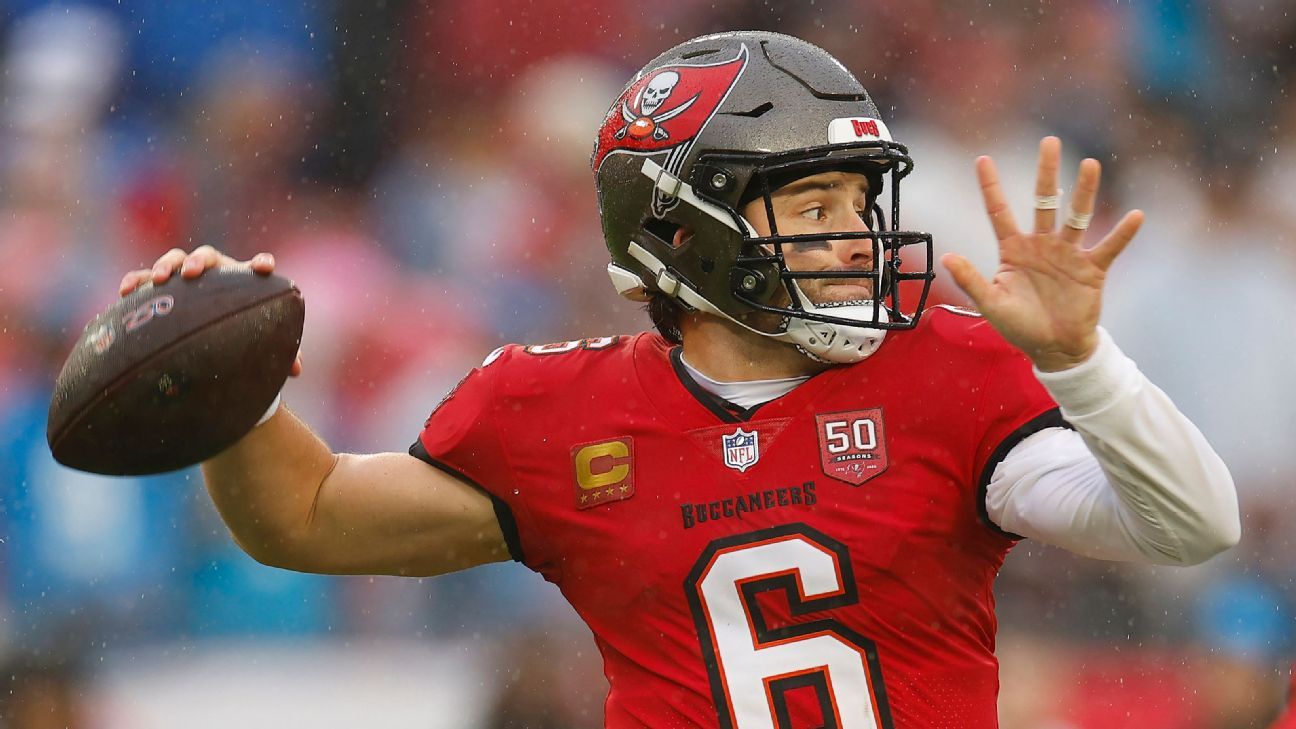
Baker Mayfield went public on the Buccaneers' stalled contract negotiations for the first time this offseason, declaring that talks are nowhere near his expectations and that he needs a deal done before training camp opens in late July. His agent, Tom Mills, has already provided that deadline to the organization—no contract discussions once pads go on. The message was direct: get it done by late July, or it doesn't happen until the season ends.
Mayfield is 52 days out from that training camp opener, and the gap between his ask and the Buccaneers' offer remains substantial. He's averaging $33.33 million annually, 16th among NFL starting quarterbacks, a ranking that understates his actual market value given the proven consistency he's delivered in Tampa over two seasons. The context matters: Sam Darnold just won a Super Bowl on a $33.5 million salary, yet Mayfield has been the more reliable quarterback over a longer sample. The Buccaneers' reluctance to close that gap signals they're either constrained by cap structure or unconvinced about long-term commitment to their rebuild—a distinction with real operational implications.
Then came the secondary blow: Mike Evans, the franchise's scoring leader and a sunk 12-year investment, signed with San Francisco in free agency. Mayfield called it disappointing and said he expected Evans to remain a Buc for life. That departure strips his receiving arsenal of its most dominant downfield weapon, forcing a strategic shift in how the offense operates. Chris Godwin, now the elder statesman of the receiver room at the start of his tenth season, becomes the focal point. The Buccaneers are betting Godwin can expand his role beyond his historical footprint—a reasonable expectation given his talent, but one that introduces operational risk if the transition stalls.
For prop bettors, the contract negotiation tension carries signal value. Mayfield's public stance—combined with the Evans departure and the compressed timeline until his deadline—creates the conditions for emotional volatility and distraction through training camp. A quarterback locked in a financial dispute while learning a new receiving corps can see his decision-making crisp deteriorate in structured practices. The Buccaneers' passing game volatility should increase over the next 52 days. Mayfield's completion percentage and yards-per-attempt figures are durable week-to-week, but intra-game variance and interception risk tend to spike when a quarterback is managing off-field pressure. The adjustment to Godwin as the primary target also tilts leverage toward shorter, intermediate patterns over the deep ball—a stylistic constraint that could suppress Mayfield's passing yards prop even if total volume holds.
Under Mayfield's contract deadline, bettors should anticipate elevated volatility in his individual passing props through late July. Once training camp opens without a deal in place, the noise likely persists through the preseason, making early-week Mayfield passing yards bets vulnerable to execution hiccups and mechanical rust. The market has already absorbed the Evans departure; what hasn't fully adjusted is the distraction tax on quarterback performance during an active contract negotiation in real time.