Ravens' Coaching Transition Meets Inflated Win Total: Why the Market May Be Pricing Continuity
By Justin Erickson ·
Baltimore swapped a legendary coach for an unproven one and finished 8-9; oddsmakers still expect 11 wins in 2026.
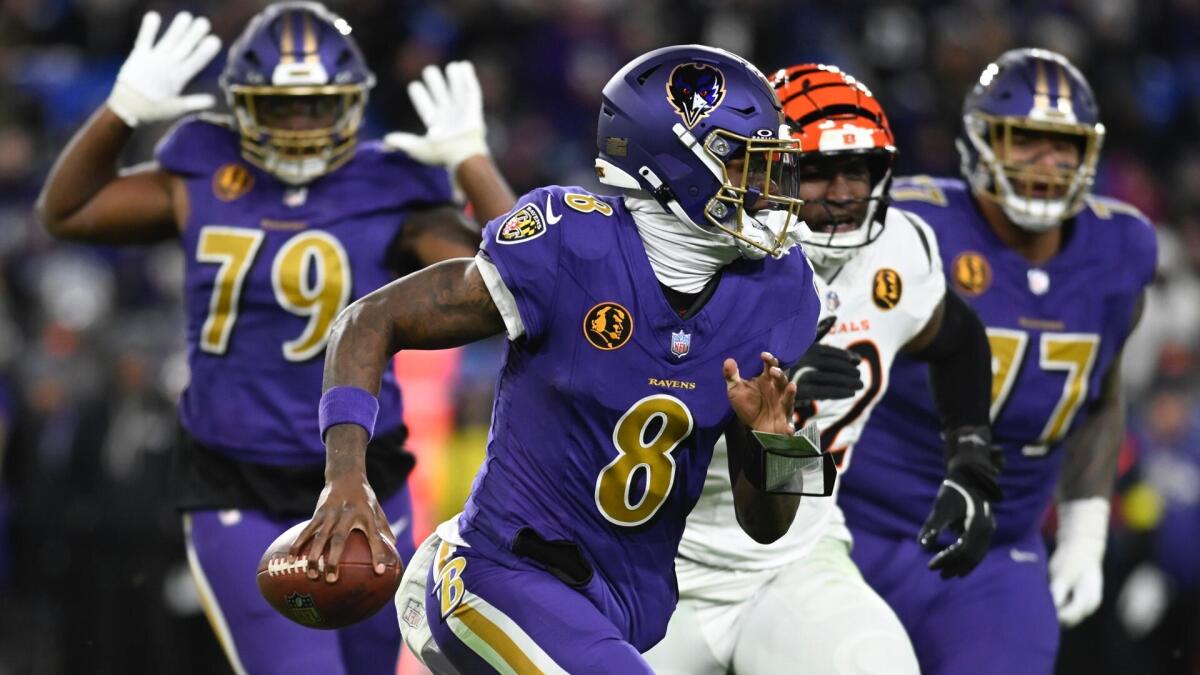
Jesse Minter takes over the Ravens organization for the first time as a head coach, stepping into the vacancy left by John Harbaugh's departure after 18 seasons. The continuity narrative dominates Baltimore's offseason positioning—Lamar Jackson remains, the roster was reinforced with edge rushers and interior linemen, and the market has pegged the Ravens' 2026 win total at 10.5/11.5, treating them as a near-lock to the playoffs at -380. But the 2025 tape complicates that complacency.
The Ravens stumbled to 8-9 last year despite Jackson's arrival as a perennial MVP candidate. More damning: Jackson went 6-7 as a starter, a sharp departure from his 70-24 career record entering the season. That collapse wasn't phantom bad luck—the defense, which had finished in the top nine in scoring for eight of the previous nine seasons, surrendered 37 points or more in four of the first five games. The pass rush ranked 31st in sacks per pass attempt. The offensive line, which led the league in yards per rush, ranked 29th in sacks allowed. These weren't close calls or marginal misses. They were categorical failures in both trenches.
Minter's offensive coordinator, Declan Doyle, inherits a passing game that struggled mightily in 2025. Todd Monken's departure removes continuity in play-calling precisely when the offense needed defensive stability to lean on. Anthony Weaver arrives as the new defensive coordinator, replacing Zach Orr, and the Ravens did address edge rush by trading for Trey Hendrickson and drafting Zion Young in the second round. On the interior, they added draft capital to reinforce the offensive line. These moves target 2025's specific weaknesses—but they don't erase the risk that Minter, a first-time head coach stepping in after a transitional coordinator shuffle, will struggle with implementation.
The betting market has priced the Ravens as if they're repeating a known quantity. The spread between 10.5 (-145) and 11.5 (+115) sits at 10.75 implied wins, assuming modest improvement. But that calculation assumes Minter navigates his first head-coaching season without friction, that Jackson returns to form immediately under a new offensive system, and that a rebuilt pass rush coheres before mid-season. First-time coaches historically post a 2-3 win regression relative to their predecessor's tenure, and that math doesn't show up in Baltimore's pricing. The Ravens' Super Bowl odds (+1000) are competitive with contenders that didn't collapse at the margins last season, yet the win-total market is behaving as though the 2025 stumble was a fluke rather than a symptom of structural strain.
From a wagering perspective, the Ravens' inflated win total becomes a leverage point. The under at 11.5 (-140) prices in near-certainty of a 12-win floor; the under at 10.5 (+120) offers cleaner value given the coaching transition and coordinator turnover. The market is extrapolating 2024's 12-win season forward without adequately discounting Minter's rookie status or the offensive line's unresolved center position. Edge rushers take 4-6 weeks to develop chemistry in a new scheme. A second coordinator in two years creates gap-and-assignment lag that historically compounds through Week 6. Baltimore's schedule and talent still support a playoff berth—the -370 playoff odds carry legitimate merit—but 11+ wins assumes flawless execution in Minter's debut, a bar that rarely clears.