Commanders 2026: The Collapse Narrative Obscures a Real Rebuild
By Justin Erickson ·
Washington's 5-win implosion last season reset expectations, but the division landscape and roster construction changes paint a messier picture than the win total suggests.
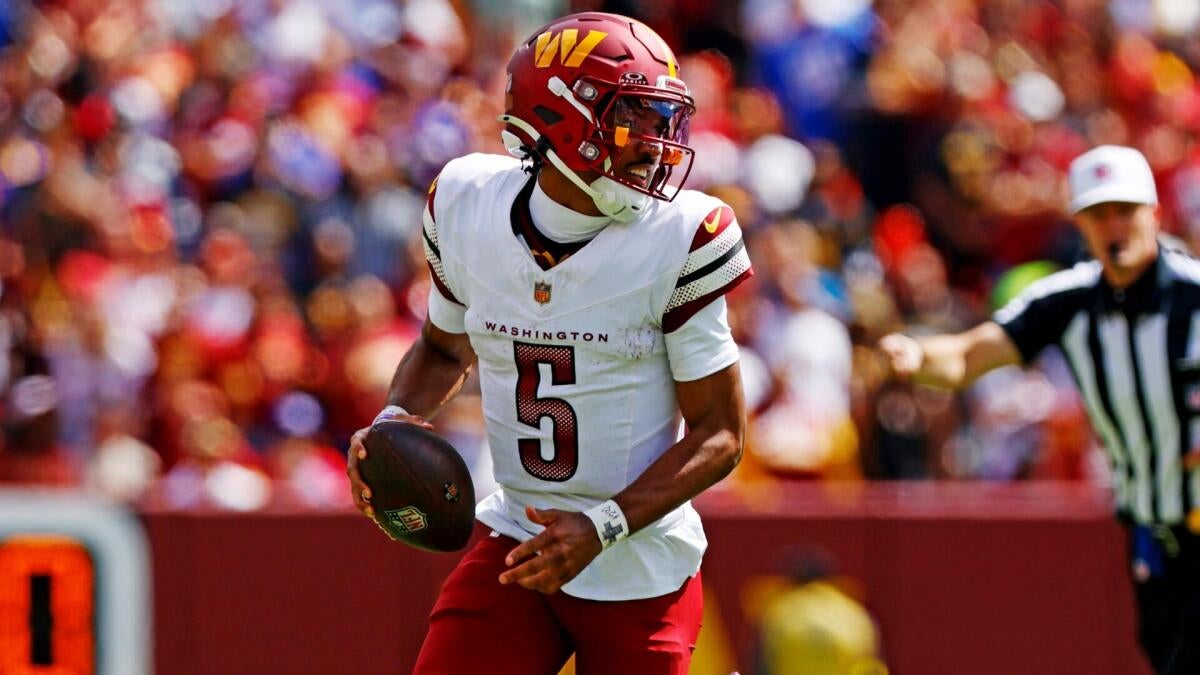
The Commanders bottomed out in 2025. After reaching the NFC Championship Game the prior season, they lost 10 of their final 12 games and finished 5-12, well below a 9.5 win total that looked reasonable in February. The narrative is straightforward: injury, regression, disappointment. But the 2026 outlook isn't simply a rebound story—it's a divot-recovery attempt in a suddenly unsettled division.
Start with the offense. Jayden Daniels missed 10 games last season and went 2-5 in starts, a brutal sample that masked Washington's actual efficiency metrics. The team ranked 12th in yards per play despite the absence; when Daniels was healthy, the offense had functional range. The arrivals of Rachaad White at running back and the mid-round drafting of receiver Antonio Williams suggest Washington is building complementary volume rather than chasing star power. Daronte Jones takes over at defensive coordinator—a hire that signals a more aggressive blitz package—while David Blough assumes offensive playcalling duties. These aren't glamorous upgrades, but they're internal-structure fixes aimed at execution rather than talent injections.
The division picture has shifted materially. The Cowboys, who dominated the NFC East's regular season before faltering in the playoffs, have spent offseason capital on defense. More important: the Eagles lost A.J. Brown to the Patriots in early June, a move that fundamentally alters the division's pecking order. Philadelphia's aerial attack loses its primary separation threat just as the Commanders are attempting to stabilize their secondary. The Giants added new coaching staff, which introduces volatility into a transitional roster. Washington's path to 8–9 wins (above the current 7.5 total) doesn't require dominance; it requires the Eagles' offense to miss Brown more than consensus expects and the Giants' coaching honeymoon to deliver modest gains, not sustained improvement.
The betting market has already begun repricing. The over on 7.5 wins carried -110 juice in February; it now sits at -125, a meaningful shift in conviction toward the positive case. The odds to miss the playoffs have remained static at -265, but that's deceptive—the underlying assumption is that Washington finishes 7–10, not 5–12. The offense's baseline metrics and Daniels' injury history create a ceiling; the weakness of the division creates a floor. Neither is especially high. A 7-win season (over the total) becomes the most probable outcome if health holds and the Eagles' offensive identity takes a genuine hit from Brown's departure. The book has already factored in some of that possibility, which means sharp plays require either a clearer view on Philadelphia's decline or a conviction that Daniels' full availability pushes the Commanders into the 8–9 range consistently.
The Super Bowl odds at +6000 remain lottery territory—Washington would need to win the weak NFC East and then navigate a playoff gauntlet with a mid-tier offense and a defense that just swapped coordinators. That's a longer shot than the divisional odds of +460 suggest. The real value in 2026 Commanders futures exists at the win-total boundaries, where market momentum is still adjusting to the Eagles' handicap and the division's compressed competitive window.