Odeyingbo's Summer Return Signals Chicago's Edge-Rush Gamble
By Justin Erickson ·
The Bears are betting on internal pass-rush development rather than external talent, making Odeyingbo's Achilles recovery a linchpin for their defensive front.
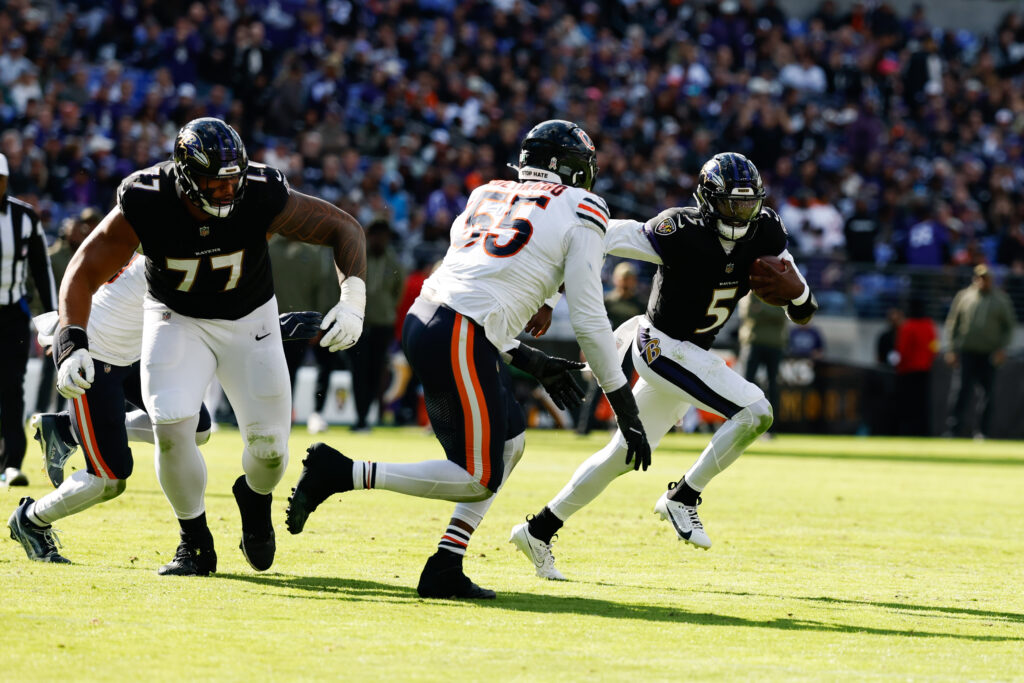
Dayo Odeyingbo will participate in the Bears' training camp this summer, defensive coordinator Dennis Allen confirmed, marking the sixth-year veteran's first full practice window since tearing his Achilles in 2025. The recovery timeline is aggressive—Odeyingbo signed a three-year, $48 million deal last offseason and carried just one sack, six pressures, and four quarterback hits before the injury shut down his debut season in Chicago after eight games. Allen's statement that Odeyingbo will "definitely be in the mix" is measured language, but it signals the organization believes he can contribute at defensive end by September.
The real story isn't Odeyingbo's return; it's what his absence forced the Bears to confront. Chicago's pass rush collapsed last season. With Montez Sweat as the only reliable edge anchor, the supporting cast—now centered on Austin Booker, Shemar Turner, and the returning Odeyingbo—carried minimal production. The Bears haven't made external splash signings. Defensive coordinator Dennis Allen has Cameron Jordan connections from New Orleans, but a reunion hasn't materialized. Instead, Chicago is banking on internal evaluation and development. That's a tacit admission that the front office overestimated what it had in 2025 and is now watching the clock on a $16 million guaranteed commitment to a player coming off a long-term injury.
Odeyingbo's pre-injury 2025 tape was pedestrian—one sack in eight games doesn't pass as a rotational starter. Achilles injuries typically produce a 12-18 month recovery arc before full explosiveness returns. Training camp participation by July is optimistic but feasible; game-ready performance is another matter entirely. The Bears are signaling they'll use the evaluation period—August exhibition games—to assess whether Odeyingbo can regain his burst. His burst is the only edge he ever had. In Indianapolis, where he signed his initial contract as a fifth-round pick, Odeyingbo flashed sack production in specific situations: when defenses were caught in coverage breakdowns or when he faced smaller tackles. He is not a scheme-independent pressure generator.
From a prop perspective, Bears team sack totals and Montez Sweat's individual sack prop represent the edge-rushing bet on Chicago in 2026. If Odeyingbo returns to 60-70% functionality (a realistic midpoint), the team's sack volume may improve 5-8% over last season. But if he stays in the 40-50% range—cautious usage, limited snap count—the onus remains entirely on Sweat, and the pass rush bottlenecks again. Sweat's individual sack line will price in either scenario; the market likely assumes Odeyingbo is a wildcard rather than a reliable contributor. That mispricing favors Sweat unders if Odeyingbo's snap count is limited, and team-sack unders if the Bears' edge group remains anemic despite the addition.
Watch training camp tape and the first two exhibition games carefully. If Odeyingbo logs 20+ snaps with visible lateral quickness, the Bears' edge count improves. If he's eased in—10-15 snaps, heavy rotation—the team is managing the injury and doesn't expect him to carry load until October at earliest. Early camp reports will price into Week 1 lines fast. The edge lives in the gap between "healthy training camp participation" (which Allen just confirmed) and "productive NFL snaps" (which is a much higher bar for a 26-year-old coming off an Achilles tear with minimal runway to game speed).