NBA
Williams Returns From Hamstring, But OKC's Timing and Usage Risk Complicate the Narrative
Jalen Williams checked in for Game 6 after three missed contests, but his return as a reserve and the Thunder's offensive rhythm raise questions about immediate fantasy and prop-market overreaction.
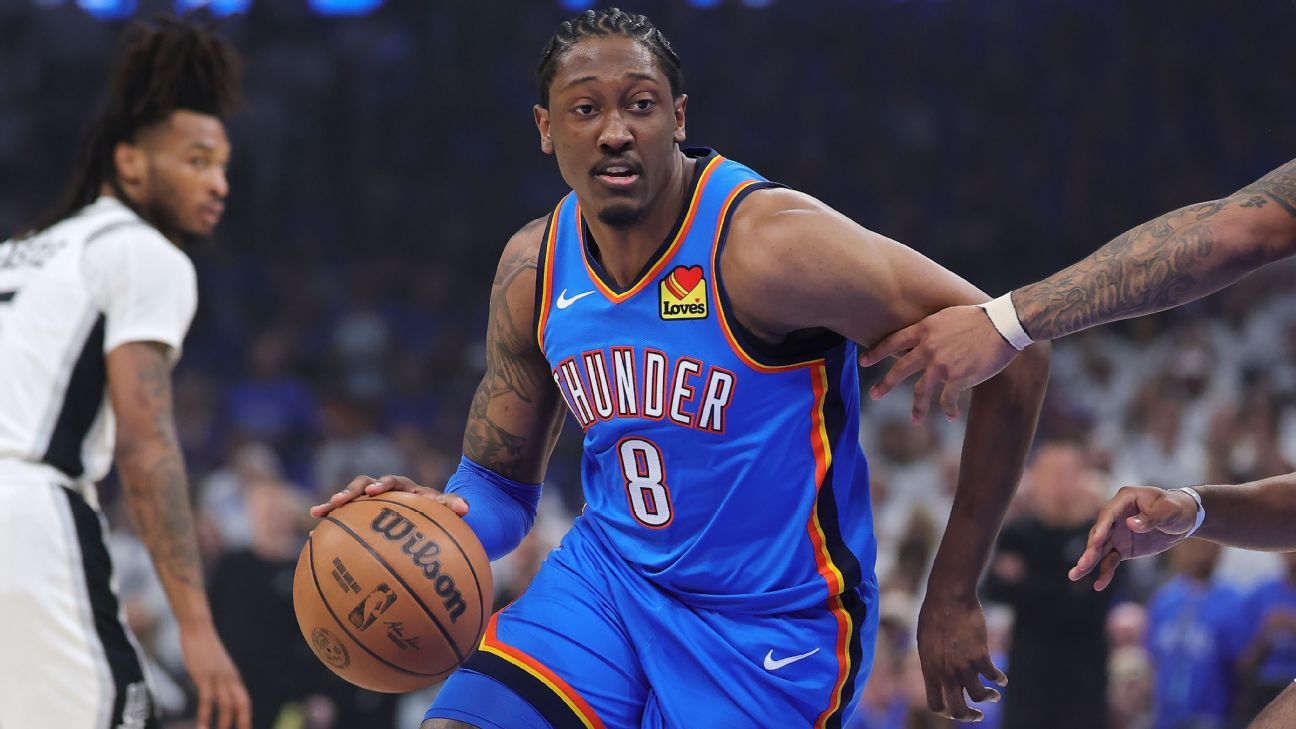
Jalen Williams is active for Oklahoma City's Game 6 against San Antonio after a three-game absence due to a left hamstring strain. The Thunder upgraded him to available minutes before tipoff and inserted him into the game with 4:13 left in the first quarter, coming off the bench for the first time since December 2022. Oklahoma City kept its Game 5 starting lineup intact with Jared McCain holding Williams' usual wing spot, a structural choice that signals cautious deployment rather than a full reinstatement.
Williams' injury history this season undercuts any assumption of immediate, full-load return. He missed 19 games in the regular season recovering from offseason wrist surgery, then suffered multiple hamstring strains—first the right, which he aggravated, then the left that sidelined him for three consecutive playoff games. His playoff sample before the injury was explosive: 26 points, 7 rebounds, 3 assists in Game 1's double-overtime loss, followed by 19 points and 4 assists in just 23 minutes in Game 2 before the strain occurred. That production level, however, came in specific contexts: high usage in competitive or desperate game states, not in a Thunder system managing load and playoff longevity. The team's decision to keep McCain in the starting role for Game 6 suggests the coaching staff is building back Williams' involvement incrementally rather than expecting him to absorb 35+ minutes immediately.
From a prop standpoint, the market's initial reaction will likely overcorrect on Williams' return. Sportsbooks will price his points, assists, and PRA lines based on his pre-injury averages or his Game 1 explosion, but Game 6 deployment context matters as much as health status. If Oklahoma City is protecting him on a minutes restriction—a reasonable assumption given the injury timeline and playoff structure—his ceiling shrinks. A 20-25 minute outing produces roughly 60-70% of his full-game scoring expectation, yet opening lines often price in closer to 80-85% based on historical averages. This creates an under bias on his individual scoring and assist props if usage is capped. Conversely, if the Thunder are desperate (down in the series) and unleash Williams fully, the over becomes valuable. Checking the series state before placing bets is critical: a tie series with home-court advantage remaining differs materially from a do-or-die scenario.
The Thunder's offensive structure also matters. McCain held the starting spot for Game 5, meaning he's been the primary ballhandler and perimeter creator in Williams' absence. When Williams re-enters, he either replaces McCain's touches (creating assist upside if the offense cycles through him) or shares the offensive load (creating usage fragmentation). The recent game film will clarify which path the Thunder took. If McCain maintained elevated playmaking responsibility even with Williams active, expect assists to consolidate back toward Williams at a higher rate in subsequent games—but not immediately in Game 6. The first game back is typically about rhythm establishment, not peak output.
The durability concern is real and persistent. Williams has played 33 games in a 82-game regular season due to multiple soft-tissue injuries. Hamstring strains, once incurred, carry elevated re-injury risk for 2-3 games post-return. The market will price his Game 6 availability as binary—healthy and available—but the probability of a reaggravation in the next 48 hours (Games 6 and 7, if necessary) is non-trivial. This creates a natural fade on his volume-based props for the next two games unless the line moves substantially to reflect that risk. If his Game 6 assist line opens at 6.5, that's a reasonable fade; if it drifts to 5.5 after market digestion of the limited minutes, you have a different evaluation.