Wembanyama's Game 1 Demolition Exposes Thunder's Defensive Ceiling in Western Finals
By Justin Erickson ·
Victor Wembanyama's 41-point, 24-rebound masterclass in double overtime wasn't just a scoring outburst—it was a systematic breakdown of Oklahoma City's rim protection that carries hard limits for a defending champion.
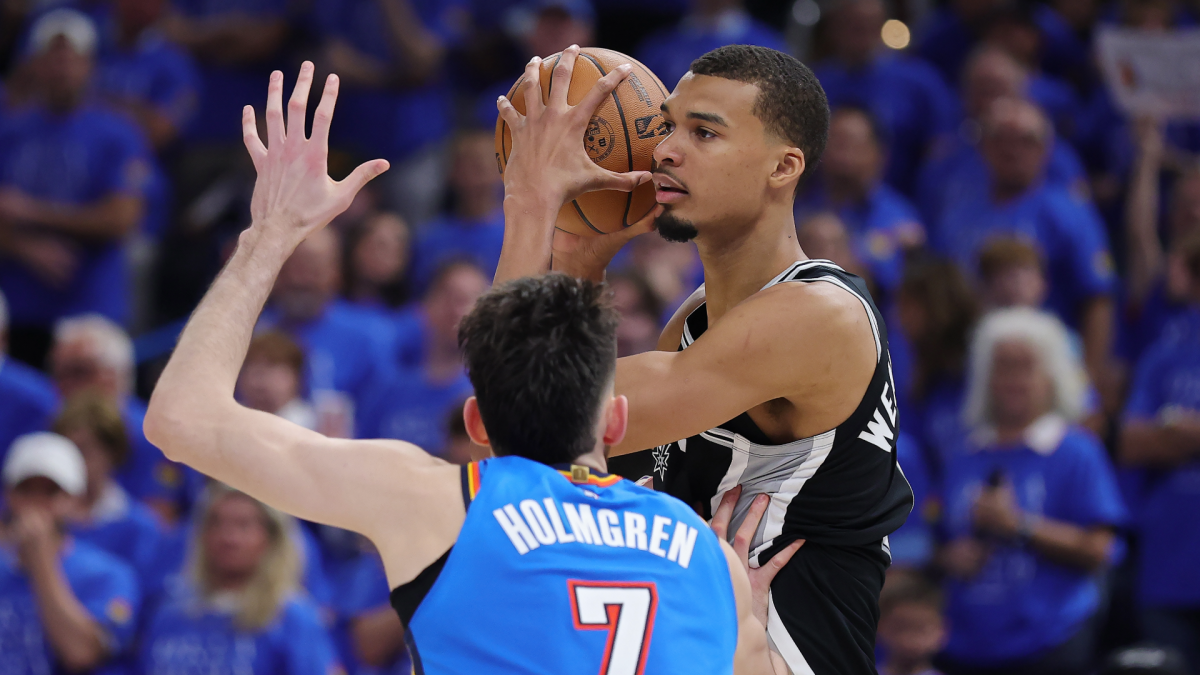
Victor Wembanyama authored one of the most complete playoff performances in recent memory in Game 1 of the Western Conference Finals, dropping 41 points and pulling 24 rebounds on 14-for-25 shooting while forcing the Thunder into double overtime. The efficiency—92% from the free-throw line, clinical footwork in the paint, and a late-game corner three that felt almost dismissive—painted a picture of a player operating at a different altitude than everyone else on the floor.
But the real story isn't Wembanyama's dominance in isolation. It's what his performance revealed about Oklahoma City's structural vulnerability when forced to defend him without adequate rim-anchoring bodies. The Thunder cycled through Isaiah Hartenstein, Jalen Williams, Lu Dort, and even Alex Caruso in a last-resort switching scheme reminiscent of how they deployed Caruso against Nikola Jokic in last year's postseason. None of it gained purchase. Wembanyama systematized his offensive diet: he bullied defenders in transition, took what the Spurs' pick-and-roll gave him in the mid-range, and when Oklahoma City compressed paint defense, he stepped out for threes with the kind of range that doesn't belong on a 7-4 frame. The Thunder's five regular-season losses to San Antonio weren't statistical noise—they were a pattern warning that their defensive identity has a hard ceiling when matched against this specific skillset.
Holmgren's ineffectiveness in the matchup underscores the problem. In four regular-season games against the Spurs, the Thunder's defensive anchor averaged just 10.5 points on 38.7% shooting, and Game 1 compression only deepened that gap. Holmgren took seven shots total in a full game that extended to 50 minutes of play. He wasn't being punished for poor defense; he was being systematically neutralized on offense because Wembanyama's gravity collapses double teams. When San Antonio runs their core offensive set—Wembanyama as the hub in a five-out scheme or rolling hard downhill—Oklahoma City has no answer that doesn't require sacrificing perimeter floor spacing. Holmgren can stay home on shooters or he can stay attached to the Spurs' center, but not both.
For prop bettors, the implications are sharp and actionable. Wembanyama's points total should see material support moving forward; the source of his production (live-ball opportunity generation through forced help rotations) is structural to this matchup, not contextual to a single game's variance. A 41-point outburst in double overtime could read as a ceiling, but the mechanism—OKC's inability to defend pick-and-roll rim runs without surrendering spacing—persists across game length. Expect Wembanyama to land in the 35+ points range for Game 2 at standard -110 or better; the market may initially overcorrect to the Game 1 performance as an outlier, meaning early-series numbers carry value before adjusting down. Conversely, Holmgren's inability to generate offense when defending Wembanyama translates to a fade on his total points prop. His seven-shot diet in Game 1 wasn't an anomaly—it's the natural byproduct of defensive assignment and offensive opportunity drought. If OKC forces ball movement to counteract San Antonio's spacing advantage, Holmgren becomes a role player, and his per-game scoring floor compresses further.
The Thunder's five losses in six matchups against the Spurs this season, now reinforced by Game 1's playoff evidence, suggests this series will follow the same script unless Oklahoma City finds an entirely different defensive architecture. They won't. That makes Game 2 a high-confidence lean toward Wembanyama floor props and away from Holmgren volume-dependent lines.