SGA's Second MVP Crowns Oklahoma City's Dynasty—and Sets the Stage for Holmgren's Postseason Emergence
By Justin Erickson ·
Shai Gilgeous-Alexander's back-to-back MVP validates the Thunder's championship core, but the real playoff story is Chet Holmgren's two-way explosion—and what it means for how defenses will attack Oklahoma City in the West Finals.
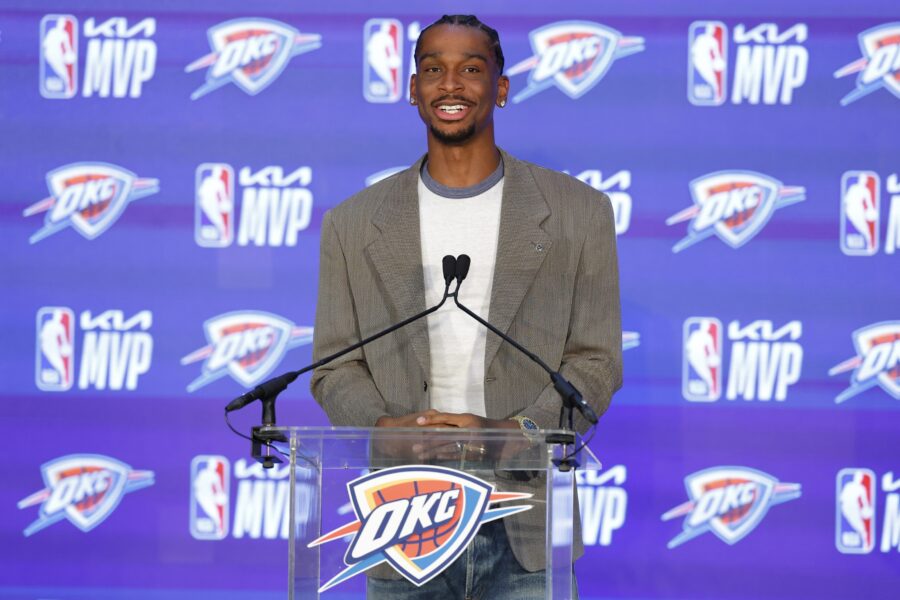
Shai Gilgeous-Alexander won his second consecutive MVP award Sunday, joining an elite tier of guards—Steve Nash, Wilt Chamberlain, Bill Russell, and Giannis Antetokounmpo—to claim the honor twice in succession. It's a personal validation for the Canadian star, but the award itself is merely punctuation on what the Thunder have already accomplished: a championship last June, a 60-win regular season, and a franchise now measured against the elite dynasties in league history. In his acceptance speech, Gilgeous-Alexander spent more time crediting teammates, coaching staff, and the people who sacrificed for him than discussing his own statistical dominance. That reflexive team-first framing matters—it's the operational philosophy that built this roster.
But the MVP narrative obscures a more urgent playoff reality: Chet Holmgren is performing at an All-NBA level right now. Through eight postseason games, Holmgren has averaged 18.6 points, 9.1 rebounds, and 2.2 combined blocks and steals on elite efficiency—.600/.387/.885 shooting—across 31.4 minutes per night. He's still managing the residual effects of a fractured hip sustained during last year's title run, yet he's become Oklahoma City's most disruptive rim defender and most reliable interior spacer when the offense needs a release valve. This isn't a complementary role player running hot; it's a 22-year-old All-Star entering his peak years and proving it in the hardest minutes of the year.
For bettors, Holmgren's emergence creates a direct valuation problem in the Western Conference Finals against San Antonio. The Spurs will likely attack Holmgren's interior coverage and ask him to defend in space—the traditional way to exploit elite shot-blockers. But Holmgren's .387 three-point mark (24 attempts) shows he's no longer an offensive liability on the perimeter. More critically, his 9.1 rebound rate per game in the postseason (36% contested) suggests he's winning physical battles despite the hip concern. Books priced Holmgren's player props—points, rebounds, blocks—on 2025-26 regular-season baseline; the postseason tape shows him operating at higher leverage and volume without declining efficiency. Early lines may not yet reflect how San Antonio's switch-heavy defense will funnel usage toward him.
The mechanism: Holmgren's assists are likely to rise if San Antonio dares to leave him unguarded on the wing—a tactical error against a .387 three-point shooter who's also a credible passer from the perimeter. Simultaneously, his block rate should climb because San Antonio will lack a traditional rim-runner capable of getting to the basket against Oklahoma City's layered interior defense. If Holmgren's offensive touches and defensive assignment window both expand, his 18.6-point playoff average could settle at 19.5–21 real quick. Rebounds are stickier—he's already averaging 9.1 and the Spurs' second-unit bigs lack the size to contest him. The edge here is temporal: early numbers (likely 17.5–18.5 points, 8.5–9 rebounds) are built on the regular-season profile. That margin compresses as San Antonio's game plan clarifies. This is a multi-game pattern, not a single-outlier spike, so the edge persists through Game 2 at minimum before overcorrection.
Gilgeous-Alexander's MVP is ceremonial proof of what Oklahoma City already knew. Holmgren's postseason explosion is the real strategic vulnerability—and the real betting angle—heading into the Finals.