Goodwin's Shooting Leap Resets Suns Rotation Math Heading Into Free Agency
By Justin Erickson ·
Jordan Goodwin's career-year three-point stroke creates a contract negotiation problem for Phoenix—and a targeting opportunity for prop bettors watching minutes allocation shift.
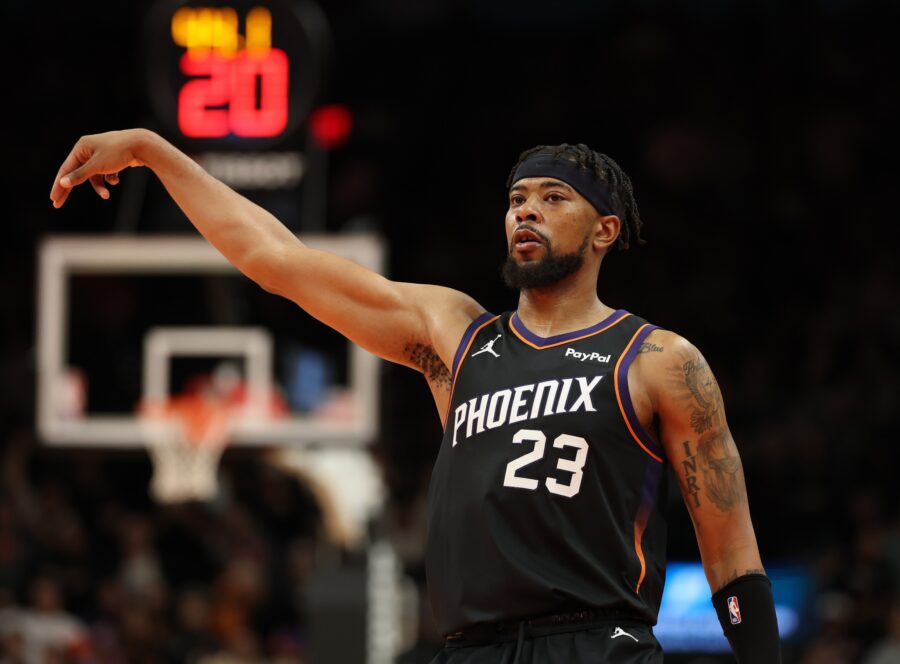
Jordan Goodwin enters unrestricted free agency on the strength of a statistical inflection point that Phoenix now has to price into its offseason payroll. The 27-year-old guard flipped his profile this season, connecting on 37.1% of his 4.3 three-point attempts while averaging 8.7 points, 4.9 rebounds, and 1.5 steals across 70 games at 22.5 minutes per night. That's a dramatic departure from his first three years in the league, when he shot 30.2% from three and 45.8% on twos—a wing profile so limited that he was primarily valued for perimeter defense and rebounding grit, not offensive creation.
The Suns now face a structural problem. They want to retain Goodwin as part of their defensive-intensity identity, but they're locked into re-signing Collin Gillespie and staring down a luxury-tax bill that will force hard decisions on restricted free agent Mark Williams. Goodwin's asking price—projected between the bi-annual exception ($11.23MM over two years) and the upper bound of $7-9MM over three or four years—sits in a gray zone where the team values him more than the open market historically has. The Suns have signaled three paths forward with Williams: a team-friendly re-sign, a sign-and-trade, or a clean split. That flexibility on the center position may be where the prop angle emerges.
If Phoenix lets Williams walk or moves him in a sign-and-trade, bench rotations compress. Goodwin's 22.5 minutes represent a secure role, but that baseline could contract or expand depending on whether the Suns bring in replacement depth at center or lean more heavily on guard versatility to cover the five. The shooting improvement is real—37.1% from three on higher volume is not noise—but the market's pricing of that improvement is still catching up. Books currently slot Goodwin's per-game prop lines based on his seasonal floor (8.7 PPG, 4.9 RPG). If the Suns front-load his role in a smaller rotation, that volume could tick upward; if they shave minutes to accommodate free-agent additions, it flattens.
The betting implication isn't about Goodwin's talent trajectory—it's about the allocation signal baked into Phoenix's free-agency decisions. A Goodwin re-sign at $7-9MM signals the team wants continuity and is willing to absorb the tax hit; that usually means stable playing time and higher per-game volume. A sign-and-trade of Williams for a more cap-efficient option signals minutes compression across the guard group. Watch the Williams decision. It tells you whether Goodwin's season-long per-game floors hold or reset downward in 2026/27.
Gambadoro reported that the Suns have no interest in pursuing Aaron Gordon, and Bourguet's sources flatly dismissed speculation on Giannis Antetokounmpo or Ja Morant as baseless. Those non-moves frame a team treading water on the margin: they're optimizing their current core, not swinging for a star upgrade. That posture favors players already in the rotation—like Goodwin—as long as the payroll algebra works. If it doesn't, his minutes take the hit first.