Jordan Walsh's $15M Extension Signals Celtics' Quiet Confidence in Depth
By Justin Erickson ·
Boston locks in a breakout rotation piece as it pivots around the Jaylen Brown trade, reshaping how it distributes offensive load.
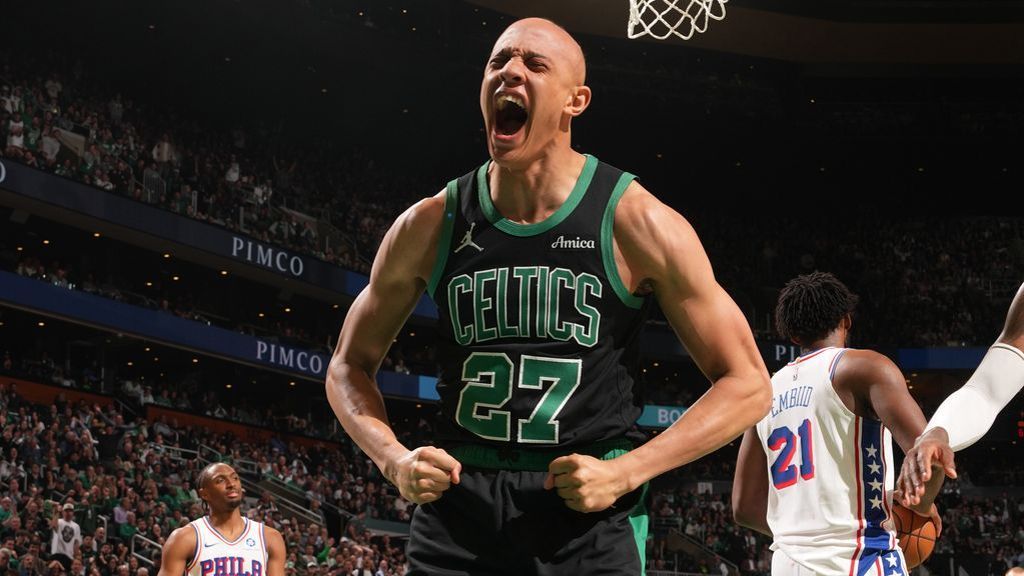
Jordan Walsh and the Celtics agreed to a three-year, $15 million extension through the 2029-30 season, sources told ESPN on Thursday. The deal follows Boston's pickup of Walsh's $2.4 million option for 2026-27, converting him from a short-term asset into a defined rotation anchor for the next four years. The timing matters: this extension comes weeks after the franchise sent Jaylen Brown to Philadelphia for Paul George, a move that fundamentally reshapes Boston's perimeter architecture and forces internal adjustments throughout the lineup.
Walsh earned this security through tangible on-court progress. Last season—his third in the league after a 2023 second-round selection—he appeared in 68 games with 25 starts, posting career highs of 5.4 points and 4.0 rebounds per game. More significant was his three-point shooting leap: he connected at 38% from deep, a stark improvement from his miserable 27% mark over his first two seasons. For a 6-foot-6 wing in today's spacing-dependent NBA, that shooting improvement transforms how coaches can deploy him. He went from a liability on the perimeter to a credible option, a shift that matters in short-series basketball where matchup flexibility becomes leverage.
The Brown-for-George trade creates immediate opportunity for Walsh's role to expand. George arrives as a primary ball-handler and shot-creator, which theoretically allows the Celtics to space the floor more aggressively and lean on bench depth to manage workload. Walsh, suddenly one of Boston's more proven secondary threats at the three-point line, becomes a natural fit in lineups where the Celtics want to push pace or create small-ball spacing. His $15 million total commitment—roughly $5 million annually—represents competent depth pricing, not a star-caliber bet. The Celtics are signaling they believe Walsh's shooting gains stick and that his defensive position flexibility (he can guard multiple perimeter positions) will remain valuable in playoff rotations.
From a prop lens, Walsh's offensive role carries embedded upside if Boston's spacing assumptions hold. Last season, he saw roughly 20-22 minutes per game in regular-season action; that baseline could tick up to 24-26 minutes if the Paul George trade materializes the intended spacing benefit. A player shooting 38% from three who gains 2-4 minutes of daily runway could easily push from 5.4 PPG to 6.8-7.2 PPG. The prop market has not yet fully repriced Walsh's role post-trade; early season overs on his points and PRA lines likely undervalue his floor given the offensive spacing that George provides. Watch his first 10 games after the trade closes for whether his three-point volume climbs from 2.8 attempts per game (where it sat last year) toward 3.5+. If it does, his scoring line belongs higher than wherever it opens.
One caveat: Walsh's extension locks him in at a rate that assumes last season's shooting was real improvement, not variance. The 38% three-point clip came on a modest 2.8 attempts per game, meaning a relatively small variance sample. If his volume jumps and his percentage regresses to the 32-34% range he might sustainably hit, his value compresses quickly. The extension itself doesn't tell us which version of Walsh the Celtics ultimately bet on—the guy who can climb to 6-7 PPG as a spacing piece, or a role player whose scoring ceiling is 4-5. The prop market's job is to watch his first month of play and extract signal from noise.