Hawks Acquire Wiggins From Thunder: Role Clarity Over Volume
By Justin Erickson ·
Atlanta trades two future seconds for a 2024-25 championship-caliber rotation guard, but Wiggins' prop ceiling in Atlanta depends on opportunity, not talent.
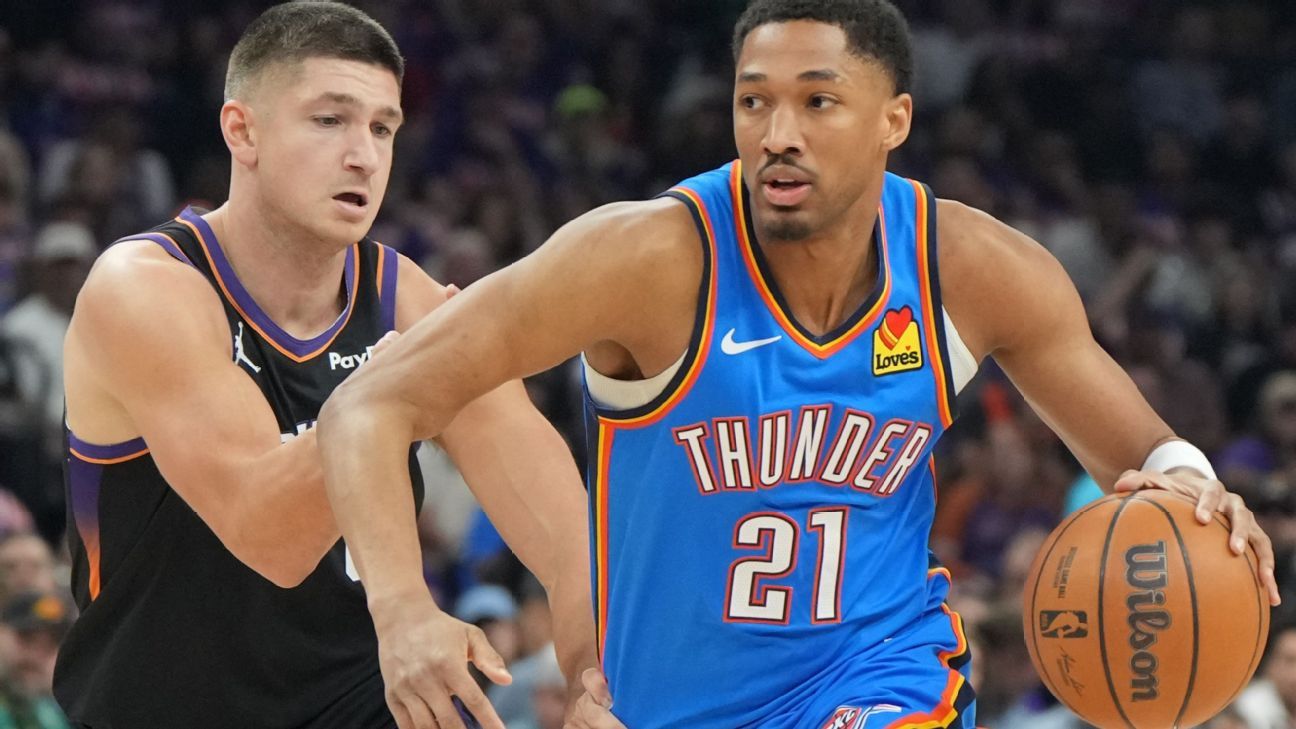
The Atlanta Hawks acquired guard Aaron Wiggins from the Oklahoma City Thunder on Sunday for two second-round picks—Atlanta's 2030 selection and the lesser of the Hawks' or Lakers' 2032 pick. The move costs Oklahoma City north of $60 million in projected tax savings while freeing a roster spot before the draft; for Atlanta, it represents another swing at depth and versatility after a first-round exit at the hands of eventual champion New York.
Wiggins, 27, arrives off a championship pedigree. He averaged 12.0 points and 3.9 rebounds in 23 minutes during Oklahoma City's 2024-25 title run, then dipped to 9.4 points across 65 games last season with 21 starts. His profile is floor-spacer and wing defender—functional, not dynamic. The Hawks, fresh off acquiring Nickeil Alexander-Walker (who posted 20.8 PPG and Most Improved Player honors) and Jonathan Kuminga (12.2 PPG in 23.1 minutes), are clearly betting on opportunity creating volume. Kuminga's contract carries a $24.3 million team option through June 29; Alexander-Walker's breakout last season proved the theory works when minutes materialize.
But Wiggins' release to Atlanta reveals a constraint the Thunder felt comfortable shedding: he didn't command a path to expanded role in Oklahoma City despite two years of proven winning. The Hawks already have McCollum locked long-term on a fresh one-year, $21 million extension, plus Alexander-Walker and Kuminga competing for wing minutes. Wiggins will slot into the fourth or fifth scoring option, assuming health and lineup coherence. His 9.4 PPG last year came without a clear usage anchor; that's different from a 12-point average on a title team where shot allocation was stable.
For prop players, the calculus hinges on role definition, not talent. Wiggins' assists and three-point makes carry the most upside if he becomes a starter-tier player; his rebounds remain modest regardless of minutes. The market will likely price his individual props conservatively early—books default to last-year volume—but his ceiling is role-dependent, not ability-dependent. Fading his first-week over props makes sense; waiting to see how many games he starts before locking in multi-game angles is sharper. Atlanta has a history of underutilizing acquired talent early in the season (Kuminga's ramp took months); Wiggins could follow the same curve. If he breaks 25 minutes per game as a starter within two weeks, his points and three-makes lines will move up fast and the early over prices will stale. Until then, treat his props as volatile and sample-constrained.