Knicks' Historic 3-Point Barrage Overwhelms 76ers in Sweep; What It Means for ECF Pricing
By Justin Erickson ·
New York's record-setting first-quarter shooting display wasn't a fluke—it signals a sustained offensive shift that will reshape Eastern Conference Finals totals and star-player prop lines.
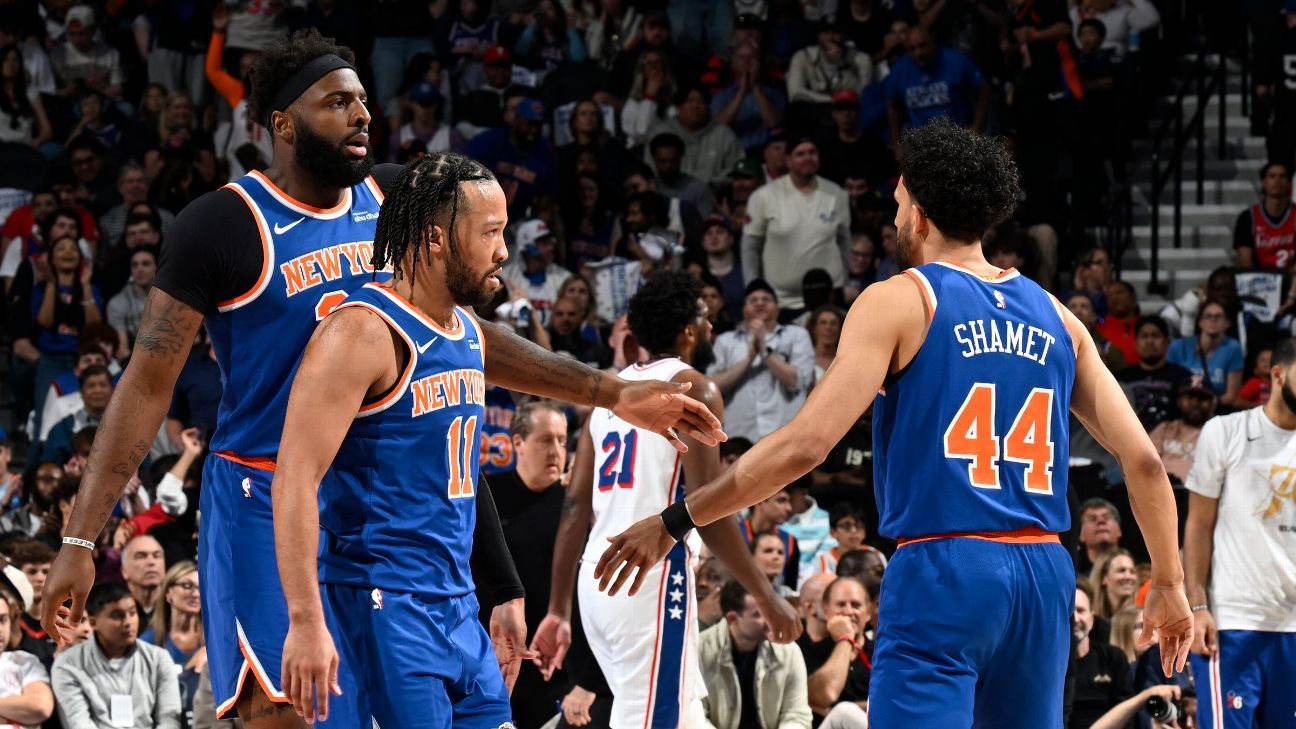
The Knicks didn't just beat the 76ers on Sunday; they dismantled them with a blueprint so efficient it rewrote the postseason record book. New York fired 11 three-pointers in the opening quarter alone—an NBA playoff record—and coasted to a 144-114 sweep of the second-round series, returning to the Eastern Conference Finals for the second consecutive year. Deuce McBride led the charge with 25 points, hitting seven of the team's 25 made threes. Jalen Brunson contributed 22 points, while Josh Hart and Karl-Anthony Towns added 17 apiece in what amounted to target practice masquerading as playoff basketball.
The narrative here extends beyond Game 4 dominance. Mike Brown's first season as Knicks head coach has produced a seven-game winning streak—the longest in franchise history—with a stylistic overhaul that prioritizes floor spacing and pace. The 76ers, despite their star power, had no answer for New York's ball movement and perimeter shot-creation. Philadelphia's defense collapsed early, and the game was decided in 12 minutes. This wasn't an outlier; it was the inevitable conclusion of a series mismatch, with the Knicks' improved depth finally punishing a 76ers roster that lacks the wing defenders needed to contain New York's motion offense.
The Knicks will face either Cleveland or Detroit in the ECF, but the more immediate question for bettors is whether this offensive ceiling is sustainable or a ceiling-shattering anomaly. The 18 three-pointers in the first half (tying an NBA playoff record) came on efficient volume—the Knicks weren't launching junk. McBride's four consecutive three-pointers in Q1 marked the first such occurrence in playoff play since tracking began in 1997. Towns, Hart, and Brunson all contributed multiple makes, suggesting the 3-point distribution isn't dependent on any single shooter.
For prop bettors, this presents a two-way knife. Team totals on the Knicks should climb slightly against Cleveland or Detroit; New York's demonstrated ability to score 70+ points in a half (they hit 54 off three-pointers alone in the first half) means unders at conventional totals (115-118 range) carry elevated risk. Conversely, Brunson's assist line becomes more interesting—when the Knicks operate in this rhythm-based, high-volume three-point system, his playmaking load increases, and he's more likely to hit 8.5+ assists. McBride's continued role expansion also warrants tracking; if he maintains 20+ minutes, his scoring props (15.5+) deserve consideration as a secondary scorer benefiting from poor defensive rotations.
The sweep removes the 76ers from conversation entirely, but it crystallizes the Knicks as a legitimate Eastern Conference threat. Their offensive infrastructure is no longer theoretical—it's a recorded fact against postseason competition. Any ECF total or star-player scoring line should reflect that ceiling, not discount it as a one-game aberration.