Brunson's Wembanyama Respect Signals Defensive Adjustment Coming for Knicks
By Justin Erickson ·
When a Finals opponent's point guard publicly acknowledges your wing defender's elite status before tipoff, the real adjustment battle is already underway.
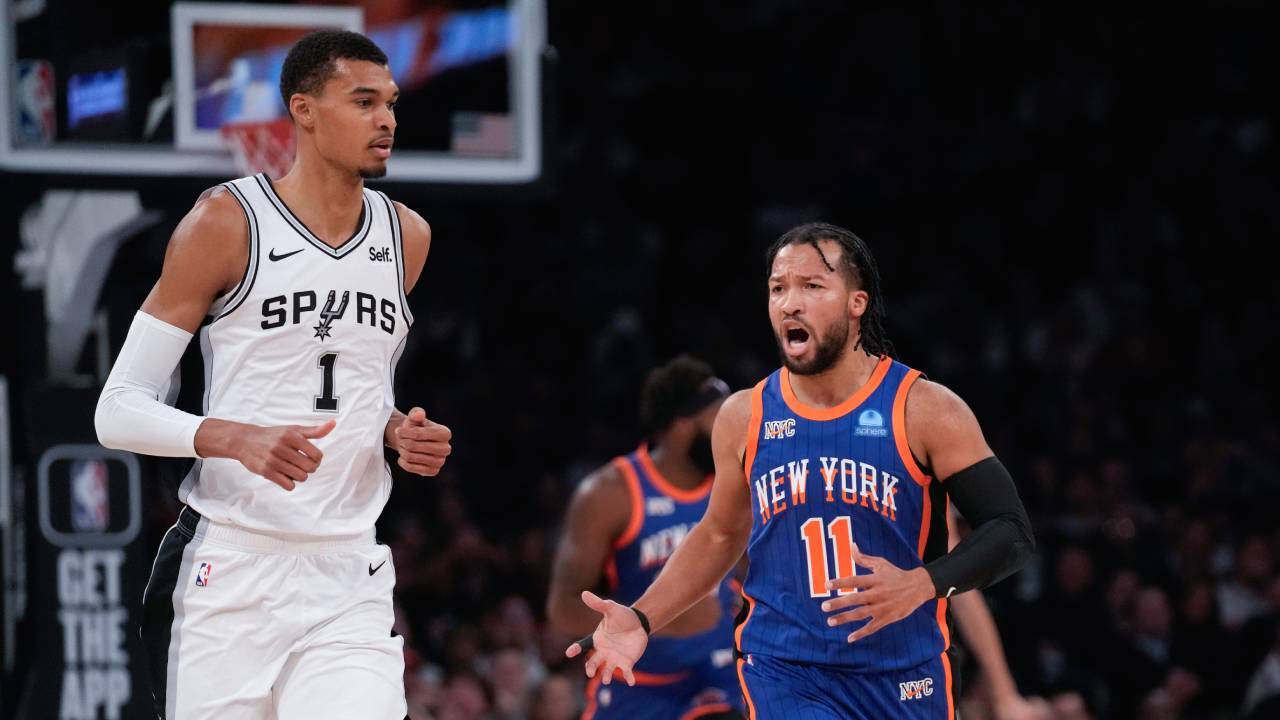
Jalen Brunson took the podium at NBA Finals Media Day and offered unprompted praise for Victor Wembanyama, calling the Spurs' 22-year-old franchise anchor "pretty incredible." On its surface, this is routine Finals-week diplomacy—acknowledge the opponent's talent, deflect pressure, move on. But in the context of a seven-game series where Brunson's offensive rhythm and shot-creation will determine New York's ceiling, his words carry tactical weight.
Wembanyama's defensive profile has evolved into one of the league's most disruptive frameworks. At 7'4" with a 7'9" wingspan, he can switch onto Brunson on the perimeter, contest pull-ups from distance, and recover to the rim in a single possession. What makes him exceptional isn't just the physical tools—it's the positioning discipline. He doesn't foul frequently despite his length; he understands angles and doesn't over-commit. For a Knicks offense that leans heavily on Brunson's pick-and-roll creation and mid-range floaters, Wembanyama represents the kind of versatile resistance that forces Brunson to either hunt switches elsewhere on the floor or accept tighter defensive coverage than he's accustomed to.
Brunson's public acknowledgment of this reality is less about respect and more about recognition. The Knicks' offensive attack flows through him—7.4 assists per game in the regular season, but that figure swells to 9.2+ in playoff series where opponents must commit extra bodies to his scoring threat. Against a team that can defend him with length and discipline without fouling, that assist multiplier compresses. Brunson will still get his points, but the path becomes narrower, and his role as a playmaker—the engine of New York's spacing and ball movement—gets constricted. His praise for Wembanyama is essentially an admission that the Knicks' offensive model requires him to operate in cleaner spaces than this Finals matchup may provide.
For bettors, this carries immediate implications for how the Knicks' offensive efficiency will be priced. Markets may anchor on Brunson's regular-season scoring average and overlook the context that Finals defenders operating within a structured scheme can reduce his assist opportunities without necessarily lowering his point total—he'll shoot more when playmaking windows close. However, the Knicks' team total will face downward pressure because bench scoring and role-player contributions become more critical when the primary initiator is working in a tighter pocket. San Antonio's defensive versatility, explicitly acknowledged by Brunson, creates a scenario where New York's offensive output becomes more dependent on three-point shooting from Donovan Mitchell, Julius Randle, and bench units—a higher-variance path than their regular-season model. Expect Knicks team totals to open lower than their 115-118 regular-season range, and that adjustment will likely hold if Wembanyama's defense performs up to his talent level.
The Spurs' investment in Wembanyama as a perimeter defender alongside his interior presence is precisely the kind of roster construction that punishes offense-heavy systems. Brunson's candid assessment suggests he already understands the problem; the question is whether the Knicks' supporting cast can solve it.