NBA · roster-move
Detroit's Powell Chase Signals Shift Away From Miami's Herro Problem
With Giannis now locked into Miami, the Heat's financial flexibility evaporates—and Detroit steps in to poach a shooter the Heat can no longer afford.
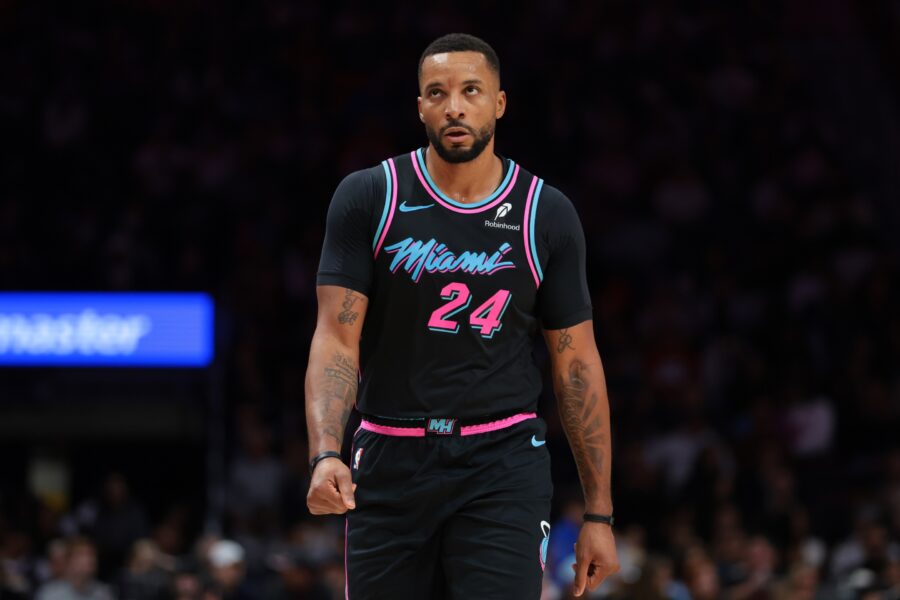
The Miami Heat's blockbuster acquisition of Giannis Antetokounmpo late Monday night has immediate ripple effects across the free-agent market. Detroit is now actively targeting Norman Powell, sources told The Stein Line, positioning the Pistons as a serious suitor for the 32-year-old guard as Miami's cap sheet tightens considerably. The Heat's inability to retain or competitively pursue Powell underscores the financial cost of the Antetokounmpo trade—a deal that consumed the salary flexibility needed to retain their existing perimeter rotation.
Powell's profile makes sense for Detroit's construction. The 6'4" guard spaces the floor with a 38.2% three-point career clip and provides secondary playmaking in pick-and-roll situations, where he averages 4.1 assists per 36 minutes. The Pistons, who finished last season ranked 25th in three-point volume and 22nd in bench unit assists, need exactly this archetype: a shooter who can function off-ball but won't clog the midrange. At 32, Powell isn't a max-salary gambit; he's a targeted addition to an existing core.
For Miami, the Giannis trade exposed a hard reality: championship contention with a star of that magnitude requires roster flexibility to collapse. The Heat chose to consolidate around Giannis rather than maintain depth—a calculus that leaves role players like Powell uncompensated. Powell will test the market, and Detroit's interest suggests they view him as a plug-and-play fit rather than a developmental project. The guard's fit alongside Cade Cunningham's playmaking and the team's young frontcourt creates a floor-spacing trio that should meaningfully improve Detroit's offensive efficiency.
From a betting lens, Powell's destination shapes his statistical floors and ceilings. In Miami's up-tempo system, he averaged 14.2 points and 3.8 assists per game. In Detroit—a team that ranked 18th in pace—his volume will contract modestly, but his role clarity improves. If he lands with the Pistons on a reasonable deal, expect his three-point attempt rate to tick upward from the 6.1 per game he posted with the Heat, given Detroit's need to space the floor. Prop markets will likely price Powell's opening games with Detroit based on last season's averages, failing to account for the systematic shift toward higher shot volume. His three-point makes (currently set around 2.1 for most free agents) should carry edge in the 2.3–2.5 range if Detroit's system encourages more catch-and-shoot looks.
The broader takeaway: Miami's hard-reset around Giannis doesn't just move one player—it cascades through the entire free-agent landscape, creating edges for teams with cap space and clear roles. Detroit has both, which is why Powell landing there makes more basketball sense than staying in South Florida.