Watson's $25M Ask Tests Denver's Payroll Limits—and Rotation Stability
By Justin Erickson ·
The Nuggets face a contract standoff with their young wing that could force trades of role players and reshape the bench scoring landscape.
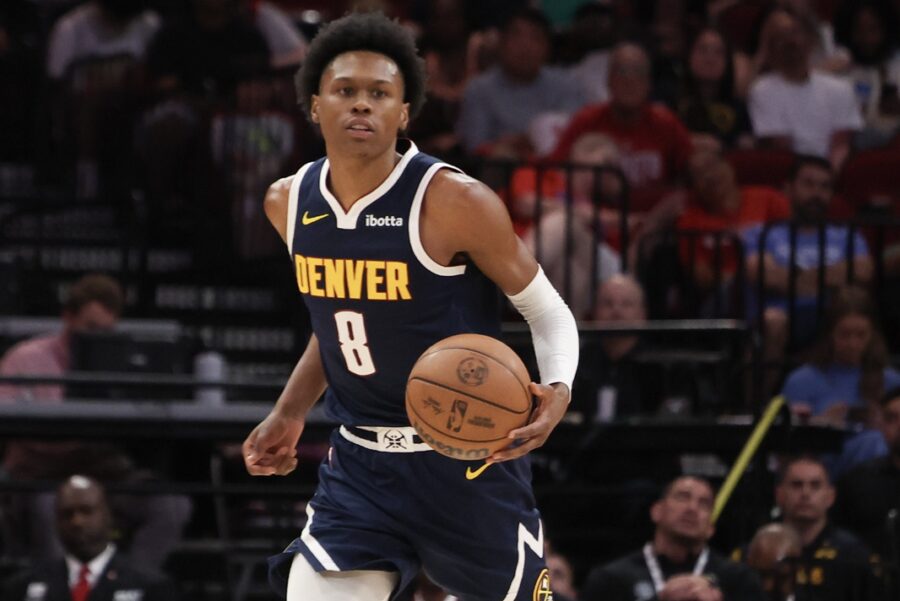
Peyton Watson is seeking a restricted free agent deal north of $25 million per year—a number that exceeds what Denver paid Christian Braun on his rookie scale extension last fall. The ask reflects Watson's confidence in his market value, but it collides with a free agency landscape where most teams with cap space have already deployed it elsewhere. Stein and Fischer report that the Nuggets have begun operating as a team willing to enter second apron territory to retain Watson and fellow RFA Spencer Jones, signaling internal conviction that both will anchor Denver's future rotation.
The math reveals the tension. Watson's $13.1 million cap hold is manageable, so Denver can let him test the market without hampering other moves. But the restricted free agent market for wings has thinned considerably since early July, and the Nuggets have shown no appetite for a sign-and-trade that would ship out a 23-year-old they consider part of the core. That leaves Denver in a bind: pay up or risk losing him to offer sheets they're forced to match. The team's willingness to absorb second apron penalties suggests they're prepared for the first option.
What's notable about Denver's payroll calculus is what's already moving. Valanciunas and Nnaji are the only rotation players actively in trade discussions—Valanciunas's $2 million guarantee on a $10 million salary (if waived by July 8) makes him a movable asset, and the Lakers are circling. Nnaji's $7.5 million salary next season, paired with a $7.5 million player option for 2027-28, gives Denver multiple exit ramps. The Nuggets turned down multiple offers for Cameron Johnson's expiring $23 million contract, a rejection that signals they're not yet prepared to sacrifice depth to clear space. Meanwhile, Braun's injury-plagued season and imminent five-year extension extension dampened his trade value, despite league-wide expectation that Denver might shop him.
For prop bettors, this creates a dual pressure on Denver's bench production. If Watson signs at $25 million or above, the Nuggets will have limited flexibility to add veteran scoring off the bench. Valanciunas's potential exit to Los Angeles removes a reliable backup center and offensive rebounder who contributed 8-10 points in limited minutes. Nnaji's presence remains uncertain but his high salary constrains the rotation's composition. The result: expect fewer reliable scoring outlets in Denver's second unit next season, which should compress bench scoring props and elevate the offensive load on Jokic, Murray, and whoever survives the reshuffling. The Nuggets are betting their championship window stays open with a younger, less experienced bench—a calculation that will register immediately in player prop lines for role players like Nnaji and any cheaper replacement for Valanciunas's minutes.
Denver's second apron threshold also limits their ability to chase veteran talent mid-season. If Watson takes $25 million and Spencer Jones re-signs, the Nuggets will have already committed to payroll that prevents the kind of deadline trades that contenders typically use to bolster depth. That structural constraint—not injuries, not fit—will be the throttle on their ceiling this season.