Holmgren's Shooting Surge and Wallace's Injury Windfall Drive Thunder Props in Game 4
By Justin Erickson ·
Oklahoma City's depth and San Antonio's defensive strategy create distinct edges for Thunder complementary scoring in the Western Conference Finals.
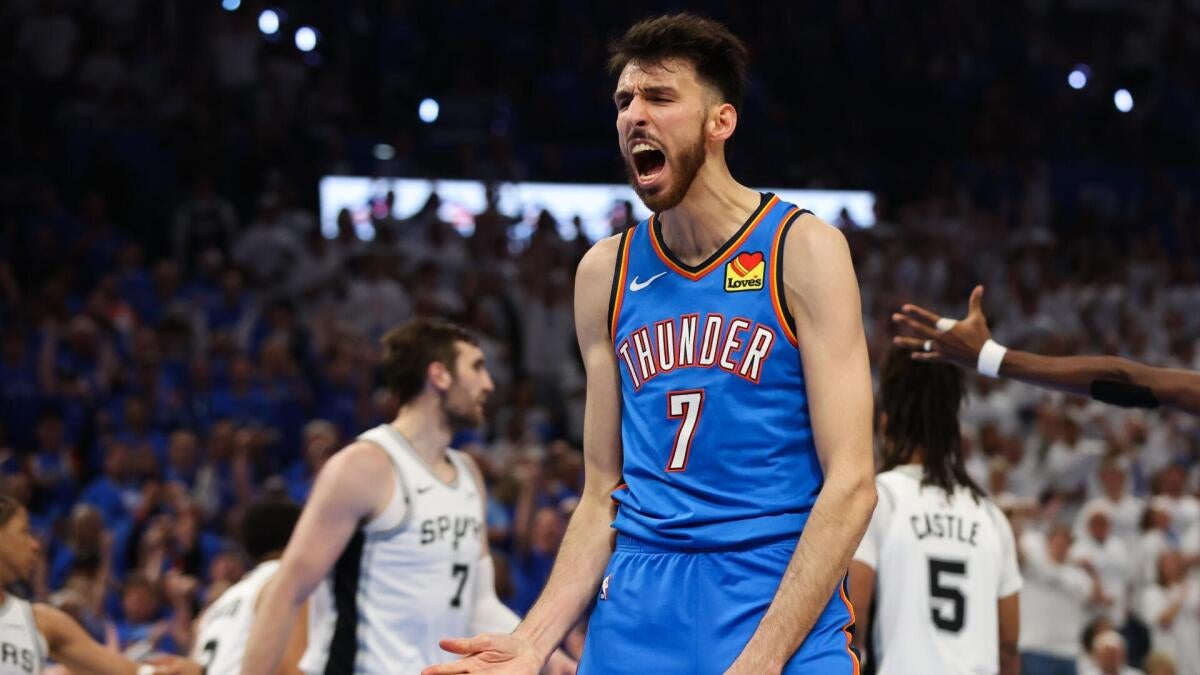
Chet Holmgren has moved past his Game 1 stall. The Thunder center scored just eight points against San Antonio's interior scheme in the series opener, but has posted double-digit scoring in each of the last two contests, including a 14-point, 5-of-7 shooting performance in Game 3. More significantly, his field-goal percentage has climbed to 50% across three games—a mark that matters for a player whose offensive role depends on efficiency rather than volume. At 21.5 points + rebounds for Sunday's Game 4, Holmgren's over looks vulnerable to San Antonio's adjustment, but his trajectory suggests otherwise.
The Spurs' defensive approach has inadvertently created Holmgren's advantage. San Antonio is using a heavy double-team strategy against Shai Gilgeous-Alexander, forcing the ball into the hands of secondary scorers. That strategy leaves fewer defenders anchored to the paint, which is precisely where Holmgren operates most comfortably. His rebounding activity has also been consistent—six double-digit rebound games in his last eight playoff appearances—and his 71.4% field-goal rate in Game 3 suggests he's reading the Spurs' coverage with improved timing. Expect him to finish north of 22 combined points and boards.
The assistant guard depth story is sharper still. Jalen Williams, Oklahoma City's third-option scorer, is listed as questionable after sitting Game 3 with a hamstring injury. Given his recurrence issues throughout the season, another absence is the more likely outcome. Ajay Mitchell (calf) is already ruled out. Cason Wallace, a reserve guard, has logged at least 14 combined points, rebounds, and assists in all three games despite limited starting minutes. If Williams sits, Wallace's playing time should tick toward 30 minutes—a meaningful floor for hitting an over at 13.5 points + rebounds + assists. He's operating as a secondary ball-handler when the Spurs' guards are focused on Gilgeous-Alexander, which inflates both his assist and scoring opportunities.
Gilgeous-Alexander's own assist line tells the deeper story. The Spurs' double-team strategy has forced him into a facilitator role, and he's recorded nine or more assists in all three games, including a pair of 12-assist nights. His over at 7.5 assists is less about volatility and more about a structural mismatch: San Antonio's guards can defend him individually, but the moment they send a second defender, a Thunder role player becomes open. This isn't a variance play—it's a repeated outcome of a fixed defensive scheme. Gilgeous-Alexander will see the double teams again because San Antonio has no alternative without completely abandoning their game plan.
The three props converge on a single thesis: Oklahoma City's role-player scoring is being supplemented by San Antonio's singular defensive focus. Holmgren gets cleaner paint looks, Wallace gets expanded minutes and easier gaps to attack, and Gilgeous-Alexander's assist total rises as a function of necessity. All three overs are priced as if Oklahoma City's depth is a secondary factor, when in fact it's the primary edge San Antonio created through their double-team commitment.