NBA · transaction
Lakers' LeBron Decision Hinges on Roster Philosophy, Not Dollars
Rob Pelinka's end-of-season message to James reveals the real negotiation isn't about salary—it's about whether the franchise can articulate a coherent championship vision around Luka Doncic.
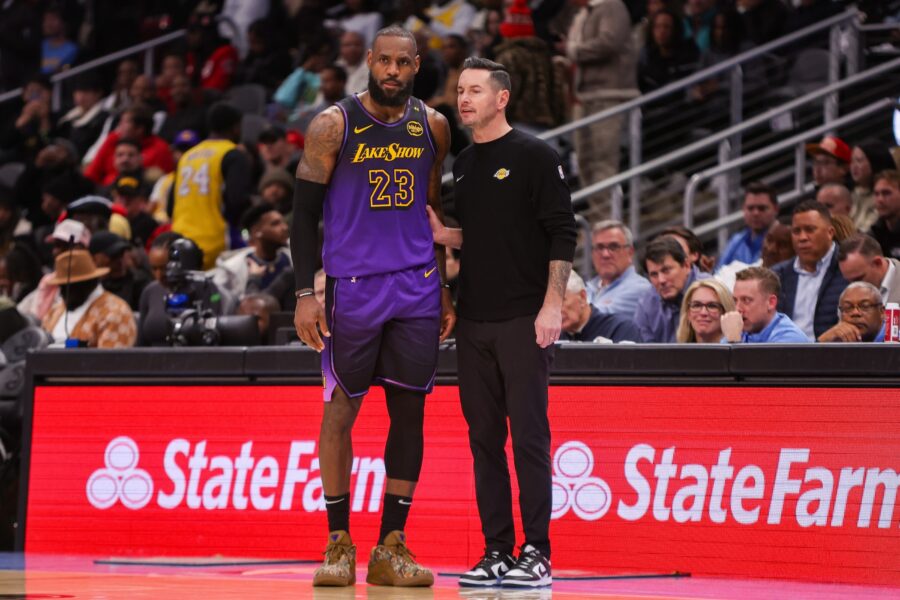
Lakers president Rob Pelinka opened Tuesday's end-of-season press conference with a clear statement: LeBron James has an open door in Los Angeles, contingent on one condition—that the 41-year-old wants to play another NBA season. The framing matters. Pelinka didn't lead with contract terms or years. He led with respect for James's autonomy, a deliberate rhetorical move that indexes to a deeper problem the franchise is trying to solve: the relationship between James and the organization frayed significantly after the Doncic acquisition last year, with sources close to the star suggesting the team attempted to engineer his exit. A harmonious 2025-26 season reset some of that damage, but Pelinka's language at the presser reveals what's actually on the negotiating table—not a number, but a narrative.
The precedent is instructive. When James last signed with Los Angeles, he accepted less than maximum salary and explicitly stated he would have taken an even steeper discount if the roster construction had aligned with his preferences. That willingness to leave money on the table doesn't mean James will do so again, but it establishes his leverage as ideological, not purely financial. As one agent told ESPN, "The Lakers can't just offer James a number. They have to offer a why behind that number. Their plan for any discount would have to be coherent." That constraint reshapes the entire offseason strategy. Pelinka and head coach JJ Redick have already committed to a architectural rebuild around Doncic as the franchise's long-term centerpiece—which implicitly asks James to accept a secondary role at 41, a concession that only works if the Lakers can demonstrate a legitimate path to contention with that three-man core (James, Doncic, Austin Reaves) plus credible depth.
Reaves, whom Pelinka also flagged as a re-signing priority, is the third pillar Pelinka must lock down, and his contract trajectory is parallel to James's in one critical way: Reaves will also test free agency and evaluate his options. The guard's scoring and playmaking profile fits around Doncic's usage rate more naturally than James's does, but the salary cap math won't accommodate both if either demands close to their full market value. Pelinka's public confidence in retaining all three suggests either internal cap relief (a trade, a veteran minimum signing, or a soft salary dump) is already being modeled, or the organization is banking on both James and Reaves accepting discounts simultaneously—a proposition that hinges entirely on execution in free agency before they hit the market.
For prop players, the uncertainty cuts two ways. If James re-signs and the Lakers add a defensive anchor or bench scorer in free agency, his scoring volume and usage rate next season should stabilize around his 2025-26 baseline—expect props like his points total and assist floor to price in relative consistency rather than a sharp decline. Conversely, if James and Reaves both reach free agency and the Lakers lose one of them, the remaining players' offensive loads spike, and iso-heavy prop lines (points, turnovers, three-point attempts) would need recalibration. The market will begin pricing in free-agent scenarios within 48 hours of the signing window. The real edge emerges if James re-signs on a discount and the Lakers remain cap-strapped: his minutes and fourth-quarter usage could be artificially depressed relative to his true capability, creating under-value on his total-volume props because the book will assume full allocation. Watch the early free-agency signings; if the Lakers stay quiet in July, it signals confidence in retaining both stars, and James's scoring props should be bid up.
Redick's stated goal of strengthening the bench compounds this. A functional rotation behind the big three removes pressure to extend James's minutes and usage in blowouts, a change that would suppress his raw totals even if his per-minute efficiency holds. The prop-betting approach here is patience: let the free-agency dominoes fall through mid-July, then isolate James's props once the roster is set and Redick's true rotation depth is visible. Single-game overs on James's scoring could carry hidden risk if the bench depth improves sharply, since it directly competes with his minute allocation.