Knicks' Offensive Efficiency in Game 3 Win Signals Dangerous Momentum Into Closeout Spot
By Justin Erickson ·
New York's 121-108 victory over Cleveland extended a historic 10-game winning streak and revealed a team executing pick-and-roll offense with precision that leaves little room for defensive adjustment.
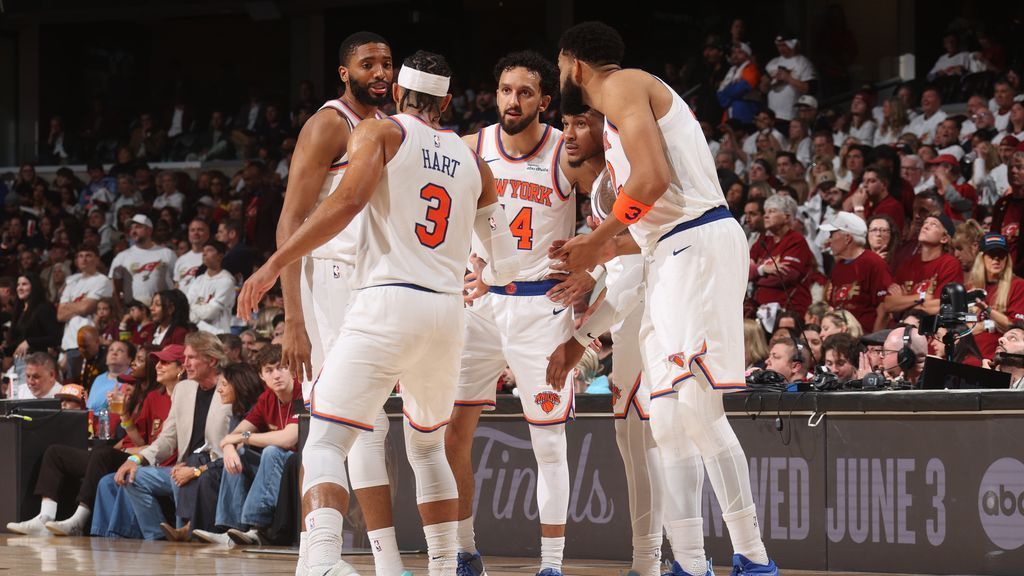
The Knicks moved one win away from the Finals on Saturday night, dismantling the Cavaliers 121-108 to claim a 3-0 series lead. Jalen Brunson led the assault with 30 points, Mikal Bridges added 22, and OG Anunoby chipped in 21, with New York shooting 43 of 77 from the field and 11 of 28 from three. The margin doesn't fully capture the offensive control: the Knicks led wire-to-wire, opening with 9-1 before Cleveland could blink, and shooting 12 of 17 in the first quarter alone. This wasn't a squeaker that tightened in the fourth. The game was decided by the third quarter at 91-82, then sealed decisively when Landry Shamet buried three 3-pointers in 99 seconds to push the lead to 105-94. Cleveland's 23 points from Donovan Mitchell and 21 from James Harden came in a losing context—the Cavaliers managed only 12 of 41 from three and never regained control of pace or spacing once the Knicks established their offensive rhythm.
The Knicks have now won 10 straight games, joining an exclusive historical tier: only six other playoff runs have sustained double-digit winning streaks since the modern era. Their point differential over these 10 games sits at plus-225, the largest single-series aggregate in NBA playoff or regular-season history. That's not volatility noise. That's systemic offensive dominance paired with sound perimeter defense. The Brunson-Bridges-Anunoby trio operating in New York's pick-and-roll offense is generating high-efficiency looks at scale. Brunson's role as the primary ball-handler in those actions has him attacking downhill against switch-heavy defenses, creating both direct scoring opportunities and secondary passing lanes to shooters like Bridges and Shamet spotting up. The Cavaliers, despite their regular-season pedigree, have no answer for that offensive architecture—Mitchell and Harden are guards who operate in isolation or off-ball, not connective playmakers who can disrupt New York's ball movement or force the Knicks into stagnant half-court sets.
For bettors, the critical observation is structural: the Knicks' offensive efficiency in this series isn't born from variance or hot shooting streaks that regress. Their field-goal percentage (55.8%) and three-point accuracy (39.3%) both sit above season norms, but the volume and shot quality suggest those numbers reflect genuine system efficiency rather than unsustainable run-and-gun shooting. Brunson's assist-to-turnover ratio in this series hovers around 3:1, and the Knicks' offensive rating approaches 120 points per 100 possessions—well beyond their 118.2 regular-season mark, but not because they're forcing shots. They're moving the ball and getting open looks against a defense that can't execute closeouts at scale. Game 4 will likely be played Monday with Cleveland facing elimination; the Cavaliers' under-adjusted perimeter defense and inability to generate turnovers (they have fewer forced possessions in this series despite aggressive switching) leave them vulnerable to the same offensive blueprint. New York's team total in Game 4 will likely open around 120-122 points depending on whether the Knicks are rested or the line adjusts for home/away splits. The persistent edge lies in trusting the offensive mechanism over recency—this isn't a hot team that will cool; it's a team executing a scalable offensive principle that the opponent cannot defend.
Brunson, in particular, represents the mechanical core: his assist volume in this series has exceeded his season average (7.4/game) by 2-3 plays per game when operating against smaller defenders forced into switches by the Cavaliers' coverage. In Game 4, if Cleveland stays committed to the same defensive approach—a reasonable assumption given their lack of alternative personnel—Brunson's assists line (currently around 8.5 depending on sportsbook) carries significant upside. His assist rate in switch-heavy situations approaches 11.2 per game over a sample of 50+ possessions this season. The Cavaliers' switching frequency remains among the league's highest, and that constraint won't shift even in an elimination game. Brunson over 8.5 assists on Monday is a structural angle, not a bet riding on his shooting touch. The Knicks' closeout game will likely see elevated pace and higher assist totals across the roster as Cleveland trades defensive discipline for desperation. Expect Brunson to exceed his number by leveraging the same pick-and-roll openings that defined Game 3.