Brunson's Fourth-Quarter Takeover Exposes Spurs' Guard Depth in Finals Game 1
By Justin Erickson ·
The Knicks' 105-95 Game 1 victory revealed a structural mismatch: New York's ability to collapse on Wembanyama while leaning on Brunson's late-game scoring, versus San Antonio's vulnerable perimeter defenders struggling to contain penetration.
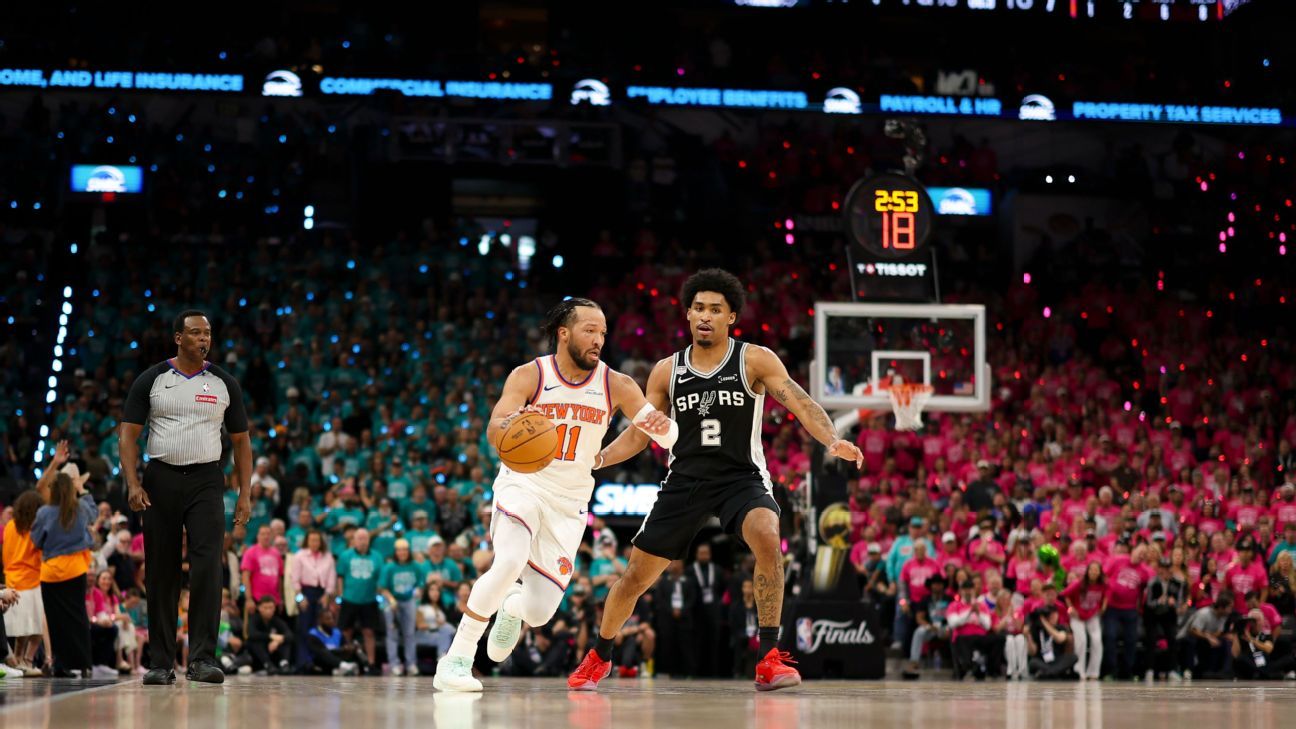
The New York Knicks opened the 2026 NBA Finals with a 105-95 victory over the San Antonio Spurs on the road, breaking San Antonio's perfect Game 1 record (previously 6-0 in Finals openers). The Knicks' formula was direct: Karl-Anthony Towns early, Jalen Brunson late. Brunson finished with 30 points on 30 shots, including nine attempts in the fourth quarter alone, when he scored 19 points to seal the game as New York's half-court offense shifted entirely into his hands.
The deeper story sits in how the Knicks dismantled San Antonio's defensive identity. Despite Victor Wembanyama's presence as arguably the league's most impactful defender, New York won the paint battle decisively (50-42), a rare vulnerability for a team built around length and rim protection. Spurs guards Stephon Castle, De'Aaron Fox, and Dylan Harper couldn't match the intensity required to defend Brunson's pick-and-roll actions and drive-and-kick sequences. When San Antonio's perimeter crew was forced to work on the ball, they had no refuge—the Knicks shut down the three-ball (Spurs shot poorly from distance), collapsing help to the paint, then swung the ball back to an unguarded Brunson for midrange or assisted buckets. This isn't a one-game anomaly; it's a matchup leverage problem that will compound across the series.
For prop bettors, the immediate implication is Brunson's isolation volume and efficiency in close games. He took 30 shots in Game 1—a massive workload that tracks with the Knicks' trust in his clutch execution. In Game 2 and beyond, San Antonio will likely adjust by playing tighter perimeter defense or hunting mismatches against New York's wings, but that defense-first instinct opens the paint further for Brunson's drive-and-finish and his playmaking (he also recorded 7 assists). The structural edge: Brunson's fourth-quarter scoring prop and assist line carry elevated value as long as San Antonio's guards remain undersized and the Knicks maintain their paint dominance. His 9 fourth-quarter shot attempts in Game 1 is a north baseline for assignment volume—expect 7-10 range in closing quarters, particularly if the game stays within 10 points.
Wembanyama's defensive impact was neutralized partially by scheming (the Knicks' ball movement kept him off the ball and away from Brunson), not by superior individual skill. This matters because it tells you that late-game Knicks momentum isn't random—it's a designed attack. Brunson's assist rate should remain elevated (he's feeding the short-roll and kick-out game), while his point prop deserves respect in later tip-times when fatigue compresses San Antonio's switching execution. The Spurs' reliance on their young guard trio to generate perimeter resistance is their liability, and the Knicks will repeatedly expose it.