Holmgren's Buzzer Block Reshapes Game 1 Narrative—And Late-Game Leverage Props
By Justin Erickson ·
When a rim protector forces overtime on a franchise's biggest stage, the betting market reprices defensive reliability and fourth-quarter execution for the entire series.
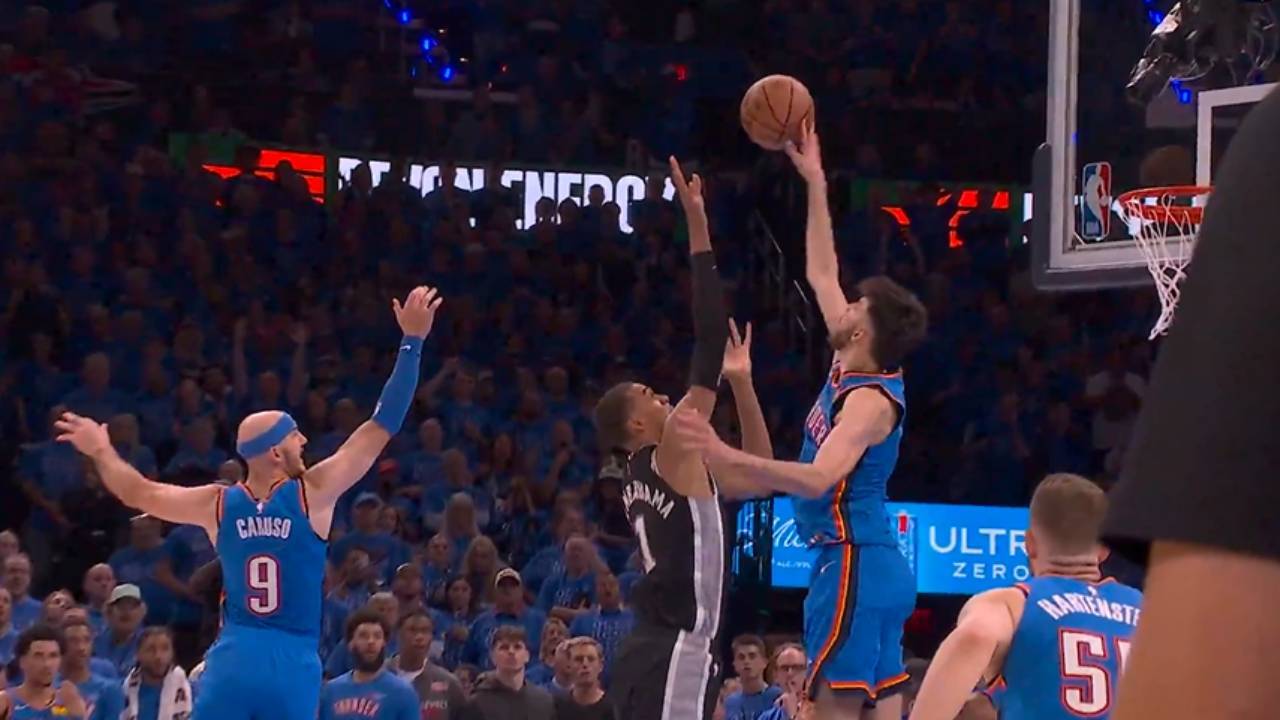
Chet Holmgren's rejection of Victor Wembanyama with 3 seconds remaining and Game 1 of the Western Conference Finals knotted at 101-101 did more than extend the contest into overtime. It announced that perimeter defense and shot-blocking discipline would carry measurable weight in a series between two squads built on switchable, mobile frontcourt play.
The block itself was a structure statement: Wembanyama, one of the league's most prolific volume scorers at the rim and mid-range, found no separation against a defender who combines 7'1" length with genuine lateral mobility. Holmgren didn't over-commit on the initial drive; he stayed vertical, closed space without fouling, and altered a shot that would have ended the game. That restraint—the difference between a clean contest and a reaching foul at 101-101—is the kind of clutch-time variable that recurs across a series and compounds through betting markets as the sample grows.
For prop bettors, the immediate takeaway is tonal. Games that hinge on late-fourth-quarter defense and shot-blocking often extend into extra play, compressing scoring density (more possessions, but lower PPP as fatigue and foul trouble mount). Wembanyama's fourth-quarter scoring and shot volume in subsequent games should be viewed through the lens of his performance when forced into tighter windows against active, vertically-aware defenders. Similarly, Holmgren's blocks and defensive fouls in crunch time become a series-tracking metric—if he's pressured into bad fouls by Game 3 or 4, that's a lead indicator that the offensive load shifts toward perimeter scorers who don't hunt the paint.
The overtime session that followed also encoded useful information. Teams that already played 48+ minutes of tight, switchable basketball are more vulnerable to isolation scoring in the extra frame, as role players and bench depth fatigue faster than stars. This shapes player-prop pricing in the subsequent games: expect modest premiums on star closer scoring lines (especially Wembanyama's) as the market reprices the volatility of deeper benches in protracted contests. Conversely, assist totals for primary playmakers may drift lower early in series games following overtime, as teams lean heavier into isolation and less into pace-dependent, pass-heavy flow.
The predictive signal here is durable. Holmgren's ability to stay vertical and contest without fouling is a skill that doesn't vanish after one game; it's a structural feature of his defensive package. Expect his block and foul rates to track tighter than season average across this series, and use that to calibrate over-unders on his combined defensive stocks. For Wembanyama, the lesson is harsher: if a championship-caliber defender can force him into awkward shot selection in the most critical moments, that pressure repeats. His fourth-quarter efficiency and late-game scoring volume should be priced with a slight discount to his regular-season rates for the duration of this series.